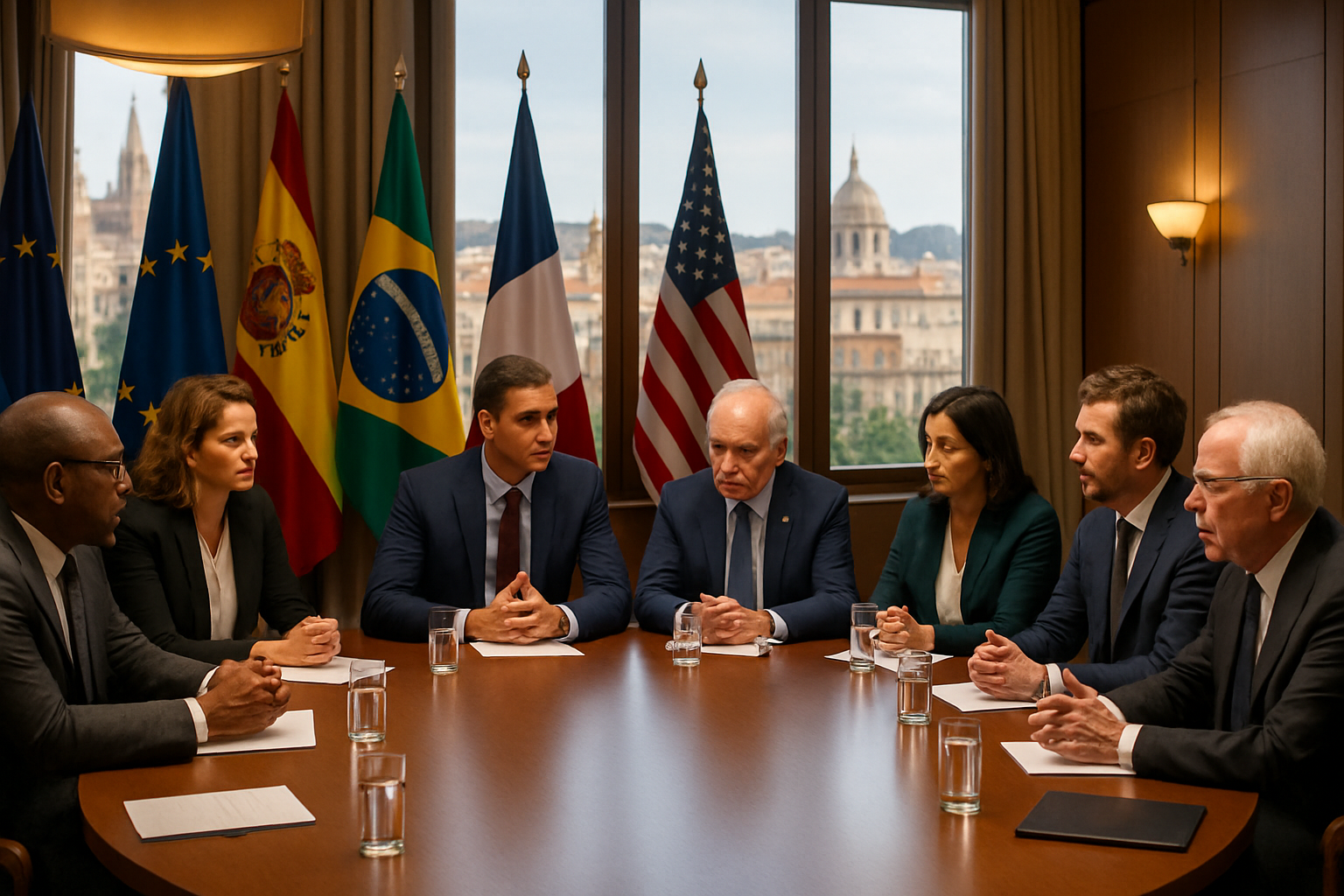
In a historic display of international progressive solidarity, over twenty world leaders convened in Barcelona for the IV Meeting in Defense of Democracy, co-chaired by Spanish Prime Minister Pedro Sánchez and Brazilian President Luiz Inácio Lula da Silva, signaling a strategic pivot from defensive resistance to proactive governance in the face of rising global authoritarianism.
The summit, held at Barcelona's Fira convention center on April 18, 2026, brought together key progressive figures from Europe, Latin America, and Africa, including Mexican President Claudia Sheinbaum, Colombian President Gustavo Petro, South African President Cyril Ramaphosa, and Austrian SPÖ leader Andreas Babler. The gathering represented the most significant coordination effort among international progressive movements since the global democratic crisis intensified.
A Strategic Pivot from Defense to Offense
Spanish Prime Minister Pedro Sánchez delivered the summit's most striking declaration, announcing that "the time of the international ultra-right and the lackey right has come to an end." More significantly, Sánchez articulated a fundamental strategic shift for progressive politics globally: "The response cannot be only defensive. It's not enough to resist, we have to propose, we have to lead."
This pivot marks a departure from the largely reactive anti-populist strategies that have characterized progressive responses to the far-right surge of recent years. Instead, the Barcelona Declaration commits participating leaders to offering concrete policy alternatives while strengthening democratic institutions against authoritarian threats.
"They have tried to make us ashamed of our ideas and our past, but that's over. Shame changes sides: let those who remain silent in the face of injustice and those who support war and violence be ashamed."
— Pedro Sánchez, Spanish Prime Minister
Key Policy Initiatives and Agreements
The summit focused heavily on wealth taxation as a central progressive policy tool. Leaders agreed on implementing taxes targeting the ultra-wealthy as both an inequality reduction mechanism and a funding source for public services. This consensus reflects progressive movements' recognition that extreme wealth concentration poses direct threats to democratic governance.
Sánchez also advocated for fundamental United Nations reform to reflect 21st-century realities, specifically calling for female leadership within international organizations. The proposal comes as traditional post-World War II institutions face criticism for being inadequately equipped to handle contemporary challenges ranging from climate change to digital governance.
The Barcelona Declaration commits participants to regular coordination meetings and shared policy development, particularly in areas of wealth taxation and democratic institutional reforms. This institutionalized cooperation represents an unprecedented level of progressive international coordination.
Latin American Leadership Dynamics
The summit highlighted significant developments in Latin American progressive politics. Mexican President Claudia Sheinbaum used the gathering to formally declare that "there is no diplomatic crisis" with Spain, definitively resolving tensions that had persisted since the López Obrador administration's demands for colonial-era apologies.
Sheinbaum's constructive approach was underscored by her offer to host future progressive summits in Mexico, demonstrating the new administration's commitment to international cooperation. The resolution came after King Felipe VI acknowledged colonial-era "abuses" and "ethical controversies" in March 2026, providing the diplomatic opening for normalization.
Colombian President Gustavo Petro, ending his presidency in August 2026, used the platform to warn of potential Latin American "rebellion" if the United States doesn't reconsider its regional policies. Petro's comments reflected broader concerns about Trump administration approaches to hemispheric relations, while maintaining some ambiguity about his own commitment to electoral processes.
Confronting the Global Far-Right Challenge
The summit was convened explicitly in response to what organizers characterized as "the most challenging period for global democracy since World War II." Recent far-right gains across Europe have created urgent pressure for progressive coordination, including France's National Rally urban breakthroughs, Sweden's Liberal-Social Democrat cooperation enabling far-right participation, and Germany's AfD expansion in the southwest.
However, progressive leaders cited encouraging precedents, particularly Viktor Orbán's defeat in Hungary after 16 years in power, as evidence that coordinated opposition can successfully challenge entrenched authoritarian leaders. This success story provided a template for the coordinated resistance strategies discussed at the summit.
The gathering occurs as European politics faces unprecedented fragmentation, with 89% of Europeans demanding greater EU unity according to Eurobarometer polling, while political reality shows increasing divisions across member states. This disconnect between public aspirations and political reality demonstrates the urgent need for the type of international progressive coordination advanced in Barcelona.
Diplomatic Tensions and Alignments
The summit was not without its diplomatic complexities. Venezuelan opposition leader María Corina Machado notably declined to meet with Spanish PM Sánchez, citing his participation in the Barcelona progressive forum. This highlighted ongoing tensions between Venezuelan opposition figures and European socialist leaders who maintain cautious approaches to the Venezuelan transition process.
The gathering's timing was particularly significant given the broader geopolitical context, occurring amid the Trump administration's aggressive foreign policy postures, including escalating tensions with Iran and challenges to traditional multilateral frameworks. Progressive leaders used the platform to advocate for multilateralism and peaceful conflict resolution as alternatives to military interventions.
Future Electoral Tests
The Barcelona summit's outcomes will be tested in upcoming electoral challenges across the progressive world. The 2027 French presidential election looms as a particularly crucial test, with Emmanuel Macron constitutionally barred from seeking a third term, potentially opening space for either progressive or far-right alternatives.
In Latin America, several participating leaders face immediate electoral pressures. Peru's ongoing political crisis, with the country seeking its ninth president in a decade, exemplifies the institutional challenges that progressive forces must navigate. Similarly, Colombia's May 31, 2026 presidential elections will test whether progressive momentum can continue beyond Petro's presidency.
Economic Context and Global Challenges
The summit addressed progressive responses to over five years of economic stress stemming from COVID-19 impacts, supply chain disruptions, and energy crises. Leaders argued that market-based solutions have proven insufficient, necessitating the wealth taxation initiatives and public service investments outlined in the Barcelona Declaration.
The gathering also addressed climate change as both an urgent policy priority and a political organizing opportunity. Progressive leaders emphasized their movements' unique positioning to address environmental challenges through social justice frameworks, contrasting with both far-right climate denial and centrist market-based approaches they consider inadequate.
Institutional Innovations and Democratic Defense
Beyond policy coordination, the summit established mechanisms for ongoing progressive cooperation. Regular coordination meetings will provide platforms for sharing electoral strategies, policy innovations, and responses to authoritarian challenges. This institutionalized approach represents a significant evolution from ad-hoc progressive international relations.
The emphasis on democratic institutional strengthening reflects progressive movements' recognition that electoral success alone is insufficient. Participants committed to reinforcing judicial independence, media freedom, and civil society capacity as essential components of durable democratic governance.
Looking Forward: From Barcelona to Global Implementation
The success of the Barcelona summit will ultimately be measured not by its declarations but by concrete governance improvements and electoral victories across participating nations. The pivot from defensive to proactive strategies requires progressive movements to demonstrate competent administration while maintaining their transformative vision.
The gathering's significance extends beyond immediate policy coordination to questions of democratic resilience in an increasingly polarized world. Whether progressive international cooperation can provide effective alternatives to both far-right nationalism and establishment centrism will influence global political development for years to come.
As participants returned to their respective countries, they carried commitments to implement wealth taxation initiatives, strengthen democratic institutions, and maintain regular coordination against authoritarian threats. The Barcelona Declaration represents both a high-water mark of progressive international cooperation and a starting point for sustained global coordination in defense of democratic values.
The summit's legacy will depend on whether this moment of progressive unity can translate into effective governance and electoral success across multiple continents, providing a practical alternative to the far-right nationalism currently challenging democratic institutions worldwide.