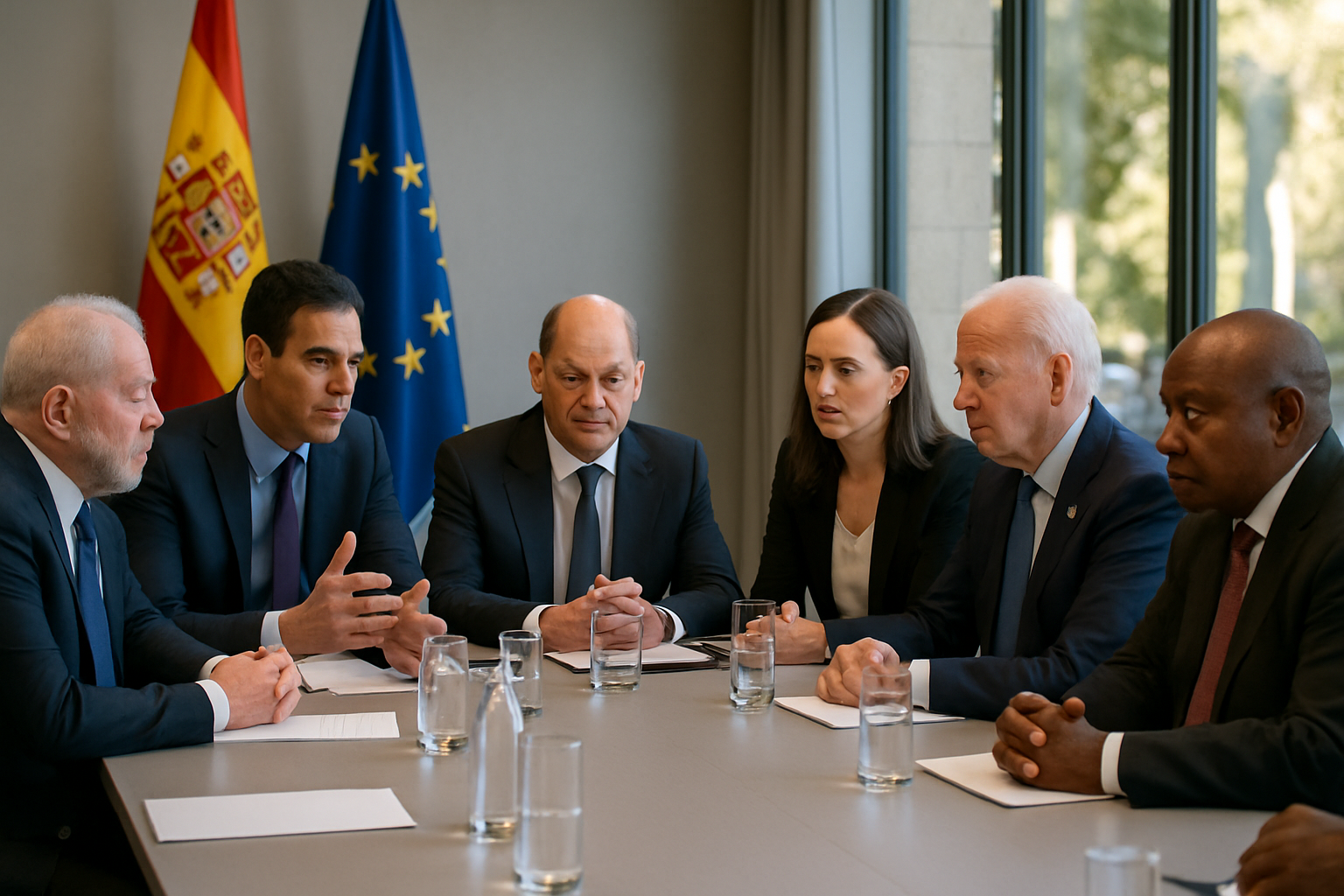
Spanish Prime Minister Pedro Sánchez and Brazilian President Luiz Inácio Lula da Silva co-chaired a historic gathering of progressive leaders in Barcelona on Saturday, uniting figures from across Europe, Africa and Latin America in a coordinated response to the global rise of far-right populism and threats to democratic institutions.
The summit, officially titled the IV Reunión en Defensa de la Democracia (Fourth Meeting in Defense of Democracy), brought together more than a dozen progressive government leaders for what organizers described as the most significant international left-wing gathering since the 2008 financial crisis reshaped global politics.
Democratic Resistance Takes Center Stage
Speaking at the Barcelona summit, Sánchez delivered a forceful call for progressive forces to move beyond defensive strategies. "The response cannot be only defensive, it is not enough to resist, we have to propose, we have to lead," the Spanish Prime Minister declared to the assembled leaders.
The timing of the summit underscored the urgency felt by progressive leaders worldwide. Recent electoral victories by far-right movements across Europe - from Hungary's Viktor Orbán's recent defeat by a democratic coalition to France's National Rally making unprecedented urban gains - have prompted left-wing parties to seek new forms of international coordination.
"What is very important is that the strength of indigenous peoples for our homeland be recognized."
— Claudia Sheinbaum, President of Mexico
Mexican President Claudia Sheinbaum, addressing questions about diplomatic tensions with Spain over historical conquest issues, emphasized that "there has never been a diplomatic crisis" with Spain, focusing instead on the summit's core mission of defending democratic values against authoritarian threats.
Wealth Taxes and Economic Justice
A central focus of the Barcelona summit was economic policy, specifically the implementation of wealth taxes targeting the ultra-rich as a tool for reducing inequality and funding public services. The proposal reflects a growing consensus among progressive leaders that extreme wealth concentration has become a threat to democratic governance itself.
The economic discussions took place against the backdrop of multiple global crises that have subjected the world economy to significant stress over the past five years. From the COVID-19 pandemic's initial economic devastation through supply chain bottlenecks and energy crises, progressive leaders argued that traditional market-based solutions have proven insufficient.
Colombian President Gustavo Petro, whose presidency ends in August, used his appearance to warn of potential rebellion in Latin America if the United States does not fundamentally reconsider its regional policies. When asked about respecting upcoming election results, Petro responded ambiguously: "Yes, but not fraud."
UN Reform and Global Governance
Sánchez also called for fundamental reform of the United Nations to better reflect 21st-century realities, specifically advocating for female leadership of the organization. The proposal reflects broader progressive concerns that international institutions designed in the post-World War II era are inadequately equipped to address contemporary challenges ranging from climate change to digital governance.
The summit's emphasis on multilateral cooperation came as global institutions face unprecedented strain. Recent conflicts in the Middle East, the ongoing war in Ukraine, and rising tensions between major powers have highlighted the limitations of current international frameworks.
Historical Context and Political Significance
The Barcelona gathering represented the latest in a series of progressive mobilizations responding to what participants characterized as a global democratic crisis. Recent electoral developments across Europe have demonstrated both the resilience of democratic institutions and their vulnerability to populist pressure.
In France, municipal elections in March 2026 saw the far-right National Rally achieve unprecedented urban breakthroughs, while in Sweden, the Liberal Party controversially ended decades of opposition to cooperation with the Sweden Democrats. Germany has witnessed the Alternative for Germany (AfD) nearly double its support in traditionally stable southwestern states.
However, progressive leaders also pointed to recent democratic victories, including Viktor Orbán's historic electoral defeat in Hungary after 16 years of increasingly authoritarian rule, as evidence that coordinated opposition can succeed against populist movements.
Looking Beyond Resistance
The summit's organizing principle - moving from resistance to active leadership - reflected lessons learned from recent electoral cycles where defensive campaigns against populism have proven insufficient. Progressive leaders argued that offering concrete policy alternatives on economic inequality, climate change, and democratic governance represents the most effective strategy for countering far-right appeal.
The gathering also served as preparation for upcoming electoral tests, including the 2027 French presidential election where Emmanuel Macron is constitutionally barred from seeking a third term, potentially opening space for both progressive and far-right alternatives.
"There will be rebellion if the United States does not rethink its policy with Latin America."
— Gustavo Petro, President of Colombia
As the summit concluded, participants committed to regular coordination meetings and shared policy development, particularly on wealth taxation and democratic institutional reforms. The Barcelona Declaration, expected to be released in the coming days, will outline specific commitments for progressive cooperation in addressing what organizers described as the most challenging period for global democracy since World War II.
Challenges Ahead
Despite the show of unity in Barcelona, progressive leaders face significant obstacles in translating summit commitments into effective governance. Recent electoral results across Europe demonstrate that economic anxieties, immigration concerns, and sovereignty questions continue to provide fertile ground for far-right messaging.
The success of the progressive response will ultimately be measured not in declarations or summit attendance, but in the ability of left-wing parties to deliver concrete improvements in citizens' lives while strengthening democratic institutions against authoritarian threats. As Sánchez emphasized, the moment demands not just resistance, but active leadership in proposing solutions to the challenges driving political polarization across the globe.
The Barcelona summit represents a critical juncture for progressive politics worldwide - a moment when defensive strategies give way to proactive governance, and when international coordination becomes essential for preserving democratic values in an increasingly polarized world.