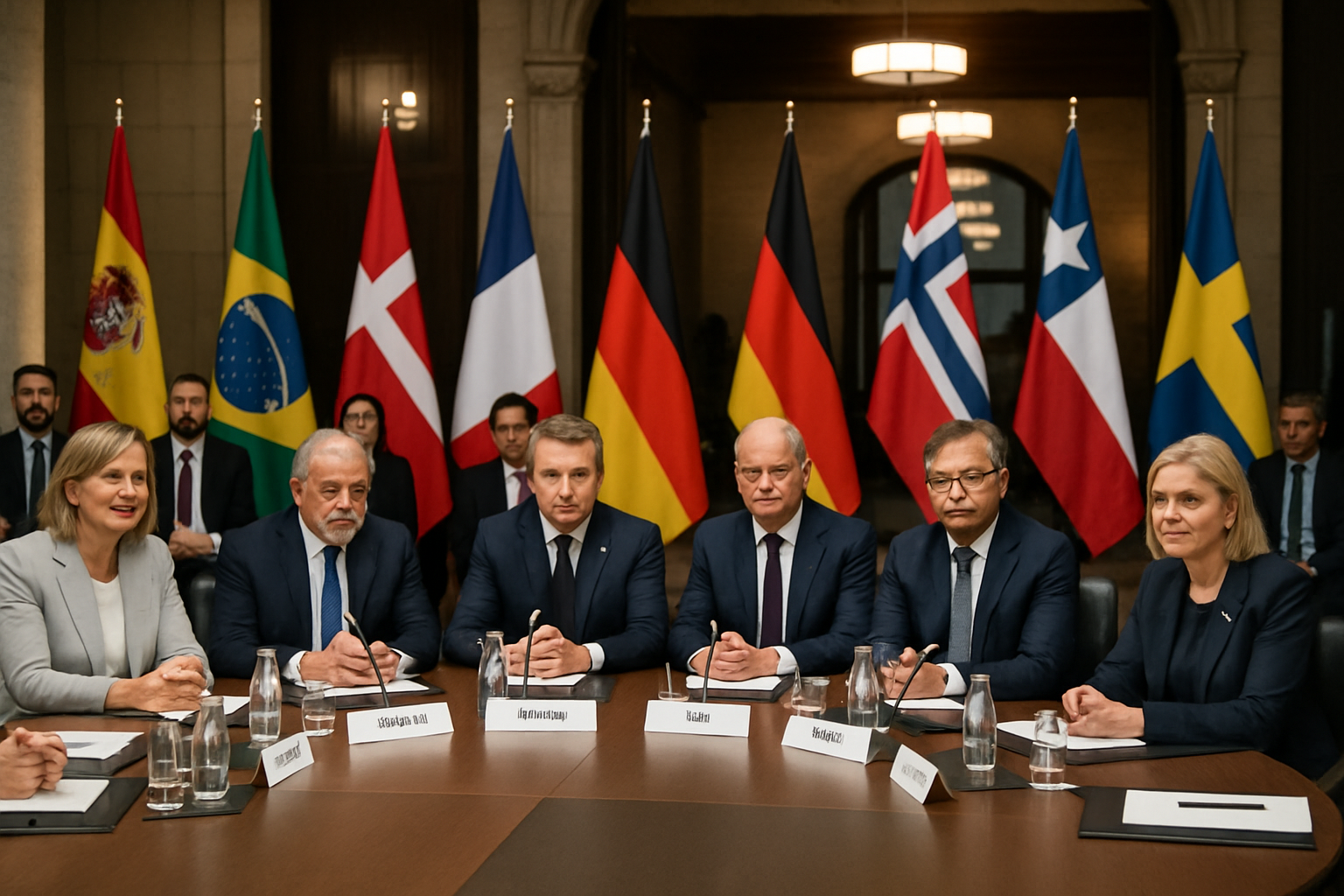
International progressive leaders converged in Barcelona for a historic summit designed to forge a unified response to the global rise of far-right movements, with Spanish Prime Minister Pedro Sánchez and Brazilian President Luiz Inácio Lula da Silva co-chairing the IV Meeting in Defense of Democracy.
The summit, held at Fira de Barcelona on April 18, 2026, brought together leaders from over fifteen countries spanning Europe, Latin America, and Africa in what organizers described as the "most challenging period for global democracy since World War II."
Strategic Shift from Defense to Leadership
Prime Minister Sánchez delivered the summit's most significant declaration, announcing a fundamental strategic pivot for the progressive movement worldwide. "The response cannot be only defensive," he declared to the assembled leaders. "It's not enough to resist, we have to propose, we have to lead."
This messaging represents a crucial departure from the reactive anti-populism strategies that have dominated progressive politics in recent years. Instead of merely opposing far-right advances, the Barcelona gathering focused on developing proactive policy alternatives that address the root causes driving voters toward extremist movements.
The timing proved particularly significant given recent electoral developments across Europe. While far-right parties have achieved breakthroughs in traditionally stable democracies - including National Rally gains in French urban areas, Sweden's Liberal-SD cooperation, and German AfD expansion in southwestern states - progressive leaders pointed to Viktor Orbán's defeat in Hungary after 16 years as proof that coordinated opposition strategies can succeed.
Key Attendees and Global Representation
The summit featured an impressive roster of international leaders, including:
- Mexican President Claudia Sheinbaum, who emphasized that diplomatic relations with Spain remained strong despite historical tensions
- Colombian President Gustavo Petro, who will conclude his presidency in August 2026
- South African President Cyril Ramaphosa
- Representatives from various European progressive parties and movements
The diversity of participants underscored the global nature of the challenge facing democratic institutions, with leaders sharing experiences from different continents about combating authoritarian threats while maintaining democratic values.
Economic Policy Consensus on Wealth Taxation
A central focus of the summit was implementing taxes targeting ultra-wealthy individuals as both an inequality reduction tool and a means of funding expanded public services. This emphasis on wealth taxation reflects growing progressive consensus that extreme wealth concentration itself threatens democratic governance.
The economic agenda comes amid more than five years of global economic stress stemming from COVID-19, supply chain disruptions, and energy crises that have demonstrated the inadequacy of market-only solutions to address systemic inequalities.
Austrian SPÖ leader Andreas Babler, who attended the summit, declared: "We must order and not divide. A strong democracy must be a social democracy." This message resonated throughout the gathering as leaders emphasized the connection between economic justice and democratic stability.
United Nations Reform Advocacy
Sánchez used the platform to call for fundamental reform of the United Nations to better reflect 21st-century global realities. Specifically, he advocated for placing a woman in leadership of the international organization, arguing that post-World War II institutions remain inadequately equipped to address contemporary challenges including climate change and digital governance.
The UN reform agenda reflects broader progressive concerns about the effectiveness of multilateral institutions in addressing modern crises and the need for more representative global governance structures.
Regional Dynamics and Diplomatic Relationships
President Sheinbaum's participation was particularly noteworthy given recent tensions over historical conquest issues between Mexico and Spain. Her emphasis that there was "no diplomatic crisis" with Spain demonstrated how the summit's democratic defense mission transcended bilateral disagreements.
Colombian President Petro delivered warnings about potential Latin American "rebellion" if the United States doesn't reconsider its regional policies, though he remained ambiguous when asked about respecting election results, stating: "yes, but not fraud."
These regional dynamics highlighted the complex geopolitical landscape progressive leaders must navigate while building international solidarity.
Context of Global Democratic Challenges
The Barcelona summit took place against the backdrop of unprecedented threats to democratic institutions worldwide. Recent elections have seen far-right parties achieve historic gains across Europe, while authoritarian leaders have consolidated power in multiple regions.
However, the defeat of Viktor Orbán's Fidesz party in Hungary after 16 years of rule provided progressive leaders with a template for successful opposition coordination. The Hungarian example demonstrated that even entrenched authoritarian leaders can be defeated through sustained, unified democratic opposition.
The summit also addressed the rise of what experts call "authoritarian innovation" - the pattern of extremist movements working within democratic systems while systematically eroding liberal norms and institutions from within.
Concrete Commitments and Future Coordination
Participants committed to regular coordination meetings and shared policy development, particularly around wealth taxation and democratic institutional reforms. The gathering established working groups to develop specific policy proposals that progressive parties could implement across different national contexts.
The summit organizers announced plans for continued international coordination as progressive movements face upcoming electoral tests, including the 2027 French presidential election where Emmanuel Macron is constitutionally barred from seeking a third term.
The "Barcelona Declaration" emerging from the summit emphasized that current challenges represent the most severe test of global democracy since World War II, requiring unprecedented coordination among democratic forces worldwide.
Strategic Implications for Progressive Politics
The April 2026 Barcelona summit represents a critical juncture for progressive politics globally. The shift from defensive strategies to proactive governance proposals reflects growing recognition that defeating authoritarianism requires offering voters compelling alternatives, not merely opposing extremist movements.
International coordination was emphasized as essential for preserving democratic values in an increasingly polarized world. Success will be measured not by summit declarations but by concrete improvements in governance while strengthening democratic institutions against authoritarian threats.
As progressive leaders returned to their respective countries, they carried with them a renewed commitment to international solidarity and a strategic framework for defending democracy through positive policy alternatives rather than reactive opposition strategies.
The Barcelona gathering may prove to be a turning point where progressive movements worldwide moved beyond crisis management toward offering voters a compelling vision for democratic governance in the 21st century.