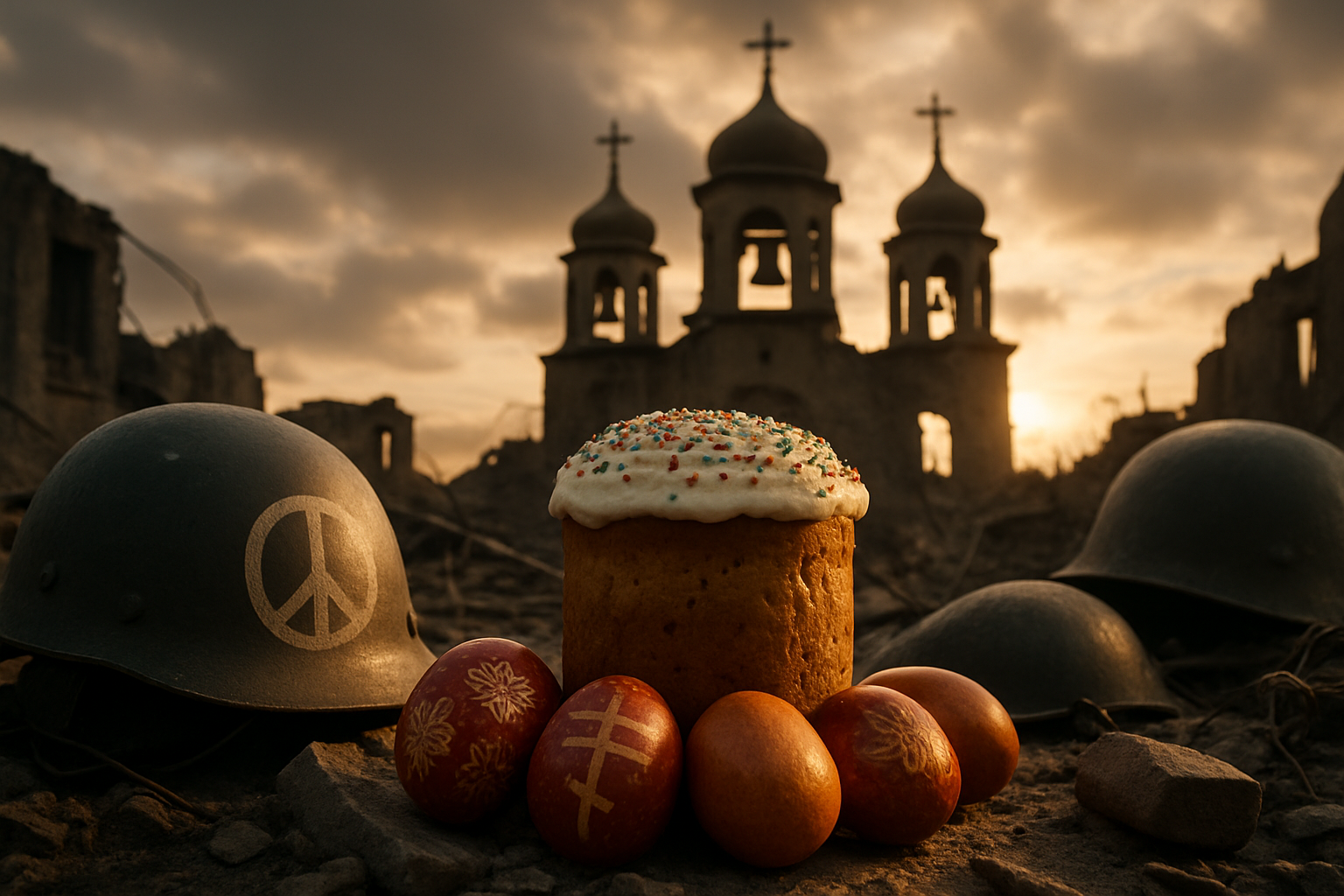
Russian President Vladimir Putin announced a 36-hour ceasefire from April 11-12, 2026, for Orthodox Easter weekend, which Ukrainian President Volodymyr Zelensky confirmed Ukraine would respect, marking the first coordinated humanitarian pause since trilateral peace talks were suspended due to the Iran crisis in March 2026.
The temporary truce, running from 1600 local time on April 11 until the end of April 12, coincides with Orthodox Easter celebrations observed by both Russian and Ukrainian Orthodox communities. According to the Kremlin statement, Putin ordered Russian forces to halt military operations in all directions while keeping troops ready to "eliminate provocations."
President Zelensky, who had advocated for an Easter ceasefire for over a week, stated that "people need Easter without threats and real move towards peace." He challenged Russia to extend the ceasefire beyond the Easter period, emphasizing the need for genuine commitment to peace rather than temporary gestures.
Diplomatic Context and Suspended Peace Talks
The Easter ceasefire comes against the backdrop of indefinitely suspended trilateral Ukraine-Russia-US negotiations, which were derailed in March 2026 by the Iran crisis consuming American foreign policy attention. The suspension represents a major setback after historic February 2026 breakthroughs that had offered the most significant diplomatic opportunity since the invasion began.
Those February achievements included a 314-prisoner exchange (the largest in 5 months), the restoration of US-Russia military communications after a 4-year suspension, and Geneva talks that achieved "significant progress" on ceasefire monitoring with European Big 5 observers participating for the first time. The framework has been preserved for potential reactivation when conditions permit.
The Trump administration's June 2026 Washington venue deadline for comprehensive peace talks now remains uncertain due to competing Middle East priorities, though the diplomatic framework remains intact.
Military Situation and Reported Violations
Despite the announced ceasefire, Bulgarian media reported deadly overnight attacks in Ukraine's Dnipropetrovsk region, where two people died and three were wounded in Russian air strikes. The attacks hit three districts in the region, with local military administration sources confirming the casualties occurred just hours after Moscow announced the Easter truce.
"Instead of the expected calm, the night brought new casualties and destruction. What happened casts a heavy shadow over hopes for even a brief pause in the war."
— Local Ukrainian Officials, as reported by Bulgarian media
The reported violations highlight the persistent challenges in implementing ceasefires during this four-year conflict. Russian territorial gains have accelerated significantly, with 481 sq km captured in January 2026 versus 260 sq km in December 2025 — an 85% increase representing the fastest monthly expansion in recent periods.
The military situation remains dire, with over 10,000 Russian drones and bombs launched in January 2026 alone. Systematic civilian targeting continues, including energy terrorism that has left over 1,170 Kyiv buildings with inadequate heating and forced Ukrainian nuclear plants to halt electricity production for the first time in the conflict.
Humanitarian Crisis and International Support
The conflict has exacted a devastating human toll. President Zelensky has disclosed that 55,000 Ukrainian soldiers have been officially killed, with a "large number" missing — and international estimates suggest actual casualties could be 2-3 times higher.
Over 17.8 million Ukrainians are accessing winter support programs, while systematic targeting of repair personnel and emergency services has been documented as war crimes. The attack on DTEK energy workers, which killed 15 employees while they were restoring power, exemplifies the systematic violations of Geneva Conventions civilian protections.
International support remains robust despite some divisions. The EU has approved a historic €90 billion loan — the largest single-nation assistance package ever — though Slovakia, Czech Republic, and Hungary refused participation. Additional support includes Sweden-Denmark's €246 million air defense package, Germany's 35 Patriot missiles, and the UK's revelation of 4 operational MRO facilities in Ukraine servicing Western equipment.
Ukraine's Strategic Evolution
Amid the suspended peace talks, Ukraine has evolved from aid recipient to security provider, deploying over 200 military specialists to the UAE, Qatar, Jordan, Bahrain, and Kuwait to combat Iranian Shahed drones — the same weapons being used to attack Ukrainian infrastructure. This strategic transformation leverages battlefield experience into new partnerships that could provide diplomatic leverage when talks resume.
Nuclear Governance Crisis
The Easter ceasefire occurs against the backdrop of an unprecedented nuclear governance crisis. The New START treaty expired on February 5, 2026, marking the first time in over 50 years without US-Russia nuclear constraints. Both nations control 80% of global nuclear weapons, with Russia possessing 4,380 warheads and the US 3,708.
UN Secretary-General António Guterres has called this a "grave turning point," warning that nuclear risks are at their "highest in decades." The restored military communications between the Pentagon and Russian General Staff represent the only remaining formal superpower diplomatic channel.
Territorial Sovereignty and Future Prospects
The fundamental sticking point remains unchanged: eastern Ukrainian territories under Russian control. Russia demands recognition of occupied territories and insists that any Putin-Zelensky talks must occur in Moscow. Ukraine maintains its territorial integrity position, with President Zelensky categorically rejecting territorial concessions.
The Ukrainian people, Zelensky has stated, would reject "handing over territories" as a "failure story." This position reflects not only political calculations but also legal and international law considerations, as the international framework maintains that the 2014 Crimea annexation violates UN Charter principles.
Orthodox Easter Significance
The ceasefire represents the shared religious and cultural traditions that transcend political boundaries. Orthodox Easter is celebrated by over half a million Orthodox Christians worldwide, demonstrating the global significance of this holy period. The temporary respite from a four-year conflict provides a moment for religious observance without the immediate threat of violence.
The religious dimension adds moral weight to the humanitarian pause, offering hope that shared spiritual values might provide bridges during times of division and paths toward healing and peace.
Strategic Implications and Framework Preservation
Despite the suspension of peace talks due to the Iran crisis, the diplomatic achievements remain intact. Prisoner exchange mechanisms, Pentagon-Moscow deconfliction protocols covering operations in Syria, the Arctic, and Africa, and the structured negotiation format using UAE methodology have proven effective for humanitarian results and can be reactivated when favorable conditions return.
The stakes include 21st-century territorial dispute resolution templates, European security architecture redefinition, international law enforcement credibility, and territorial sovereignty principles that will influence power competition for decades. Success in eventual resumed talks could end Europe's deadliest war since World War II and provide a conflict resolution template for future disputes.
Looking Ahead
The timeline for resumed negotiations depends on the resolution of the Iran situation and broader Middle East stability. The Iranian crisis demonstrates the interconnected nature of regional conflicts in today's multipolar security environment, where managing simultaneous crises challenges the international community while addressing Europe's most significant security challenge since the Cold War.
Framework preservation remains critical, as the most substantial US-Russia agreement since the conflict began provides a foundation for future engagement when conditions permit. The coming phase remains uncertain, but the Easter ceasefire offers a reminder of the human cost and the complex challenges facing peace efforts in what many consider a template-setting moment for international diplomacy and conflict resolution in the 21st century.
As both nations observe Orthodox Easter, the temporary pause serves as a reminder that even in the darkest conflicts, moments of shared humanity can emerge, offering hope that diplomatic innovation might yet triumph over military escalation in determining the trajectory of European security for decades to come.