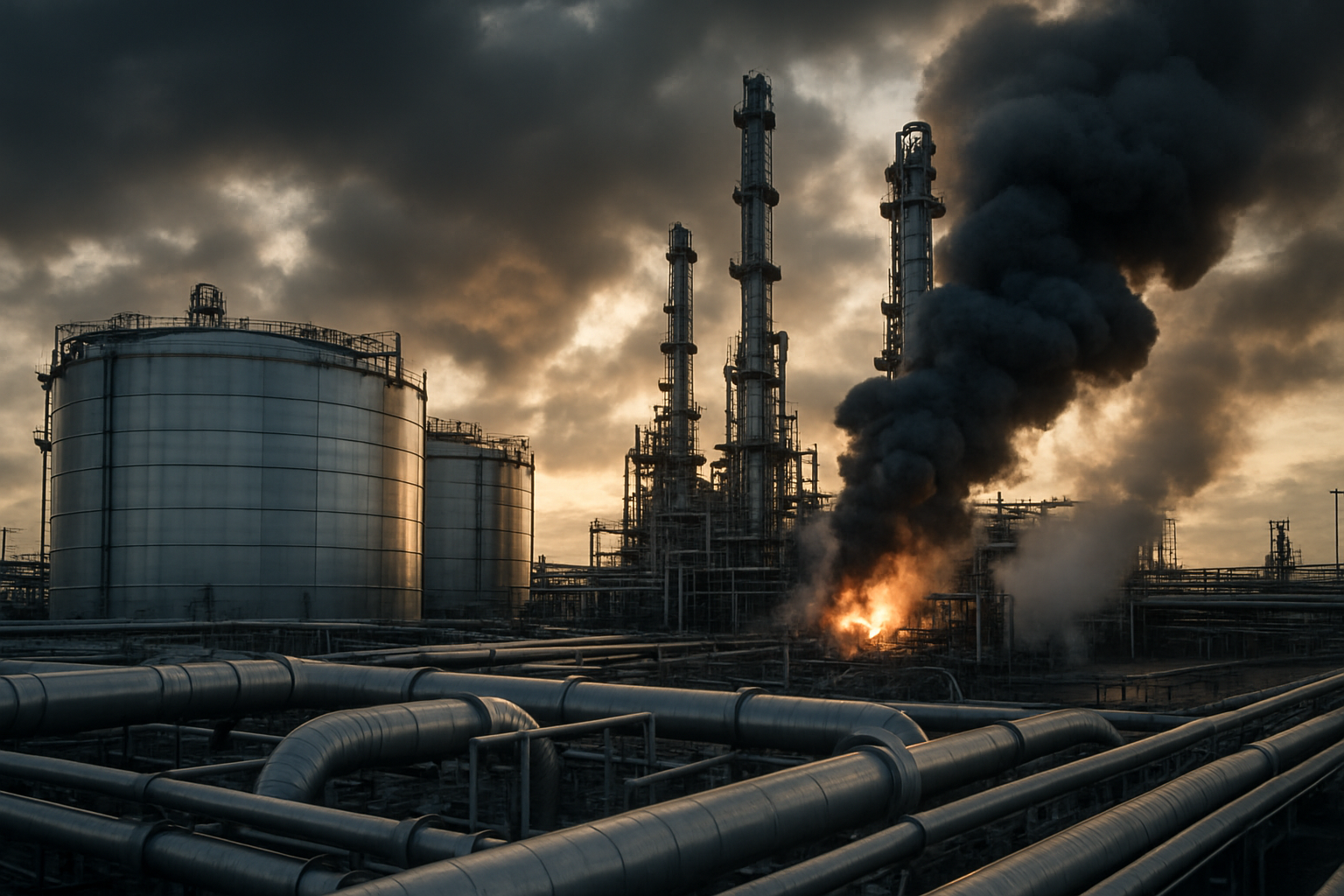
Oil prices surged 10% to $80 per barrel and European gas prices rocketed more than 50% higher on Monday as the escalating Iran conflict triggered the most serious global energy crisis in decades, with Qatar's state-run energy firm halting liquefied natural gas production following Iranian attacks.
The dramatic price spike came as QatarEnergy, the world's largest LNG company, announced it was ceasing production at two major facilities after Iranian drone strikes targeted gas processing infrastructure in Ras Laffan and Mesaid. The company is expected to declare force majeure on LNG supplies, marking a watershed moment for global energy security.
"This is the most significant threat to global energy supplies since the 1970s oil crisis," said Maria Belova, a leading energy analyst. "Europe could face a gas deficit of up to 40 billion cubic meters if this situation persists, with TTF prices potentially reaching levels comparable to the spring of 2022."
Strait of Hormuz Under Threat
The energy crisis intensified as Iran declared the Strait of Hormuz "unsafe" for commercial shipping, effectively closing the vital waterway through which approximately 40% of global seaborne oil transits daily. Major shipping companies including Maersk and MSC suspended operations through the strategic chokepoint, leaving more than 150 oil and LNG tankers anchored in Persian Gulf waters representing billions of dollars in stranded cargo.
The closure comes amid "Operation Epic Fury," the largest coordinated US-Israeli military operation against Iran since the 2003 Iraq invasion, which has triggered massive Iranian retaliation across the region. The Islamic Revolutionary Guard Corps declared "no red lines remain" as it launched systematic strikes against energy infrastructure throughout the Gulf states.
European natural gas prices jumped 48% to reach €47.32 per megawatt-hour by midday GMT, the highest level since February 2025. While still below the extreme peaks of over €300 reached during the early Ukraine war crisis, analysts warn that sustained disruption could drive prices even higher.
OPEC Response Insufficient
OPEC+ held an emergency meeting and approved a production increase of 206,000 barrels per day for April, but energy experts say this is woefully inadequate to offset the shipping disruptions affecting the Persian Gulf. Alternative routes around the Arabian Peninsula would add significant time and costs to oil deliveries, while spare capacity remains limited.
The energy crisis is already rippling through global markets, with natural gas prices surging 24% in Europe and 78% in the United States over recent weeks. Countries from Sweden to Australia are warning of imminent fuel price increases, while Mexico faces concerns about a potential "gasolinazo" - a sharp rise in gasoline prices that could trigger social unrest.
"What we're seeing is a perfect storm - the loss of Qatar's LNG production combined with the closure of the world's most critical oil chokepoint," said Duncan Amoah, executive director of Ghana's Chamber of Petroleum Consumers.
— Duncan Amoah, Ghana COPEC Executive Director
Aviation and Supply Chains Paralyzed
The crisis extends far beyond energy markets. Over 18,000 flights have been cancelled worldwide as Iran, Iraq, Israel, UAE, Qatar, Syria, Kuwait, and Bahrain simultaneously closed their airspace - the most comprehensive aviation disruption since the COVID-19 pandemic. Dubai International Airport, the world's busiest for international passenger traffic, has been completely shut down after sustaining missile damage.
Major carriers including Emirates, Air France-KLM, Wizz Air, and Bulgaria Air have suspended all Middle East operations, stranding hundreds of thousands of passengers globally. The disruption has severed the critical Europe-Asia aviation hub, forcing complex rerouting that adds hours and significant costs to international flights.
Supply chains across multiple industries are facing severe disruption. The Persian Gulf serves as a critical hub not just for energy but for global trade, affecting everything from consumer goods to industrial materials. Strategic petroleum reserves provide only a temporary buffer against sustained supply disruption.
Nuclear Diplomacy Collapse Triggers Crisis
The energy crisis erupted following the complete breakdown of US-Iran nuclear negotiations, despite what had been hailed as the most promising diplomatic breakthrough since the 2018 collapse of the Joint Comprehensive Plan of Action (JCPOA). Geneva talks had achieved "broad agreement on guiding principles," but fundamental disagreements over Iran's ballistic missile program and regional proxy networks proved insurmountable.
Iran maintained that its missile program and support for regional allies were "red lines" that could not be part of nuclear-only negotiations. The United States, led by Secretary of State Marco Rubio, insisted on a comprehensive agreement addressing missiles, armed groups, and human rights violations.
The diplomatic collapse came as Iran continues enriching uranium at 60% purity, approaching the 90% weapons-grade threshold, with sufficient material for multiple nuclear weapons if weaponized, according to former IAEA inspector Dr. Yusri Abu Shadi.
Regional Coalition Under Strain
Perhaps most significantly, the crisis has severely strained an unprecedented regional coalition of Saudi Arabia, UAE, Qatar, and Egypt that had backed the diplomatic process. Egyptian President Abdel Fattah el-Sisi condemned Iranian attacks on "sisterly Arab countries," warning of "comprehensive chaos" spreading across the region.
The UAE confirmed one civilian death in Abu Dhabi from missile debris, while Kuwait's international airport was struck by Iranian drones, injuring airport employees and forcing flight suspensions. Qatar intercepted 65 ballistic missiles and 12 drones using Patriot systems, with eight people injured by falling fragments.
This marks the first time Iranian forces have directly targeted Gulf Cooperation Council member states that had supported diplomatic engagement, fundamentally altering the regional security architecture that has underpinned energy market stability.
Global Economic Implications
Financial markets are reacting with alarm to the energy crisis. Stock markets have crashed across Asia, with Pakistan's KSE-100 index plummeting 8.97% and forcing trading suspensions. Dow futures dropped 400-570 points overnight, while European markets opened with losses exceeding 2%.
The crisis highlights the dangerous over-dependence on strategic chokepoints for global energy security. The Strait of Hormuz, at just 21 miles wide at its narrowest point, handles more seaborne oil traffic than any other waterway. Its closure, even temporarily, creates immediate global supply chain disruptions extending far beyond the energy sector.
Sweden has already warned that electricity prices could rise 10-20 öre per kilowatt-hour, with gasoline increasing 1-2 kronor per liter. Australian authorities have issued similar warnings about fuel price increases, while Canadian officials are accelerating plans to position the country as a major LNG supplier to help diversify global supply chains away from geopolitically volatile regions.
Nuclear Governance Crisis Context
The energy crisis unfolds against a broader nuclear governance breakdown. The New START treaty between the United States and Russia expired on February 5, marking the first time in over 50 years without US-Russian nuclear constraints. Combined with China's nuclear expansion and UN Secretary-General António Guterres' warnings that nuclear risks are at their "highest in decades," the failure of Iran diplomacy represents a template-setting moment for 21st-century crisis management.
The rapid transition from diplomatic breakthrough to military confrontation demonstrates the fragility of modern crisis management mechanisms in an increasingly multipolar world. Success in containing this crisis could provide a framework for future nuclear disputes; failure may accelerate the shift toward military solutions over diplomatic engagement globally.
Looking Forward: Energy Security Rethink
The March 2026 energy crisis represents a watershed moment that will reshape global energy security planning for decades to come. The simultaneous disruption of both Qatar's LNG production and Strait of Hormuz shipping has exposed the vulnerability of modern energy systems to geopolitical shocks.
While strategic petroleum reserves provide temporary buffers, the scale of the disruption - affecting 40% of global oil transit and a major LNG producer - requires fundamental rethinking of energy supply chain diversification. The crisis accelerates discussions about alternative suppliers, routes, and energy sources, though transitions require years or decades to implement effectively.
As the situation continues to evolve, the international community faces critical decisions about energy security architecture, diplomatic crisis management, and the balance between economic interdependence and geopolitical stability. The stakes extend far beyond immediate market volatility to encompass the fundamental principles governing international stability in the post-World War II order.
The coming days and weeks will determine whether this crisis remains a contained regional confrontation or escalates into a broader Middle Eastern conflict with worldwide implications for energy markets, supply chains, and the basic mechanisms of international crisis resolution that have maintained relative stability for decades.