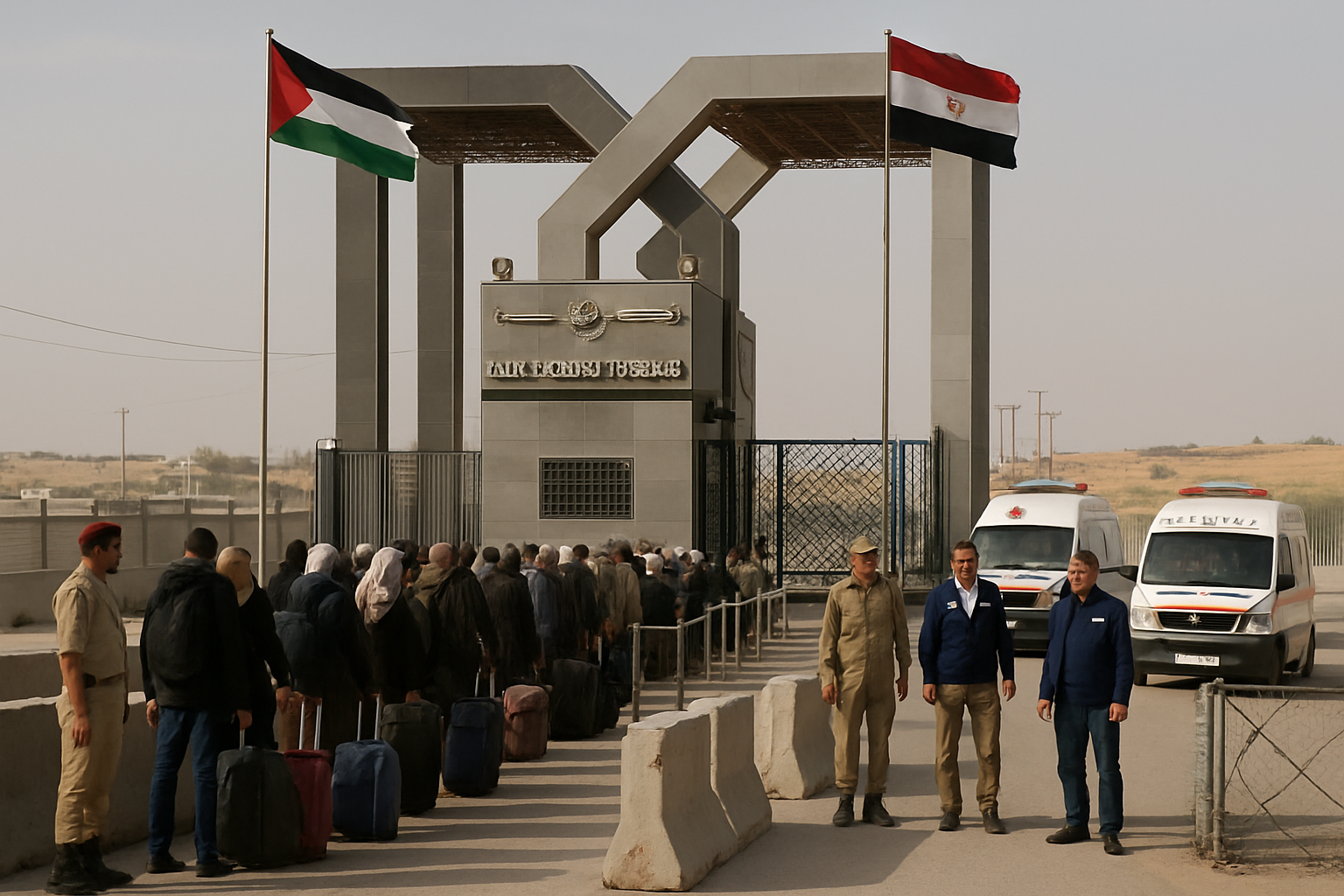
Gaza's Rafah border crossing with Egypt has partially reopened after nearly two years of closure, but the resumption of Palestinian movement remains severely limited, with Hamas condemning what it calls "systematic harassment" of returnees and only a fraction of expected crossings taking place on the first operational day.
The crossing, Gaza's main gateway for its 2.3 million residents, reopened on February 2, 2026, as part of the fragile ceasefire agreement brokered in October. However, operations on the first day fell far short of expectations, with only 27 Palestinians able to cross in both directions despite planned quotas allowing for up to 200 daily movements.
Limited First-Day Operations Highlight Ongoing Restrictions
According to multiple Palestinian and Egyptian sources, Israeli authorities permitted only 12 Palestinians to return to Gaza from the 50 who were scheduled to cross, while allowing just 15 medical patients and companions to exit for treatment in Egypt. The remaining 38 Palestinians who had planned to return were denied passage after failing Israeli security screenings.
The crossing operated for more than 10 hours on its first day, with only about a dozen returnees and a small group of medical evacuees managing to cross in each direction. Egyptian officials had initially announced that approximately 150 people were expected to leave Gaza on the reopening day, but these numbers proved overly optimistic.
Three ambulances carrying injured Palestinians successfully reached the Egyptian side of the border on Monday afternoon, where patients were immediately examined by Egyptian health officials to determine appropriate hospital placement. Egypt has mobilized a massive healthcare response, placing 150 hospitals on high alert with 300 ambulances deployed specifically for Gaza medical evacuations.
Hamas Condemns "Organized Terrorism" at Border
Hamas has strongly condemned what it describes as "systematic harassment and extortion" of Palestinians attempting to cross the border, particularly targeting women and children. The movement's spokesman, Hazem Qasem, characterized Israeli security procedures as "organized terrorism" and a form of collective punishment designed to deter Palestinians from returning to their homes.
"The systematic mistreatment that returning Palestinians are subjected to through the Rafah crossing constitutes organized crimes aimed at deterring Palestinians from returning to their homeland"
— Hamas Statement
Palestinians who successfully returned to Gaza through the crossing shared testimony about prolonged interrogations and degrading procedures conducted by Israeli security forces. Many described the crossing experience as far from normal, with some reporting feeling humiliated by the extensive security protocols.
The first group of returnees, numbering approximately 12 individuals, arrived at Nasser Medical Complex in Khan Younis Monday evening, where they were greeted by family members with tears of joy after being separated for months or years.
Operational Constraints and International Oversight
The Rafah crossing operates under strict Israeli-Egyptian security protocols with European Union monitoring teams overseeing operations. Daily quotas theoretically allow for 150 Palestinians to exit Gaza and 50 to enter during six-hour operational windows, but actual numbers remain significantly lower due to extensive security screening procedures.
The crossing permits only pedestrian traffic, with no goods or humanitarian aid allowed to pass through. This restriction maintains the broader blockade of Gaza while providing limited human movement for medical emergencies and family reunifications.
UN spokesperson Stephane Dujarric welcomed the reopening as a positive development, though international observers have expressed concerns about the severe operational restrictions that limit meaningful humanitarian impact for Gaza's population.
Humanitarian Crisis Continues Despite Border Opening
Gaza's Health Ministry reports that approximately 20,000 Palestinians are awaiting medical evacuation, a stark contrast to the current capacity of the crossing. The last major medical evacuations through Rafah occurred in February 2025, leaving thousands of patients without access to specialized treatment unavailable in Gaza's devastated healthcare system.
Adding to the humanitarian concerns, Gaza's Civil Defense announced on Tuesday that all its vehicles have ceased operations due to fuel shortages, further limiting emergency response capabilities in the territory. The Civil Defense called for urgent intervention to address the fuel crisis, warning that the shortage of basic fuel needed for humanitarian interventions poses additional risks to civilian populations.
Meanwhile, Israeli authorities continue to restrict the entry of humanitarian aid to Gaza, with Hamas alleging that these restrictions have actually tightened since the ceasefire began. This occurs as Gaza faces widespread destruction following months of conflict, with the territory's death toll reaching 71,800 according to local health authorities.
Regional and International Reactions
Eight Arab and Muslim nations, including Saudi Arabia, Jordan, Egypt, UAE, Qatar, Indonesia, Pakistan, and Turkey, have issued joint condemnations of what they term Israeli ceasefire violations. The countries' foreign ministers report over 1,000 Palestinian casualties from Israeli strikes since the ceasefire began, raising concerns about the agreement's implementation.
Jordan continues to operate a separate medical corridor, recently evacuating its 23rd batch of patients, including 18 children and 38 companions, highlighting alternative pathways for Gaza's medical emergencies while the Rafah crossing operates under severe restrictions.
Egypt has demonstrated significant commitment to supporting Palestinian medical needs, with Health Minister Khaled Abdel Ghaffar personally coordinating the response from the New Administrative Capital. The deployment of 150 hospitals and 300 ambulances represents one of the largest humanitarian mobilizations in the region.
Testing Ground for Ceasefire Implementation
The Rafah crossing's limited reopening serves as a critical test case for the broader Israel-Hamas ceasefire agreement reached in October. The crossing's operations are seen as an indicator of both sides' commitment to implementing the deal's humanitarian provisions.
However, the significant gap between planned and actual crossings on the first day raises questions about the practical viability of the current arrangements. The crossing has been under full Israeli military control since May 2024, when Israel launched operations that led to its closure.
International observers note that while the reopening represents a symbolic milestone, the severe operational restrictions limit its immediate humanitarian impact. The crossing's future operations depend on the continued success of the ceasefire agreement and the willingness of all parties to gradually expand access for Gaza's population.
As operations continue into the second day, Palestinian families on both sides of the border remain hopeful that procedures will improve and that more people will be permitted to cross. However, the pattern established on the first day suggests that meaningful freedom of movement for Gaza's 2.3 million residents remains a distant prospect under the current security arrangements.