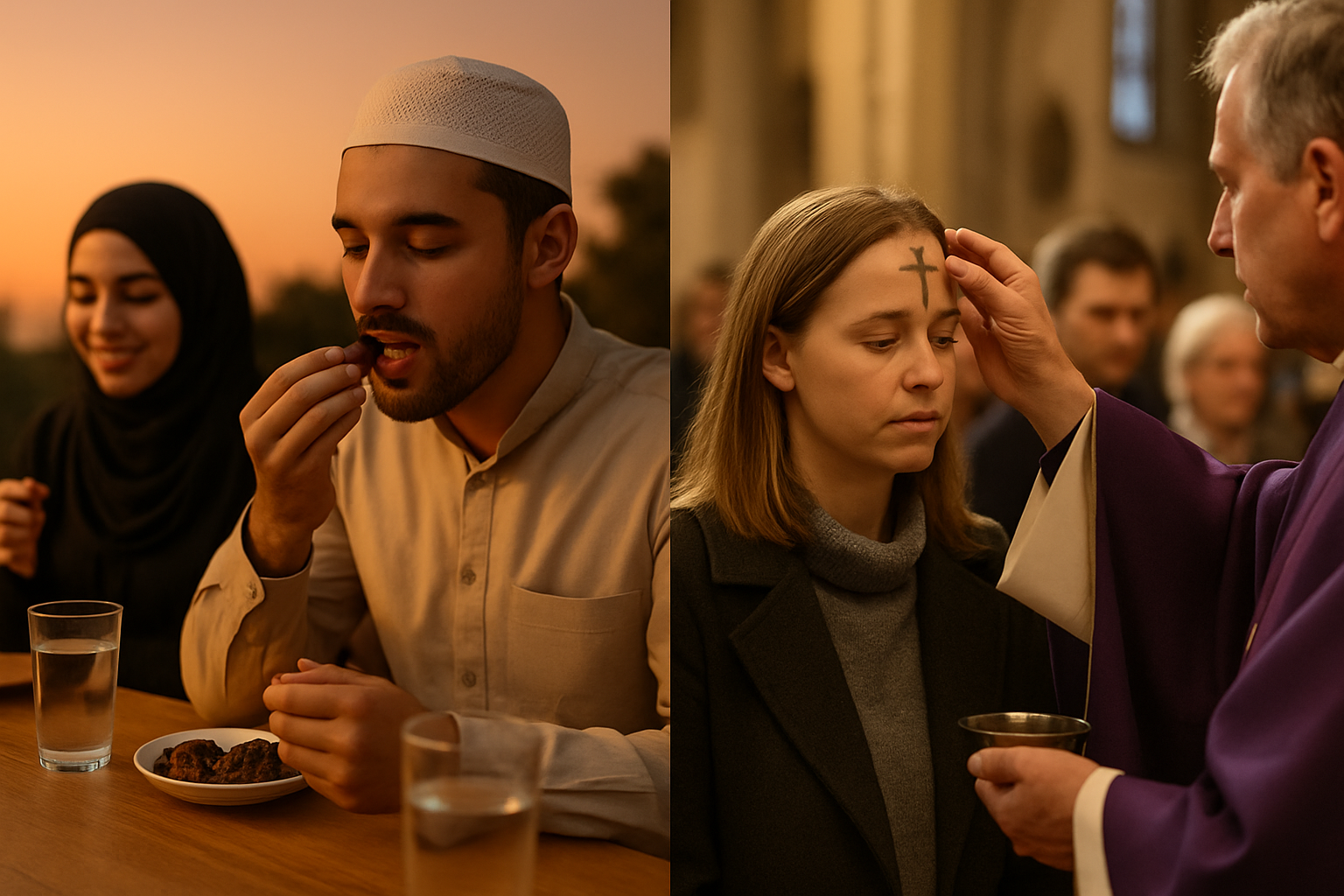
In an extraordinary convergence of faith traditions, nearly 2.5 billion believers across the globe entered their most sacred seasons simultaneously as Muslims began observing Ramadan and Christians commenced Lent on February 18, 2026, marking a historic moment of shared spiritual discipline across religious boundaries.
The Islamic month of Ramadan 1447 AH officially commenced following successful crescent moon sightings Tuesday evening across multiple countries, with the vast majority of Muslim nations including Saudi Arabia, Nigeria, UAE, Qatar, Kuwait, Iraq, Algeria, Ghana, Bosnia and Herzegovina, and Uganda confirming Wednesday February 18 as the first day of fasting. Simultaneously, Christians worldwide entered the 40-day Lenten season beginning with Ash Wednesday, creating an unprecedented alignment of the world's two largest periods of religious observance.
Global Confirmations and Regional Variations
The determination of Ramadan's commencement followed traditional lunar observation methods enhanced by modern technology. Saudi Arabia's Supreme Court confirmed crescent moon sightings at Hawtat Sudair and Tumair observatories in Al-Majma'ah Governorate, while Nigeria's Sultan of Sokoto and President General of the Supreme Council for Islamic Affairs accepted reports from across the nation, declaring Wednesday as the first day of fasting for Africa's most populous Muslim nation.
In Austria, the Islamic Religious Community announced the beginning under the motto "Zeit für Zuversicht" (Time for Hope), while Bosnia and Herzegovina's Muslim community prepared to welcome the holy month after sunset Tuesday evening. Ghana's Muslim population embraced what Sheikh Imran, a prominent cleric in Madina, described as "a time for self-purification, reflection on one's actions, and giving back to those in need."
Some regional variations emerged, with a few countries including certain regions beginning Thursday February 19, reflecting traditional differences in lunar calendar determination and geographical visibility of the crescent moon. This diversity within unity has long characterized Islamic lunar calendar observance while maintaining the underlying spiritual cohesion of the global Muslim community.
Unprecedented International Coordination
The 2026 Ramadan observance builds upon extraordinary international preparation efforts coordinated throughout early February. Saudi Arabia launched the Custodian of Two Holy Mosques' Ramadan programs on an unprecedented scale, distributing 2.2 million Quran copies and translations to 120 countries, providing 1,000 tons of dates (representing a 300-ton increase and reaching 18 new countries), and deploying 91 imams to 49 countries for prayers and spiritual guidance.
President of Uzbekistan Shavkat Mirziyoyev signed a comprehensive resolution titled "On Measures of State Social Support for Vulnerable Segments of the Population During the Sacred Month of Ramadan," demonstrating sophisticated governmental approaches to facilitating religious observance while supporting vulnerable communities.
"This is a historic moment demonstrating how ancient spiritual traditions find meaningful expression through contemporary international cooperation,"
— UN Secretary-General António Guterres
UN Secretary-General António Guterres marked the beginning of Ramadan with an appeal for overcoming divisions and strengthening humanitarian aid, particularly highlighting ongoing conflicts in Afghanistan, Yemen, Gaza, and Sudan. His statement emphasized the month's potential for fostering global solidarity and compassion.
The Rare Convergence of Sacred Seasons
The simultaneous commencement of Ramadan and Lent represents a providential alignment that religious scholars note offers unique opportunities for interfaith understanding and mutual learning. Both traditions emphasize remarkably similar themes: fasting as spiritual discipline, prayer and meditation, charitable giving, personal reflection, and preparation for major religious celebrations—Eid al-Fitr for Muslims and Easter for Christians.
For Muslims, Ramadan commemorates the first revelation of the Quran and requires dawn-to-sunset fasting, additional prayers including Taraweeh, increased charitable giving through zakat, and enhanced community bonds through shared iftar meals. The fast extends beyond food and drink to include abstaining from smoking, marital relations during daylight hours, and focusing on spiritual purification.
Christian Lent, beginning on Ash Wednesday, marks a 40-day period of preparation for Easter, commemorating Jesus Christ's fasting in the desert. The season emphasizes prayer, fasting, and almsgiving as pillars of spiritual discipline, with many Christians choosing specific forms of self-denial or increased charitable activities to deepen their faith journey.
Cultural and Educational Adaptations
Educational institutions across Muslim-majority countries implemented comprehensive adaptations to accommodate fasting requirements. Saudi Arabia's education departments approved revised schedules with classes beginning at 9-10 AM instead of earlier hours, while Qatar's Ministry of Education and Higher Education coordinated similar adjustments. The Qassim Region scheduled public school classes for 10 AM with adult education programs at 9:30 PM, demonstrating sophisticated understanding of fasting demands while maintaining educational objectives.
In a remarkable display of inclusive accommodation, Finnish schools established their fourth annual "fasting parks" during Ramadan, providing dedicated quiet spaces for up to 100 Muslim students per school during lunch periods while their peers eat in cafeterias. This initiative represents a sophisticated secular-religious accommodation model that has gained international attention.
Weather forecasting services provided specialized outlooks for the holy cities of Makkah and Madinah, with Saudi Arabia's National Center for Meteorology issuing preliminary forecasts showing below-average rainfall and slightly higher temperatures to assist the millions of pilgrims and visitors expected at the Two Holy Mosques during the sacred month.
Technology Meets Tradition
The 2026 observances demonstrate sophisticated integration of modern technology with traditional spiritual practices. Mobile applications for prayer times, Quranic recitation, and charitable giving are facilitating global diaspora participation across diverse time zones and cultural contexts. Saudi Arabia's Sudair Observatory employed AI-enhanced crescent detection while maintaining traditional visual confirmation by authorized religious committees, representing the modern evolution of centuries-old lunar calendar determination.
Social media platforms and digital communication networks have enabled unprecedented coordination of charitable initiatives, community iftars, and spiritual programming reaching millions of believers worldwide, while maintaining the essential human connections that define these sacred seasons.
Economic and Social Impact
The simultaneous observance of both religious seasons creates significant economic impacts through altered consumption patterns, increased evening social activities post-iftar for Muslims, and enhanced charitable giving across both communities. Egypt extended business hours for shops, restaurants, and cafes to close at 2:00 AM daily throughout Ramadan to accommodate the shifted social rhythms, while maintaining workshop restrictions at 10:00 PM in residential areas.
Kuwait's approach exemplified inclusive governance, with the Amir extending Ramadan greetings not only to citizens but specifically to expatriate communities, demonstrating recognition of the significant international populations participating in the observance and contributing to the social fabric of their host countries.
Challenges and International Cooperation
The global observance occurs amid significant international challenges, including ongoing conflicts in multiple regions and climate-related pressures. However, the coordination demonstrated in Ramadan preparations—spanning 120 countries and involving unprecedented levels of international religious diplomacy—provides a template for how global cooperation can function effectively when serving fundamental human needs for spiritual meaning and community connection.
Regional variations in start dates, while sometimes creating administrative complexities, also demonstrate the dynamic nature of traditional religious practices adapting to local conditions while maintaining global unity of purpose. Countries like Egypt and Jordan beginning Thursday February 19 due to unsuccessful local moon sightings reflect the continued importance of traditional observation methods alongside modern astronomical calculations.
Interfaith Understanding and Global Significance
Religious leaders across denominations have noted the providential timing of this convergence, offering opportunities for Christians and Muslims to learn from each other's traditions of self-discipline, spiritual growth, and community service. Both seasons emphasize preparation for resurrection celebrations—Easter for Christians and the spiritual renewal symbolized by Eid al-Fitr for Muslims—creating natural bridges for interfaith dialogue and mutual understanding.
The simultaneous observance affects nearly 2 billion Muslims and over 2.4 billion Christians worldwide, representing the largest concurrent religious observance in human history. This scale demonstrates the continuing relevance of ancient spiritual traditions in providing meaning, community, and moral guidance in an increasingly interconnected world.
As communities worldwide enter these sacred seasons together, the historic convergence serves as a powerful reminder of shared human values transcending religious boundaries: the pursuit of spiritual growth through discipline, the importance of community solidarity, care for the vulnerable, and the universal human need for periods of reflection and renewal. The successful international coordination evident in 2026 Ramadan preparations, combined with the natural alignment with Christian Lent, offers hope for continued interfaith cooperation and mutual understanding in addressing global challenges through shared commitment to compassion, service, and spiritual development.