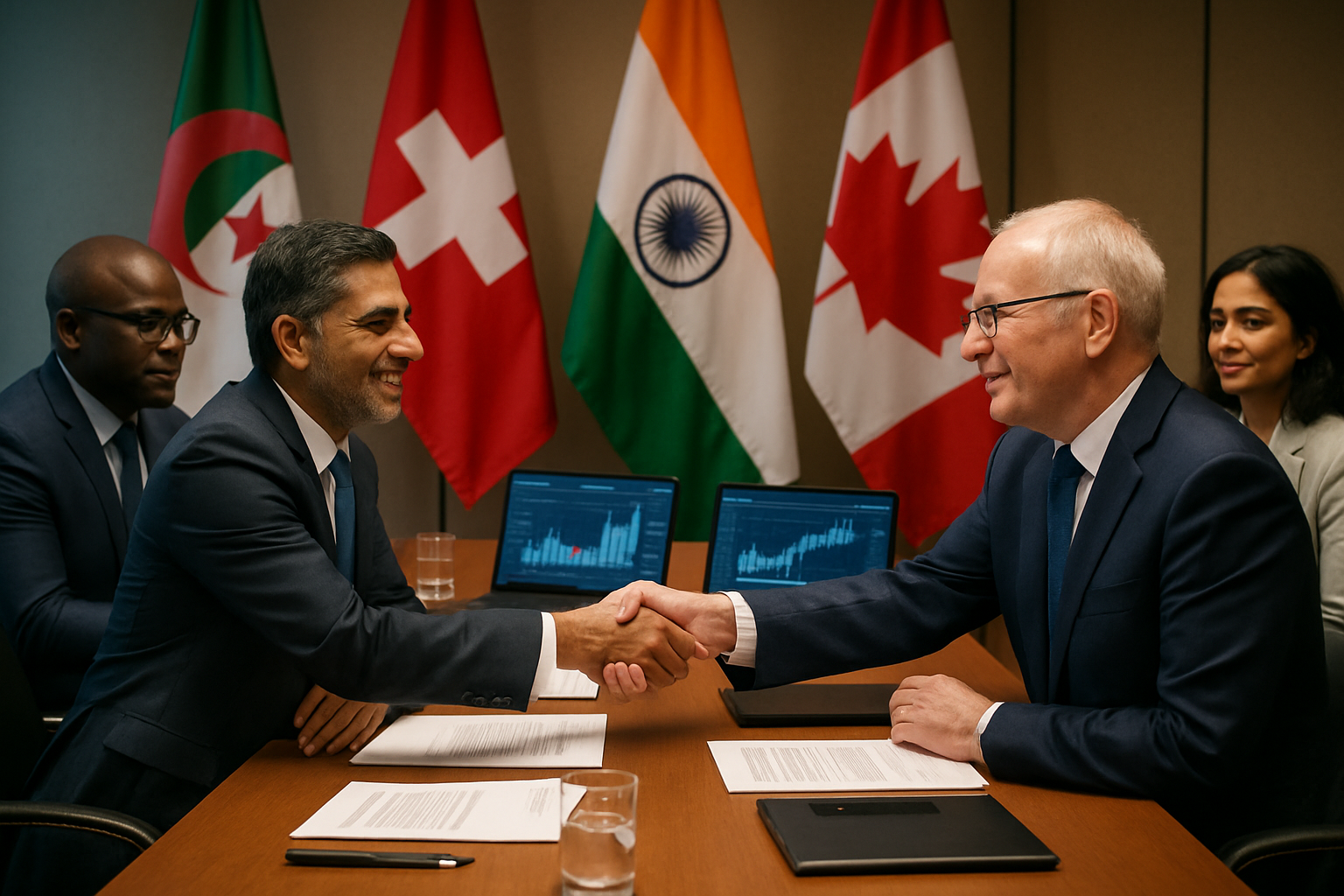
A wave of strategic economic partnerships is transforming global trade relationships as nations increasingly pursue bilateral cooperation over multilateral frameworks, with recent developments spanning from North Africa to South Asia demonstrating the shift toward targeted diplomatic and commercial engagement.
The latest manifestation of this trend emerged Monday when Algeria's Foreign Ministry Secretary-General Lounas Moqraman hosted Swiss Deputy State Secretary Monica Schmutz Kirgöz, responsible for Middle East and North Africa affairs at the Swiss Foreign Ministry. The meeting, part of Kirgöz's working visit to Algeria, focused on strengthening cooperation and partnership ties between the two nations across multiple sectors.
According to a Foreign Ministry statement, the discussions represented an opportunity to address bilateral cooperation and partnership relations between Algeria and Switzerland in various fields, occurring within the framework of bilateral visits and commitments between the two countries.
India-Canada Nuclear Partnership Takes Center Stage
Meanwhile, in New Delhi, India and Canada announced what leaders described as a series of "key trade accords" that included cooperation on critical minerals and a "landmark" uranium supply deal for nuclear power. The agreements, revealed during high-level meetings in the Indian capital, represent a significant expansion of economic ties between the two nations.
The comprehensive framework encompasses multiple strategic sectors, with particular emphasis on energy security and critical minerals cooperation. Sources familiar with the negotiations described the uranium supply arrangement as having the potential to reshape regional energy dynamics while strengthening democratic partnerships in the Indo-Pacific region.
India and Canada have also struck agreements across technology, critical minerals, space, defense, and education sectors, according to diplomatic sources. Canadian officials indicated that the partnerships reflect both nations' commitment to diversifying supply chains and reducing dependence on single-source suppliers for critical materials.
Bilateral Trade Strategy Gains Momentum
These developments align with a broader international trend toward bilateral partnerships over multilateral frameworks, following the pattern established by the Trump administration's successful agreements with Argentina, which eliminated over 1,600 US tariffs, and India, which saw a framework potentially expanding trade from $50 billion to $500 billion.
"The era of complex multilateral negotiations giving way to agile, strategic bilateral cooperation allows nations to achieve faster results while addressing specific mutual interests."
— Senior Trade Analyst, reviewing global partnership trends
The Algeria-Switzerland discussions reflect similar priorities, with both nations seeking to enhance economic cooperation while maintaining strategic autonomy. Switzerland's focus on North African partnerships comes as European nations diversify their economic relationships amid global supply chain vulnerabilities exposed by recent geopolitical tensions.
Strategic Resource Cooperation
The India-Canada critical minerals cooperation particularly addresses global concerns about supply chain concentration. Currently, China controls approximately 60% of global critical minerals production and 90% of refining capacity, creating vulnerabilities that democratic nations are actively seeking to address through alternative partnerships.
The uranium supply component of the India-Canada agreement holds special significance given India's ambitious nuclear power expansion plans and Canada's position as a leading uranium producer. The partnership provides India with energy security diversification while offering Canada stable long-term demand for its nuclear materials.
Regional Integration Through Bilateral Frameworks
These partnerships demonstrate how nations are pursuing regional integration through overlapping bilateral arrangements rather than comprehensive multilateral agreements. The approach allows for more targeted cooperation addressing specific national priorities while maintaining flexibility to adapt to changing global conditions.
Algeria's engagement with Switzerland reflects North Africa's strategic positioning as a bridge between Europe, Africa, and the Middle East. The partnership potential spans energy cooperation, where Algeria's substantial hydrocarbon resources could complement Switzerland's technological expertise and financial capabilities.

Implementation Challenges and Opportunities
Success of these bilateral partnerships requires sustained political commitment across electoral cycles, adequate funding for infrastructure development, and coordination between government levels and private sector engagement. The Canada-India nuclear cooperation, for instance, necessitates complex regulatory harmonization and safety standard alignment.
Similarly, Algeria-Switzerland cooperation must navigate different economic systems and regulatory frameworks while building on existing diplomatic foundations. Both partnerships represent long-term strategic commitments requiring institutional mechanisms for regular consultation and progress monitoring.
Global Context of Economic Realignment
These developments occur within a broader context of global economic realignment, where nations are seeking greater control over their economic relationships and faster adaptation to changing conditions. The approach contrasts with traditional trade blocs that often require extensive consensus-building and compromise on national priorities.
The timing of these announcements reflects the urgency many nations feel about securing reliable partnerships amid global uncertainties. Energy security, critical materials access, and technological cooperation have become central to national security strategies, driving the search for trusted partners.
"Modern partnerships emphasize technology transfer and institutional capability building versus simple commodity exchanges, creating more sustainable foundations for long-term cooperation."
— International Trade Expert, analyzing partnership evolution
Regional Security and Economic Development
The partnerships also reflect recognition that economic cooperation serves as a foundation for broader regional stability. By creating mutual economic benefits, nations establish incentives for peaceful conflict resolution and cooperative approaches to shared challenges.
Canada's engagement with India, for example, occurs within the broader context of Indo-Pacific strategy, where democratic nations are strengthening ties to maintain regional balance. Algeria's partnerships with European nations like Switzerland support regional stability in North Africa while providing European access to North African markets and resources.
Looking Ahead: Template for Future Cooperation
These recent agreements may serve as templates for future international economic cooperation, demonstrating how nations can achieve meaningful partnership through targeted, sector-specific agreements. The approach allows for building trust through successful cooperation in specific areas before expanding to broader frameworks.
The success of current partnerships will likely influence other nations considering similar approaches. Key factors for success include transparent governance frameworks, regular consultation mechanisms, and measurable objectives that demonstrate concrete benefits to participating countries.
As global economic conditions continue to evolve, the flexibility and responsiveness demonstrated by bilateral partnership approaches may prove increasingly valuable compared to more rigid multilateral structures. The challenge will be ensuring that bilateral cooperation contributes to broader regional stability and prosperity rather than creating exclusive arrangements that fragment global economic integration.
Implementation Timeline and Monitoring
Both the Algeria-Switzerland and India-Canada partnerships will require careful implementation planning with clear timelines and progress indicators. Regular ministerial-level consultations, technical working groups, and business-to-business connections will be essential for translating political agreements into practical cooperation.
The nuclear cooperation component of the India-Canada agreement particularly requires extensive technical coordination and safety protocol alignment. Similarly, Algeria-Switzerland cooperation will need to address different legal and regulatory systems while building on existing diplomatic relationships.
As these partnerships develop, they will provide valuable insights into effective models for bilateral economic cooperation in an era of increasing global complexity and changing power dynamics. Their success could accelerate similar arrangements worldwide, potentially reshaping the architecture of international economic relations for years to come.