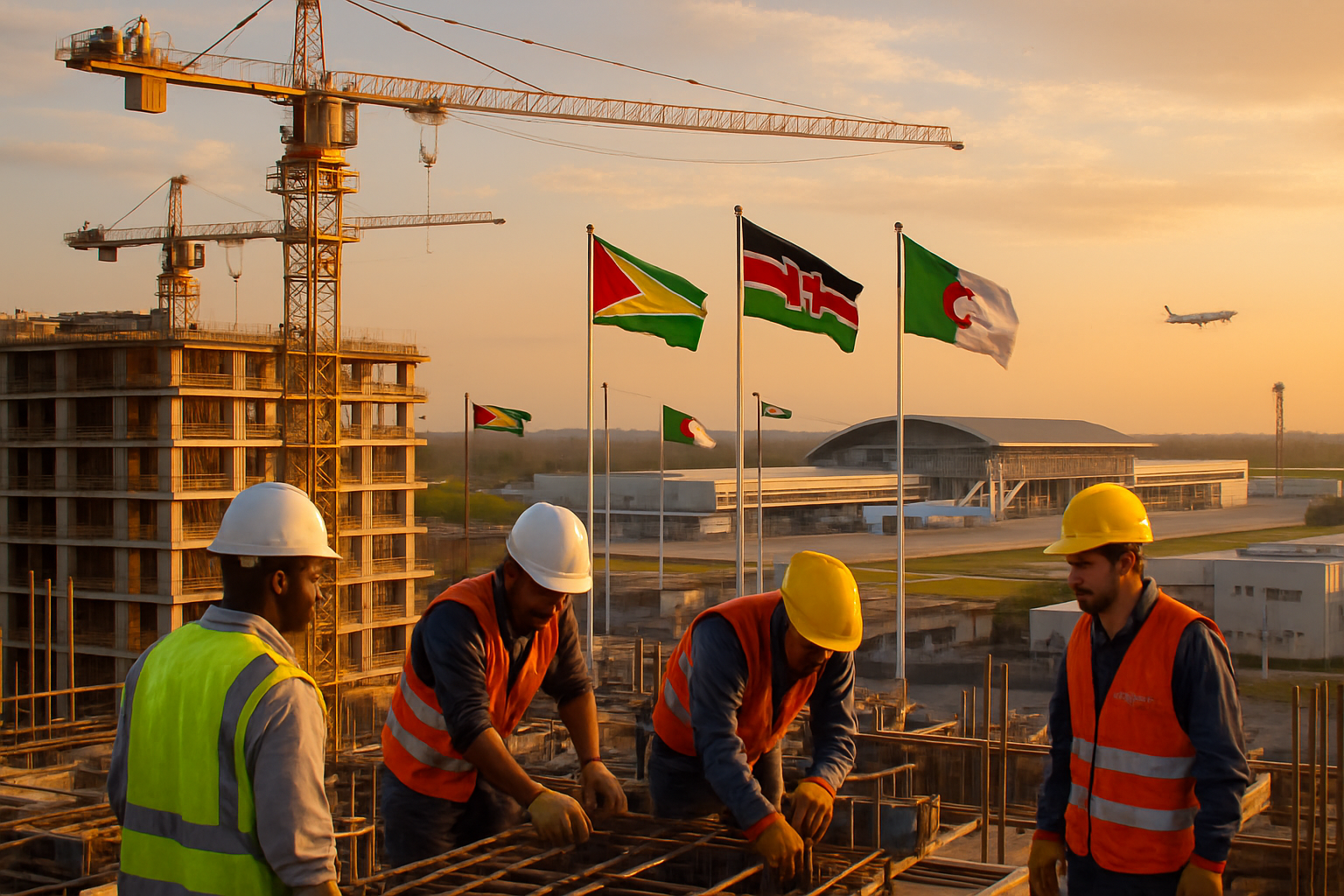
A coordinated wave of regional economic development projects spanning three continents demonstrates unprecedented international investment in infrastructure modernization, with Guyana launching a $63 billion resort complex, Kenya unveiling a 20-year airport transformation plan, and Algeria advancing automotive sector partnerships.
Guyana's Tourism Infrastructure Revolution
Foundation work has officially commenced on Guyana's most ambitious hospitality project - the Hilton-branded 256-room Georgetown Seafront Resort and Convention Centre. The GYD $63 billion investment represents one of the largest hospitality developments currently underway in the Caribbean region, secured under a 2025 Investment Agreement between Go-Invest and international developers.
The Georgetown Seafront Resort project positions Guyana to transform its tourism and business events landscape significantly. The development's scale and international branding through Hilton reflects growing confidence in Guyana's economic trajectory and its potential as a regional destination for both leisure and corporate travelers.
"This project marks a pivotal moment for Guyana's tourism sector, establishing our country as a world-class destination for international visitors and business events."
— Go-Invest Official Statement
Kenya's Aviation Modernization Initiative
Kenya has unveiled an ambitious 20-year masterplan for Jomo Kenyatta International Airport (JKIA) expansion and terminal modernization designed to significantly boost capacity and address decades of aging infrastructure challenges. The comprehensive development strategy aims to position JKIA as East Africa's premier aviation hub while alleviating chronic congestion issues.
The Kenya Airports Authority (KAA) expansion project represents a strategic response to growing passenger volumes and freight demands across the East African region. The modernization initiative incorporates cutting-edge airport management technologies and sustainable design principles to create a facility capable of serving projected passenger growth through 2045.
This infrastructure investment aligns with Kenya's broader economic development strategy, recognizing aviation connectivity as essential infrastructure for international trade, tourism growth, and regional integration within the African Continental Free Trade Area framework.
Algeria's Automotive Sector Partnership
Algeria's Stellantis subsidiary has signed a comprehensive partnership agreement with the Professional Training and Apprenticeship Center in Staouali, Algiers, targeting youth skills development and employment preparation within the automotive sector. The initiative represents a strategic approach to bridging the gap between vocational training and industry-specific workforce needs.
The partnership launched during February's professional training cycle opening, aims to sustainably connect vocational education with real automotive sector requirements. Stellantis Algeria will provide technical expertise and pedagogical support to instructors and educational administrators while enhancing curriculum content with practical industry applications.
This collaboration model demonstrates the evolution of international corporate engagement in workforce development, moving beyond traditional corporate social responsibility toward strategic partnerships that address specific skills shortages while building local capacity in high-value manufacturing sectors.
Global Context and Strategic Significance
These developments occur within the context of an unprecedented global infrastructure investment surge, with over $570 billion committed to transportation, hospitality, and economic development projects worldwide during 2026. The coordinated timing of these announcements reflects broader international recognition of infrastructure investment as essential for post-pandemic economic recovery and climate adaptation.
The diversity of approaches demonstrated across these three projects - luxury tourism infrastructure in Guyana, aviation capacity expansion in Kenya, and private-sector workforce development in Algeria - illustrates how different nations are leveraging their comparative advantages while addressing specific economic development priorities.
Regional integration benefits are evident across all three initiatives. Guyana's resort development strengthens Caribbean tourism competitiveness, Kenya's airport expansion supports East African economic integration, and Algeria's automotive training partnerships contribute to North African industrial development and Mediterranean economic cooperation.
Investment Models and Financing Innovation
The projects demonstrate sophisticated financing approaches combining international private investment, public-private partnerships, and strategic industry collaboration. Guyana's resort development utilizes international hotel brand partnerships with domestic investment promotion agencies, while Kenya's airport expansion represents public infrastructure modernization with potential private sector operational partnerships.
Algeria's Stellantis partnership exemplifies how multinational corporations are increasingly integrating workforce development into their operational strategies, creating sustainable talent pipelines while contributing to local economic development objectives.
These financing models reflect the maturation of international development cooperation, moving beyond traditional aid paradigms toward mutually beneficial partnerships that create sustainable economic opportunities while addressing specific infrastructure and capacity needs.
Technology Integration and Sustainability
Modern infrastructure projects increasingly incorporate smart technology systems, climate adaptation measures, and environmental sustainability as standard requirements rather than optional considerations. Kenya's airport expansion includes digital traffic management systems and renewable energy integration, while Guyana's resort development emphasizes environmental protection alongside economic development.
The integration of technology with traditional sectors, demonstrated through Algeria's automotive training partnership, reflects the global economy's evolution toward digitally-enhanced manufacturing and service delivery requiring sophisticated workforce development approaches.
Economic Multiplier Effects
Each project creates significant economic multiplier effects extending beyond immediate construction employment. Guyana's resort development will generate permanent hospitality sector employment while attracting international visitors and business events. Kenya's airport expansion improves regional connectivity, reducing transportation costs and enhancing market access for businesses across East Africa.
Algeria's training partnership creates skilled automotive sector employment while potentially attracting additional manufacturing investment through the availability of trained workers. These effects contribute to broader economic competitiveness and sustainable development objectives.
Implementation Challenges and Success Factors
Large-scale infrastructure projects face common implementation challenges including environmental compliance, community engagement, technical coordination, and sustained political commitment across project timelines. Success factors identified across multiple international projects include transparent governance frameworks, comprehensive stakeholder consultation, and adaptive management capabilities.
The diversity of approaches represented by these three projects provides resilience against single-solution dependencies while offering multiple models for adaptation in similar contexts worldwide. International cooperation and knowledge sharing enhance the likelihood of successful implementation and operation.
Future Development Trajectory
February 2026 represents a potentially pivotal moment in establishing infrastructure development patterns that will influence global economic competitiveness and regional cooperation for decades ahead. The integration of immediate economic needs with long-term sustainability requirements, demonstrated across these projects, establishes important precedents for balancing development objectives with environmental and social considerations.
The success of these initiatives could catalyze additional investment and international cooperation, creating positive development cycles that strengthen national capabilities while contributing to regional integration frameworks. As global economic challenges intensify, coordinated infrastructure investment represents a proactive approach to building resilience and prosperity through enhanced connectivity and capacity development.