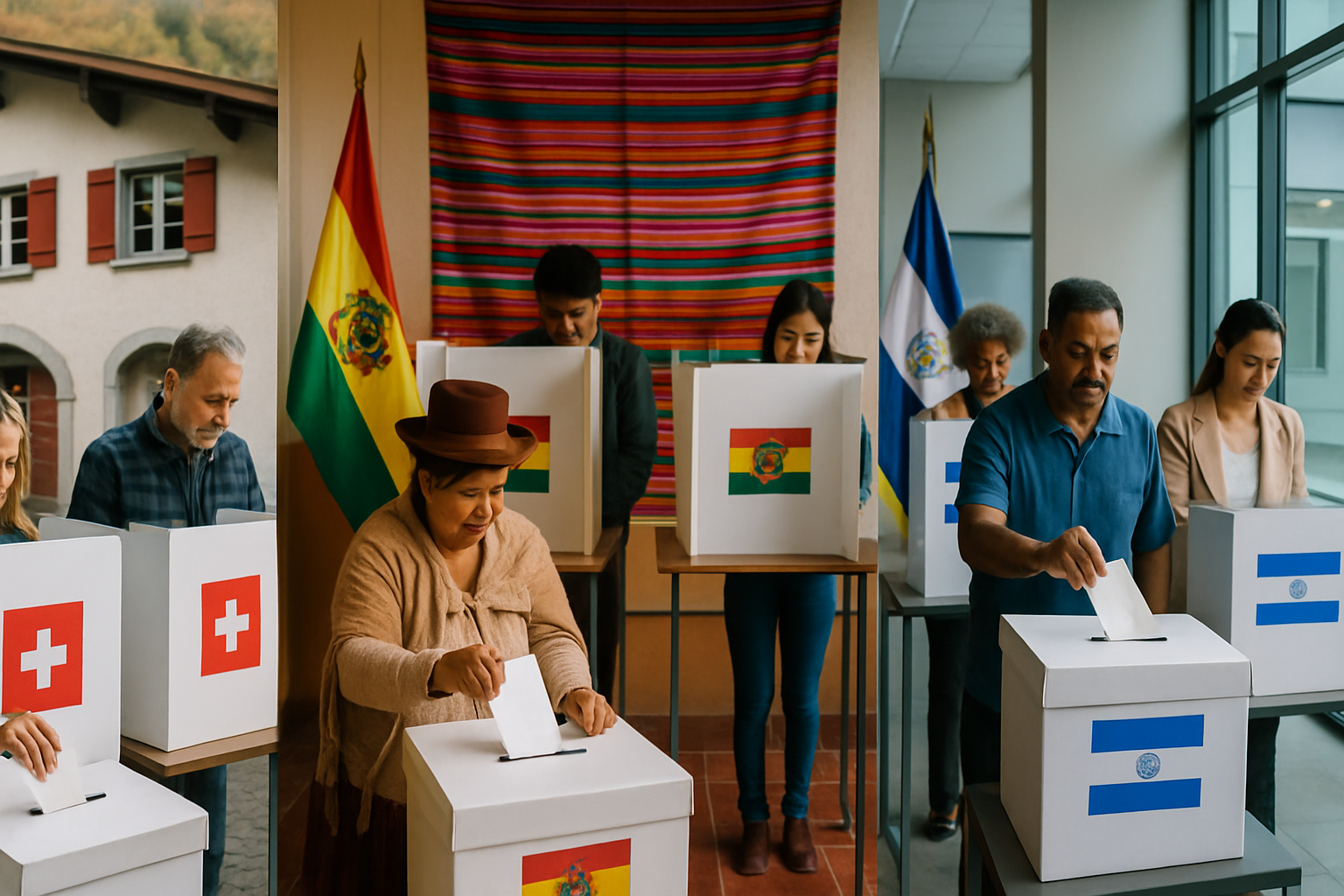
Regional and municipal elections across Bolivia, El Salvador, and Switzerland are revealing fundamental shifts in democratic participation and political representation, as traditional power structures face unprecedented challenges from fragmentation, institutional reform, and evolving voter expectations.
March 2026 has emerged as a pivotal month for democratic processes across diverse political landscapes, where subnational elections are serving as critical barometers for broader political transformations. From the Andean highlands to Central American capitals and Alpine municipalities, voters are navigating complex political terrain marked by institutional upheaval, generational change, and the persistent influence of both traditional and emerging political forces.
Bolivia's Political Fragmentation Creates Electoral Uncertainty
In Bolivia's La Paz department, the upcoming subnational elections present a dramatically transformed political landscape where traditional power structures have collapsed, leaving voters without clear ideological anchors. The disintegration of the Movement for Socialism (MAS), the dispersion of established elites, and the delegitimization of social movement leadership have dismantled the major identity-based political blocs that structured regional power competition for two decades.
This political vacuum has created what analysts describe as "anomie" - a state of normlessness where traditional political loyalties have dissolved without clear alternatives emerging. The dominant electoral logic has shifted to reactive voting, where citizens cast ballots against candidates rather than in favor of specific platforms or ideologies.
"What remains is a fragmented field without clear centers of gravity, where anomie coexists with the emergence of new discourses but lacks the organizational capacity to channel voter sentiment effectively."
— Political analyst quoted in La Razón
The collapse of MAS, which dominated Bolivian politics for over a decade under Evo Morales, has left a particularly significant void in La Paz and El Alto - traditionally strongholds of indigenous political representation. Without established leadership structures or coherent programmatic alternatives, the electoral landscape has become increasingly unpredictable, with multiple small movements competing for influence but lacking the institutional capacity to govern effectively.
El Salvador's Systematic Electoral Preparations Signal Institutional Renewal
Meanwhile, El Salvador's Supreme Electoral Tribunal (TSE) has taken a markedly different approach, emphasizing institutional preparation and legal compliance ahead of the 2027 general elections. The TSE issued official communications to all legally registered political parties, establishing clear deadlines and procedures for internal party elections - a foundational requirement for democratic participation.
Under the established Electoral Calendar 2027, political parties must convene their internal candidate selection processes by April 7, 2026, with internal elections completed no later than July 29, 2026. This systematic approach reflects lessons learned from previous electoral cycles and demonstrates institutional commitment to democratic transparency and legal compliance.
The emphasis on early preparation and clear procedural guidelines represents a significant evolution in Central American electoral administration, particularly given the region's history of contested elections and institutional fragility. El Salvador's approach provides a template for proactive electoral management that could influence regional best practices.
Switzerland Faces Critical Municipal Leadership Decisions
In Switzerland, the municipal elections in Zurich represent a different but equally significant democratic moment. The elections will determine which politicians will shape the city's direction for the next four years, with particular attention focused on whether current leadership can maintain continuity or if voters will demand fundamental change.
The Swiss electoral context highlights the importance of local governance in federal systems, where municipal decisions directly impact citizens' daily lives through urban planning, public services, and local economic development policies. Unlike the fragmented landscapes in Bolivia or the institutional focus in El Salvador, Swiss voters are evaluating specific policy outcomes and leadership effectiveness within established democratic frameworks.
Swiss municipal elections also serve as important indicators for national political trends, as local results often prefigure broader shifts in voter sentiment that emerge in subsequent cantonal and federal elections.
Comparative Democratic Challenges and Adaptations
These three electoral contexts reveal distinct but related challenges facing contemporary democratic systems. In Bolivia, the primary challenge is rebuilding institutional legitimacy and creating coherent political alternatives in a fragmented landscape. The absence of credible leadership has created space for populist appeals but also opportunities for innovative political movements that can address citizen concerns without relying on traditional power structures.
El Salvador's emphasis on procedural compliance and early preparation reflects lessons learned from regional electoral crises, demonstrating how institutional reform can strengthen democratic processes. The country's systematic approach to electoral administration provides stability that enables meaningful political competition within established legal frameworks.
Switzerland's municipal elections represent the challenges of maintaining democratic engagement in stable institutional environments, where voter decisions focus on policy effectiveness and leadership competence rather than fundamental regime questions.
Regional Implications for Democratic Governance
These electoral developments occur within broader patterns of democratic evolution across Latin America and Europe, where traditional political parties face pressure from changing voter expectations, economic challenges, and generational shifts in political participation.
The Bolivian case demonstrates the risks of political institutional collapse, where the absence of credible alternatives can lead to governance paralysis and voter alienation. This fragmentation creates opportunities for anti-system movements but also spaces for innovative political solutions that address citizen concerns more effectively than traditional structures.
El Salvador's institutional approach provides a counterexample, showing how proactive electoral administration can create stability that enables meaningful political competition. The country's emphasis on legal compliance and procedural transparency establishes foundations for democratic legitimacy that transcend specific electoral outcomes.
Switzerland's municipal focus highlights the continuing importance of local democracy in addressing citizen concerns, even in highly developed political systems where national institutions function effectively.
Future Trajectories and Democratic Resilience
The outcomes of these regional elections will provide crucial insights into the adaptive capacity of democratic institutions under different types of stress. Bolivia's elections will test whether fragmented political landscapes can produce effective governance or whether institutional collapse creates longer-term democratic risks.
El Salvador's systematic approach to electoral preparation may establish regional best practices for electoral administration, particularly if the 2027 elections demonstrate improved democratic legitimacy and institutional credibility.
Swiss municipal results will indicate whether established democratic systems can maintain citizen engagement and effective governance amid global pressures for political change and institutional reform.
"These elections represent more than routine democratic exercises - they are testing grounds for institutional adaptation and political innovation under diverse pressures facing contemporary democracies worldwide."
— International election monitoring expert
The convergence of these electoral contexts in March 2026 provides a unique opportunity to observe how different democratic systems adapt to contemporary challenges. While each nation faces distinct political circumstances, their experiences offer valuable insights into the resilience and adaptability of democratic institutions across diverse cultural, economic, and institutional contexts.
The success or failure of these regional elections will influence broader discussions about democratic governance, institutional reform, and political representation in an era of rapid social and economic change. Their outcomes will be closely watched by political scientists, policymakers, and citizens concerned with the future of democratic participation and effective governance in the 21st century.