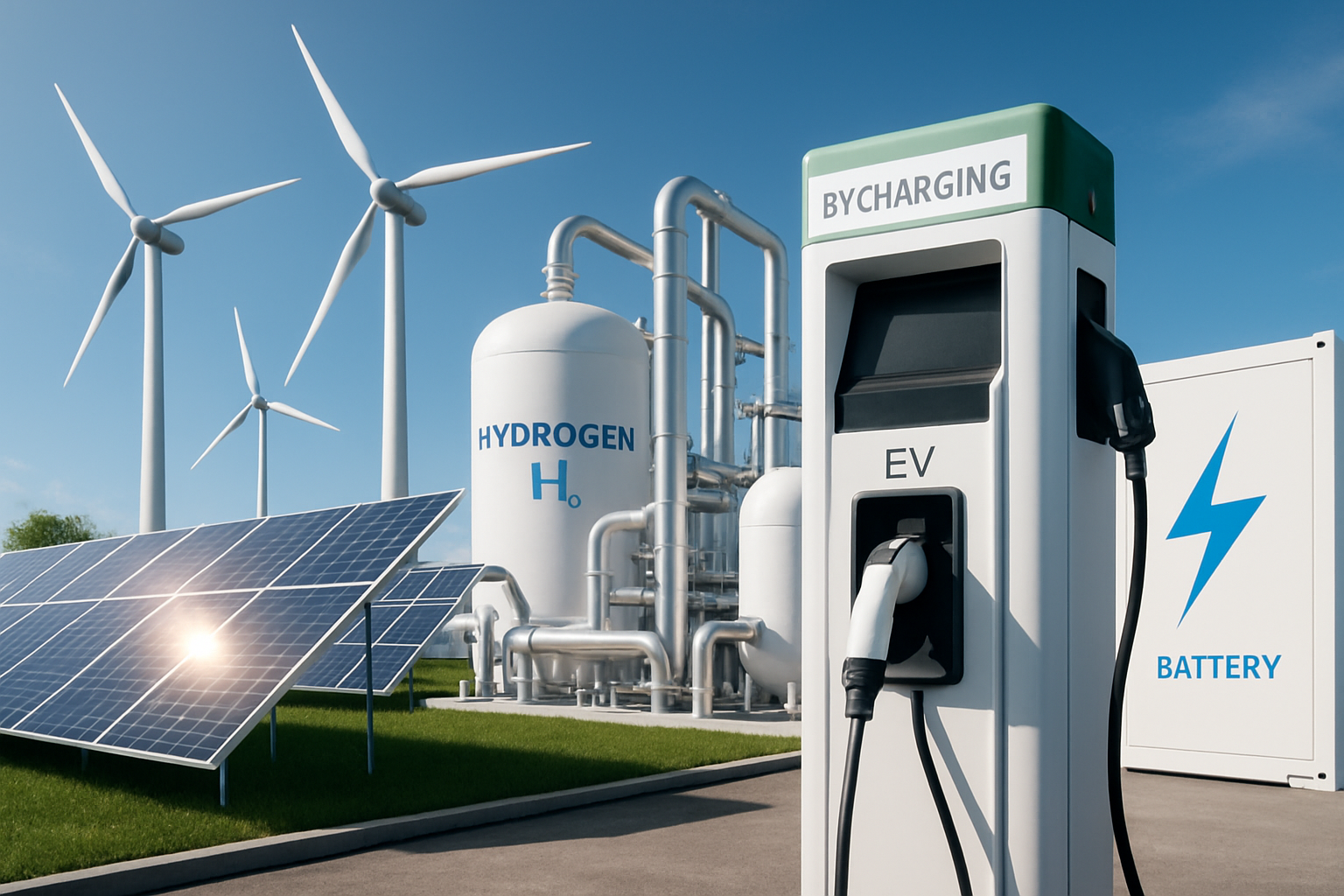
A wave of groundbreaking renewable energy initiatives across three continents is reshaping the global clean energy landscape, with Hungary's nuclear power milestone, Portugal's innovative storage breakthrough, and Uganda's electric cooking revolution demonstrating the accelerating transformation toward sustainable energy systems.
Hungary's Nuclear Renaissance Reaches Construction Milestone
Hungary achieved a critical nuclear energy milestone with the official commencement of construction on the Paks II nuclear power plant, marking Europe's largest nuclear construction project and a decisive step in the continent's nuclear renaissance. The pouring of the first concrete has elevated the project's status under International Atomic Energy Agency (IAEA) standards to that of a nuclear power plant under construction.
Hungarian Foreign and Trade Minister Péter Szijjártó emphasized the government's strategic foresight during Thursday's ceremony, noting that Hungary had committed to nuclear expansion during a period when nuclear energy faced political ostracism across much of Europe. This decision now positions Hungary at the forefront of Europe's renewed embrace of nuclear technology as a cornerstone of carbon-neutral energy strategies.
"This project represents not only a guarantee for reducing ancillary costs but also serves as the flagship of Europe's nuclear renaissance."
— Péter Szijjártó, Hungarian Foreign and Trade Minister
The Paks II initiative occurs within a broader context of global energy transition challenges, including warnings from EU auditors about critical materials shortages that threaten renewable energy scaling. China's dominance in controlling 60% of global production and 90% of refining capacity for essential materials like lithium, cobalt, and rare earth elements has created supply chain vulnerabilities that nuclear energy can help address.
Portugal's Revolutionary Water-Air Energy Storage
Meanwhile, Portuguese researchers have achieved a technological breakthrough with the development of an innovative energy storage system that could revolutionize renewable energy reliability. The startup KeepIt, originating from the Faculty of Sciences at the University of Lisbon, has created a pioneering system using compressed air and water to store energy, offering a sustainable alternative to traditional battery storage solutions.
This water-air "battery" technology represents a significant advancement in addressing one of renewable energy's primary challenges: intermittency. By utilizing abundant natural resources—water and air—the system provides a cost-effective and environmentally sustainable method for storing energy generated during peak renewable production periods for later use during demand spikes or low generation periods.
The Portuguese innovation comes at a critical time as European nations seek energy storage solutions that reduce dependence on Chinese-controlled battery materials. Estonia recently opened continental Europe's largest battery storage facility with capacity to serve 90,000 households, while Austria achieved 88% renewable electricity production in 2024, demonstrating the continent's commitment to renewable integration despite supply chain challenges.
Uganda's Electric Cooking Revolution
In East Africa, Uganda is pioneering a transformative approach to household energy through the launch of affordable financing for electric cooking technologies. Equity Bank Uganda, in partnership with UKAID and the Ministry of Energy, has introduced the Modern Energy Cooking Services (MECS) Trust Fund, aimed at accelerating the adoption of eCooking products and technologies throughout the country.
This initiative addresses multiple sustainability challenges simultaneously: reducing deforestation pressure from traditional biomass cooking, improving indoor air quality for households, decreasing carbon emissions, and creating new economic opportunities in the clean energy sector. The program represents a shift from subsidy-dependent models to market-driven financing solutions that make electric cooking accessible to Uganda's diverse economic demographics.
The electric cooking revolution aligns with broader African energy transformation trends, including record investments in renewable energy infrastructure. Recent developments across the continent include Burkina Faso's record 94-ton gold production generating over $6 billion in revenue, Ivory Coast's approval of gold mining projects worth $1.2 billion, and South Africa's R325 million commitment to rare earth element extraction.
Global Context and Strategic Implications
These developments unfold against the backdrop of January 2026 being recorded as the hottest month in global history, with 18 of the past 19 months exceeding 1.5°C above pre-industrial levels. This climate urgency has accelerated international cooperation on renewable energy initiatives, despite supply chain vulnerabilities and geopolitical tensions.
The US-EU-Japan alliance, involving 55 countries, has emerged as a coordinated response to Chinese dominance in critical minerals sectors. Japan's breakthrough in deep-sea mining at Minamitorishima, extracting rare earth elements at 6,000-meter depth with concentrations 20 times higher than terrestrial mines, exemplifies innovative approaches to supply chain diversification.
Technology Integration and Innovation
The renewable energy surge demonstrates sophisticated integration of traditional and cutting-edge technologies. Hungary's nuclear expansion incorporates Russia's latest VVER reactor technology with advanced safety systems, digital monitoring, and robotics assembly, providing stable baseload electricity that complements weather-dependent renewables.
Portugal's water-air storage system represents breakthrough thinking in energy storage, moving beyond lithium-ion battery dependence toward sustainable, locally sourced solutions. Uganda's electric cooking financing model demonstrates how financial innovation can accelerate technology adoption in developing economies where traditional infrastructure investment models have proven insufficient.
These projects incorporate smart grid management systems, advanced storage technologies, and efficiency optimization designed for climate resilience. Romania's combination of traditional natural gas with cutting-edge battery storage provides a transition pathway that maintains energy security while building renewable capacity.
Economic and Social Impact
The renewable energy transformation creates significant economic multiplier effects across different development contexts. Hungary's nuclear project will generate over $39.1 billion in orders for Russian companies throughout its operational stage, lasting through the start of the 22nd century, while creating thousands of specialized jobs and providing stable high-paying employment over a century-plus operational lifetime.
Portugal's innovation ecosystem, supported by university research and private sector collaboration, demonstrates how knowledge-based economies can lead global technology development. Uganda's electric cooking initiative creates new value chains in appliance sales, maintenance services, and electrical infrastructure development while improving health outcomes through reduced indoor air pollution.
Challenges and Opportunities
Implementation challenges remain significant across all three initiatives. Hungary faces geopolitical tensions over Russian energy cooperation despite IAEA backing. Portugal must scale innovative technology from research prototype to commercial viability. Uganda requires substantial electrical grid infrastructure development to support widespread electric cooking adoption.
However, these challenges are creating opportunities for international cooperation and technology transfer. The Critical Minerals Ministerial in Washington D.C. brought together African resource suppliers with developed economies seeking supply chain diversification. Sweden-Denmark provided €246 million in assistance packages, while multiple bilateral agreements emerged between the US and countries like Guinea and Morocco.
Future Implications and Global Transformation
The convergence of nuclear renaissance, innovative storage solutions, and electrification financing represents a fundamental shift toward energy independence and supply chain diversification. These initiatives demonstrate that effective global climate action requires diverse approaches addressing local needs while contributing to global decarbonization goals.
Success depends on sustained international cooperation, technological innovation, economic viability, and adaptation capability. The diversity of approaches—from advanced nuclear technology to compressed air storage to microfinance-enabled electrification—provides resilience against single-solution dependencies that have characterized previous energy transitions.
As extreme weather events increase in frequency and intensity, these renewable energy initiatives provide essential infrastructure for climate adaptation. Estonia's record electricity consumption during the coldest winter in 25 years, Cuba's massive blackouts affecting 3.4 million people, and Arctic weather patterns killing over 140 people since late January underscore the critical importance of resilient, diversified energy systems.
The February 2026 renewable energy surge across Hungary, Portugal, and Uganda represents more than technological progress—it signals a coordinated global response to climate change that balances immediate energy security needs with long-term sustainability goals through innovation, cooperation, and adaptive management strategies.