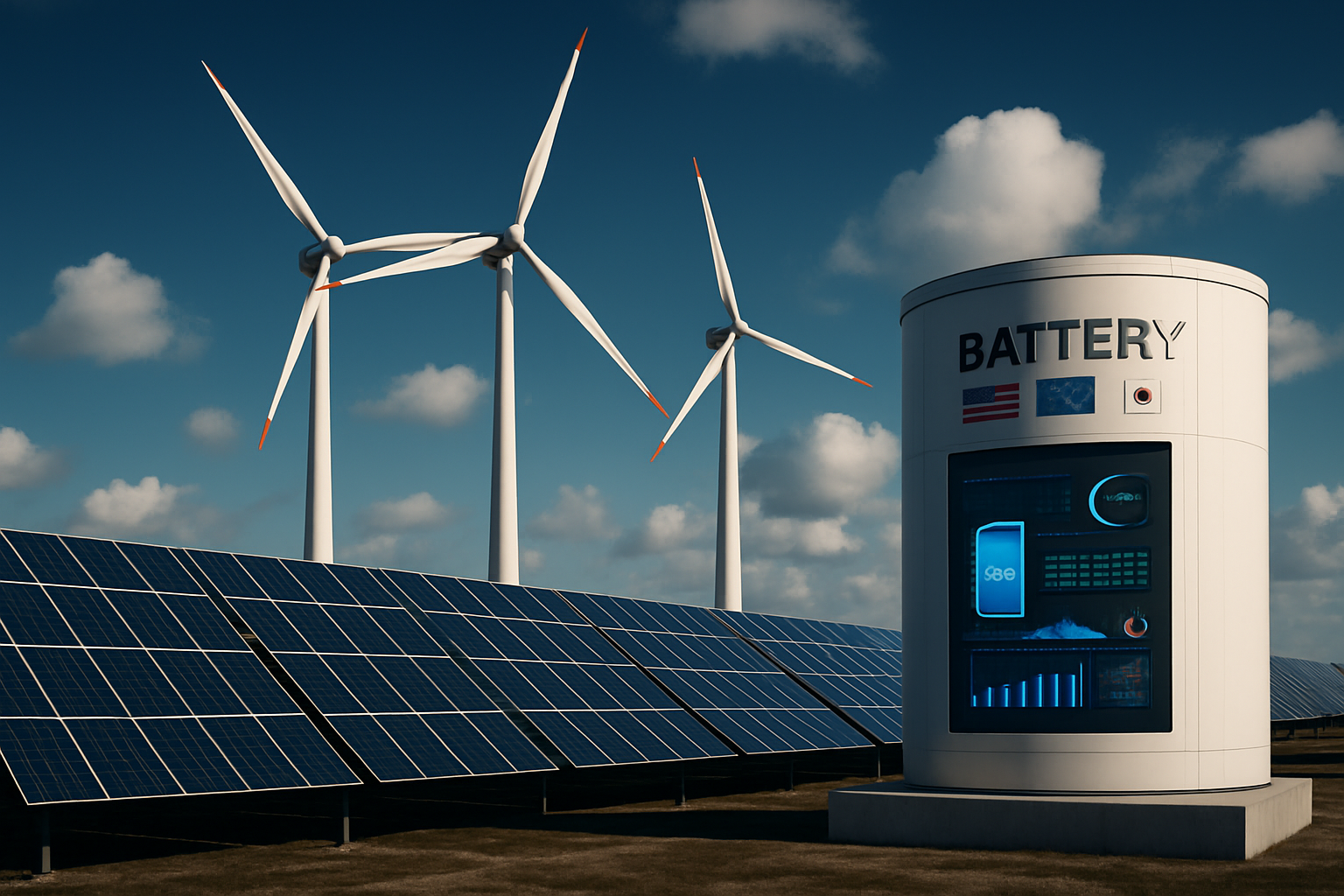
A comprehensive analysis of renewable energy developments across Azerbaijan, China, and Spain reveals an unprecedented acceleration in clean energy deployment driven by mounting global fuel crisis pressures and technological breakthroughs that are fundamentally reshaping the international energy landscape.
Azerbaijan Sets Regional Energy Storage Precedent
Azerbaijan has emerged as a pioneering force in regional energy transformation through the establishment of large-scale energy storage centers representing the first deployment of battery energy storage technology at such magnitude across the Commonwealth of Independent States (CIS) region.
The country has successfully commissioned energy storage facilities with a combined capacity of 250 MW and 500 MWh at the 500 kV Absheron and 220 kV Agdash substations, financed entirely through domestic resources. This achievement positions Azerbaijan as both an early adopter and emerging regional frontrunner in grid modernization technologies during a critical period of global energy transition.
"This represents the first deployment of battery energy storage at such scale across the CIS region, positioning Azerbaijan as an adopter as well as an emerging regional frontrunner in grid modernization technologies."
— AzerNews Energy Analysis
The strategic significance of Azerbaijan's energy storage breakthrough extends beyond technical achievement. The country has established itself as a U.S. Chamber of Commerce-recognized East-West energy coordinator, with current annual U.S. trade valued at $74.9 million and massive expansion potential from $27.2 billion in global exports. Azerbaijan achieved remarkable economic diversification with non-oil GDP representing 52.7% of total output as of December 2025, providing a foundation for sustainable renewable investment beyond traditional energy exports.
China Capitalizes on Global Energy Transition
China's strategic positioning in the global renewable energy market has reached a critical inflection point as oil-shocked nations worldwide accelerate their transition to clean energy sources. The ongoing Iran war's oil shock has dramatically increased security risks for oil-dependent countries, creating unprecedented incentives for renewable energy adoption that will outlast current price spikes.
China maintains strategic dominance through controlling 60% of global critical materials production and 90% of refining capacity for lithium, cobalt, and rare earth elements essential for renewable infrastructure. This supply chain control enables technological leadership and positions Chinese renewable exports to perform exceptionally well during 2026, potentially offsetting losses from higher-priced oil imports.
The geopolitical implications are profound, as a fifth of global oil supply and liquefied natural gas plus a third of seaborne fertilizers traditionally flow through regions now experiencing conflict-related disruptions. This creates sustained demand for Chinese renewable technology and energy storage solutions that extends far beyond immediate crisis responses.
Spain Confronts Grid Modernization Challenges
Spain faces a critical juncture in its renewable energy transformation as experts and industry executives urgently call for grid infrastructure "synchronization" with the country's renewable energy explosion. The challenge involves balancing Spain's potential as a renewable energy "gold mine" against investment bottlenecks threatening to constrain deployment.
Spanish energy leaders emphasize the need to coordinate grid infrastructure development with rapid renewable capacity expansion while addressing concerns that electricity faces disproportionately higher taxation compared to natural gas. This policy asymmetry complicates the economic case for electrification despite Spain's abundant renewable resources.
During the sixth Economic Forum discussions, industry representatives highlighted the urgent requirement for infrastructure investment to match Spain's renewable potential. The country's geographic advantages and technological capabilities position it as a potential renewable energy export hub for Europe, but only if grid modernization keeps pace with generation capacity expansion.
Global Supply Chain Vulnerabilities Expose Critical Dependencies
The renewable energy acceleration occurs against a backdrop of severe supply chain vulnerabilities that threaten long-term sustainability goals. China's dominance in critical materials processing creates strategic dependencies that the U.S.-EU-Japan Critical Minerals Partnership, involving 55 countries and seven African alternative suppliers, is attempting to address through massive diversification investments.
Memory chip shortages have driven semiconductor prices to sixfold increases, affecting renewable control systems and smart grid infrastructure until 2027 when new fabrication facilities come online. These disruptions highlight the complex technological dependencies underlying modern renewable energy systems and the need for more resilient supply chain architectures.
Climate Urgency Accelerates Policy Response
The renewable energy surge occurs during unprecedented climate conditions, with January 2026 marking the 19th consecutive month of global temperatures exceeding 1.5°C above pre-industrial levels. This sustained warming demonstrates human-induced climate change fundamentally overriding natural variability, creating additional urgency for rapid clean energy deployment.
Estonia maintains European renewable leadership with 88% renewable electricity generation and continental Europe's largest battery storage facility serving 90,000 households, providing a template for successful renewable integration. The Estonian model demonstrates that comprehensive renewable systems can maintain grid stability and energy security even during extreme weather conditions.
Economic Transformation Through Energy Innovation
The convergence of renewable technology advancement, supply chain pressures, and climate urgency is creating profound economic transformation opportunities. Countries implementing comprehensive renewable strategies demonstrate enhanced economic resilience and attract sustainable investment across multiple sectors including clean technology manufacturing, energy storage systems, and grid infrastructure development.
International cooperation frameworks are evolving from traditional North-South aid models toward peer-to-peer collaboration, with developing nations emerging as renewable energy solution providers leveraging indigenous knowledge, abundant renewable resources, and innovative governance approaches. This shift represents a fundamental change in global energy geopolitics toward greater energy independence and supply chain diversification.
Technology Integration Drives Innovation
Modern renewable energy projects demonstrate sophisticated integration of cutting-edge technology with traditional energy management approaches. Digital monitoring, smart grid management, automated efficiency systems, and predictive maintenance capabilities enable precise optimization of renewable energy integration while maintaining power system reliability.
The technological evolution includes advanced materials science, robotics assembly, AI-powered optimization, and cybersecurity measures that have become standard requirements for renewable infrastructure. Weather-resistant materials, enhanced drainage systems, and backup capabilities are designed to handle extreme weather events with increasing frequency due to climate change.
Implementation Challenges and Opportunities
Despite technological advances and increasing economic viability, renewable energy deployment faces significant implementation challenges. Funding sustainability remains critical for developing nations where immediate economic pressures can override long-term environmental considerations. Technical capacity building requires sustained investment in education, training, and institutional development.
Climate change continues disrupting project timelines, requiring adaptive management approaches that can respond to rapidly changing environmental conditions. However, the diversity of renewable approaches provides resilience against single-solution dependencies, offering multiple pathways for addressing complex energy challenges across different economic and geographic contexts.
Strategic Implications for Global Energy Security
The March 2026 renewable energy developments represent a critical juncture in global energy transformation where crisis-driven demand converges with technological readiness and policy innovation. The success of comprehensive renewable energy strategies could catalyze additional projects throughout respective regions, demonstrating that clean energy transitions are achievable across different economic and political contexts.
Energy infrastructure investments are creating economic multiplier effects spanning construction, manufacturing, and operational sectors with long-term competitiveness benefits through reduced energy costs and enhanced energy independence. The integration of cutting-edge technology with practical solutions offers hope for meeting urgent climate action demands while supporting economic development and energy security.
The window for effective climate action continues narrowing as ecological systems approach critical thresholds, but the technological innovation, international cooperation, and policy coordination emerging in March 2026 provide genuine opportunities for maintaining planetary sustainability during Earth's most environmentally challenging recorded period. Success depends on sustained international cooperation, enhanced multi-sector coordination, and financial commitments recognizing renewable energy infrastructure as essential for human prosperity and planetary sustainability.