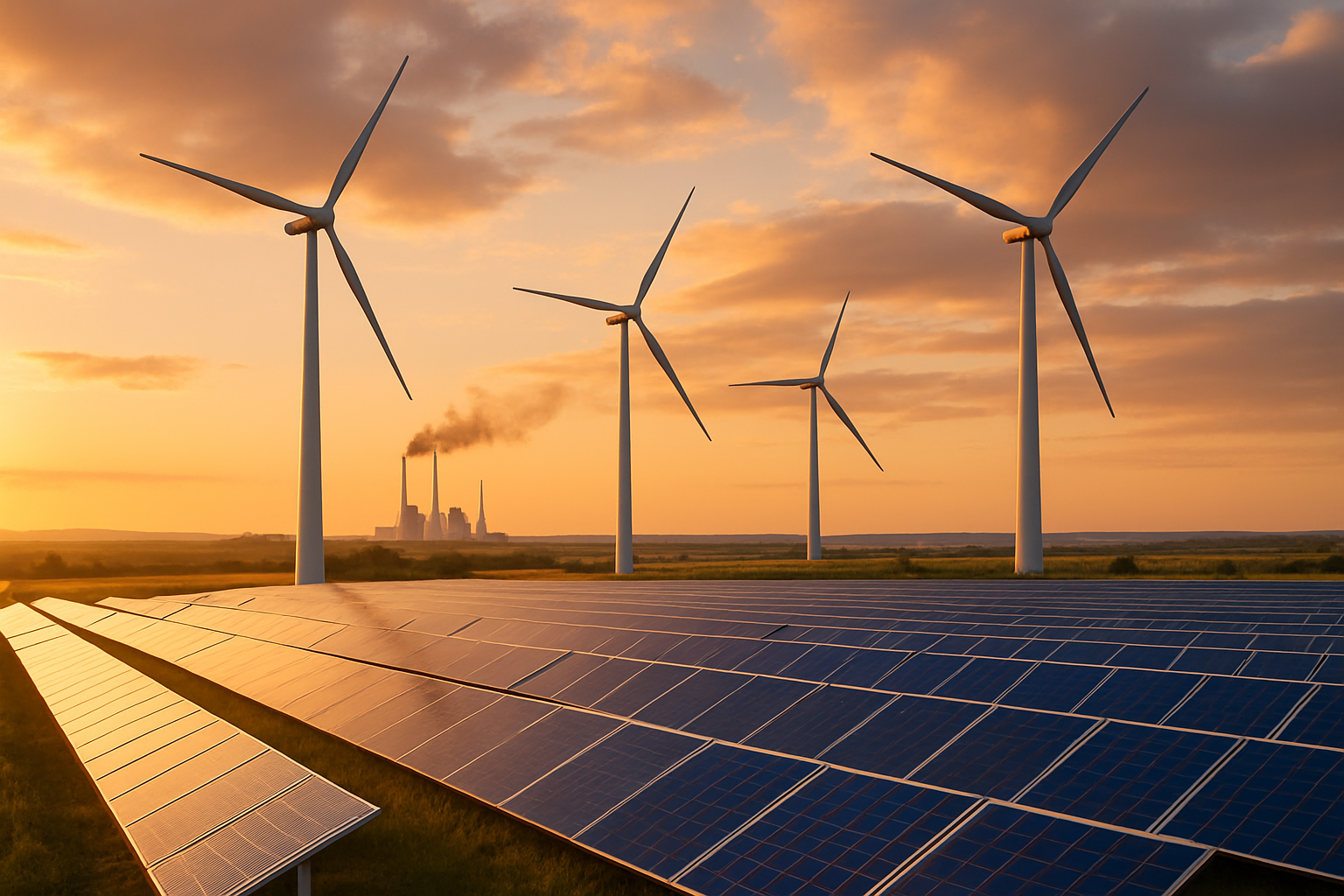
For the first time in more than a century, global electricity generation from renewable energy sources has surpassed coal-fired power plants in 2025, marking a historic turning point in the world's energy transition and climate fight, according to a landmark report from London-based energy think tank Ember.
The milestone represents a fundamental shift in how the world powers itself, with renewable sources including solar, wind, and hydroelectric power collectively generating more electricity than coal for the first time since the industrial age began. The achievement comes as renewable installations experienced unprecedented growth, successfully meeting 100% of the world's rising electricity demand in 2025.
Solar Power Leads the Energy Revolution
Solar energy emerged as the primary driver of this historic transformation, experiencing rapid deployment across continents as costs continued to plummet. The technology has become the most economical choice for new electricity generation worldwide, with installations accelerating dramatically throughout 2025.
Spanish energy markets demonstrated this solar surge, with renewable capacity additions enabling the country to meet soaring electricity demands while reducing dependence on fossil fuels. The growth pattern reflects a global phenomenon where declining costs and improving efficiency have made renewables increasingly attractive to both utilities and consumers.
"This is the beginning rather than the end of the energy transition. The window for effective climate action is narrowing, but this milestone provides a template for scaling clean energy transformation globally."
— Ember Energy Think Tank Analysis
Overcoming Infrastructure Challenges
The renewable energy surge occurred despite significant supply chain challenges that threatened to slow deployment. China's dominance over critical mineral production—controlling 60% of global production and 90% of refining capacity for lithium, cobalt, and rare earth elements—created vulnerabilities in renewable infrastructure scaling.
To address these dependencies, the US-EU-Japan Critical Minerals Partnership, involving 55 countries and seven African suppliers, is coordinating efforts to diversify supply chains. However, these alternative sources require massive infrastructure investment and years of development time.
Memory chip shortages have also driven prices up sixfold, affecting smart grid systems and renewable control technologies. These constraints are expected to persist until new fabrication facilities come online in 2027.
Climate Context Adds Urgency
The renewable milestone comes during an unprecedented period of global warming, with January 2026 marking the 18th consecutive month that global temperatures exceeded 1.5°C above pre-industrial levels—the longest sustained warming streak in recorded history. This sustained warming demonstrates that human-induced climate change has fundamentally altered atmospheric systems beyond natural recovery mechanisms.
The International Energy Agency (IEA) requires a tripling of renewable capacity by 2030 to meet climate targets, creating enormous pressure on already-constrained supply chains. The 2025 achievement provides hope that such acceleration is possible with sustained international cooperation and investment.
Regional Leadership and Success Stories
Several regions have emerged as renewable energy leaders, providing templates for global deployment. Estonia achieved 88% renewable electricity generation alongside continental Europe's largest battery storage facility serving 90,000 households, demonstrating that high renewable penetration is achievable with proper grid management.
The success stories extend beyond technology to encompass sophisticated integration of cutting-edge renewable systems with traditional energy management approaches. Modern renewable projects now incorporate real-time monitoring, predictive maintenance, AI-powered optimization, and automated operations from the design phase.
Economic Transformation Engine
The renewable transition is functioning as an economic development strategy rather than a regulatory burden. Digital infrastructure investments provide $3-4 returns per dollar over a decade, while renewable energy deployment creates both construction and permanent operational employment opportunities.
Countries implementing comprehensive renewable protection strategies demonstrate greater economic resilience and attract sustainable investment across multiple sectors, including green technology manufacturing, eco-tourism, and environmental services. The economic multiplier effects often exceed traditional extractive industries while building competitiveness in clean technology markets.
International Cooperation Evolution
The 2025 milestone reflects an evolution in international cooperation, with South-South frameworks expanding as developing nations emerge as environmental solution providers rather than aid recipients. Technology transfer mechanisms are supporting rapid infrastructure scaling while respecting local autonomy and cultural priorities.
Knowledge sharing has created global networks that strengthen local capacity while contributing to planetary sustainability. The diversity of approaches provides resilience against single-solution dependencies, offering multiple adaptation pathways for addressing complex environmental challenges.
Looking Ahead: The Road to 2030
While the 2025 achievement represents a historic breakthrough, experts emphasize this is just the beginning of the necessary energy transformation. The window for effective climate action continues to narrow as ecological systems approach critical thresholds that could trigger potentially irreversible changes.
Success depends on sustained international cooperation, enhanced coordination between sectors, and increased financial commitments that recognize environmental protection as essential infrastructure for human prosperity and planetary sustainability.
The tools, knowledge, and cooperation frameworks exist for comprehensive energy transformation, as demonstrated by the renewable energy surge of 2025. The challenge now lies in scaling these solutions rapidly enough to match the pace of environmental change during what many experts consider the decisive climate action decade.