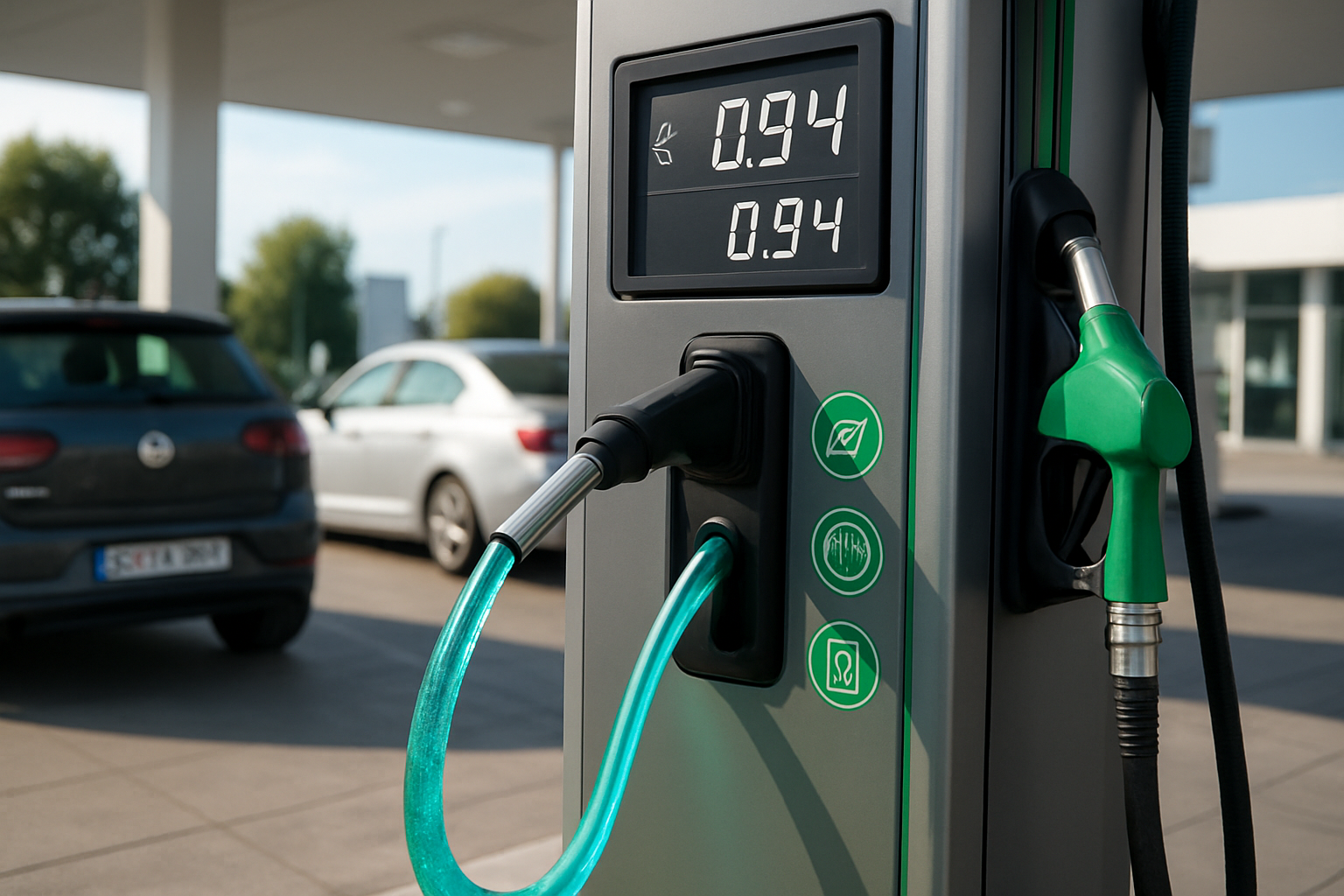
A revolutionary liquid fuel technology promising costs under €1 per liter while delivering substantial environmental benefits is emerging as a potential game-changer for the automotive industry, arriving at a critical moment when traditional fuel markets face unprecedented volatility and supply chain disruptions.
The new fuel technology, characterized by its "clearly positive environmental footprint" and significant cost advantages compared to traditional gasoline, represents a major breakthrough in alternative fuel development. Current market conditions have created an ideal environment for adoption, with Brent crude oil surging to $119.50 and WTI reaching $108.15 - the first breach of $100 per barrel since 2022.
Market Context and Timing
The fuel innovation emerges against a backdrop of severe global energy disruption. Iran's closure of the Strait of Hormuz, which handles 40% of global oil transit, has created what industry analysts describe as the "most severe energy security crisis in decades." This geopolitical instability has driven fuel prices to crisis levels across Europe, with some regions approaching €3 per liter for traditional gasoline.
The timing couldn't be more strategic. European consumers face mounting pressure from rising energy costs, while governments implement emergency measures to control fuel prices. Austria has introduced comprehensive fuel price brake systems, Romania has prepared five scenarios to prevent diesel from exceeding 10 lei per liter, and Hungary has implemented immediate price caps to counter "war-driven price explosions."
Environmental and Economic Advantages
The new liquid fuel technology offers a dual advantage that traditional alternatives have struggled to achieve: genuine environmental benefits coupled with economic accessibility. Unlike many green technologies that command premium pricing, this innovation positions itself as both environmentally responsible and financially attractive to consumers.
"The basic advantage is found in its clearly positive environmental footprint, while in the current phase it is also significantly more economical compared to traditional gasoline."
— Industry Analysis Report
This combination addresses two critical barriers that have historically limited alternative fuel adoption: cost competitiveness and environmental impact. Previous attempts at fuel alternatives often required consumers to choose between economic and environmental considerations, limiting mass market appeal.
Industry Transformation Context
The automotive sector is experiencing what experts describe as the most significant transformation in modern history. Electric vehicle adoption has accelerated dramatically, with used EVs now cheaper than gasoline vehicles across European markets due to soaring fuel costs. However, infrastructure limitations and range anxiety continue to create adoption barriers, particularly in rural areas and for long-distance travel.
This liquid fuel technology could serve as a crucial bridge solution, offering immediate environmental and economic benefits without requiring the extensive infrastructure overhaul needed for full electrification. The technology would work with existing fuel distribution systems and vehicle engines, potentially with modifications.
Supply Chain and Production Challenges
The development comes as traditional automotive fuel systems face unprecedented supply chain disruptions. China controls approximately 60% of critical materials production and 90% of refining capacity for lithium, cobalt, and rare earth elements essential for electric vehicle batteries. Memory chip shortages have driven semiconductor prices six times higher, affecting everything from vehicle control systems to smart fuel pumps.
Regional manufacturing strategies are emerging as companies establish production closer to primary markets, reducing transportation costs and supply chain vulnerabilities. The US-EU-Japan Critical Minerals Partnership, involving 55 countries and 7 African suppliers, seeks supply chain diversification, but requires years of infrastructure development.
Global Energy Crisis Impact
The fuel innovation emerges during what the International Energy Agency describes as requiring the largest strategic petroleum reserve release in 50-year history - 400 million barrels from 32 countries. Japan is releasing 80 million barrels for the first time since the 2011 Fukushima disaster, highlighting the severity of current supply disruptions.
Consumer impact has been immediate and severe across Europe. Sweden faces electricity increases of 10-20 öre and gasoline increases of 1-2 kronor, with Malmö most exposed due to continental integration. Ireland has seen "brazen rip-off" heating oil and motor fuel price increases, while Austria reports fuel cost increases of 20%.
Technology Integration and Infrastructure
Modern fuel systems increasingly incorporate sophisticated technology from the design phase, including real-time monitoring, predictive maintenance, digital payments, and environmental optimization. The new liquid fuel technology would benefit from this existing infrastructure while potentially requiring specific handling or processing equipment.
Climate adaptation has evolved from optional to mandatory requirement, with enhanced drainage, weather-resistant materials, and backup power systems designed for future rather than historical climate conditions. January 2026 marked the 18th consecutive month of temperatures exceeding 1.5°C above pre-industrial levels, emphasizing the urgency of environmental solutions.
Market Dynamics and Competition
The automotive fuel market is experiencing fundamental disruption beyond traditional gasoline-electric competition. Chinese manufacturers have achieved technological breakthroughs like BYD's Megawatt Flash Charging system, delivering 400km range in 5 minutes, while maintaining dominance in critical supply chains.
European manufacturers are seeking Brussels financial support to compete with Chinese alternatives, while battery longevity studies show Tesla Model S vehicles from 2012-2014 retaining 85-92% capacity after 200,000+ miles, supporting robust used EV markets with 15-20 year practical lifespans.
Government Policy and Regulatory Response
European governments are implementing comprehensive responses to energy challenges. Estonia leads with 88% renewable electricity and continental Europe's largest battery storage system serving 90,000 households. Austria has doubled EV charging capacity with 1,000 additional stations, while New Zealand invested $50 million doubling its charging network through ChargeNet and Meridian Energy.
However, infrastructure constraints persist. Urban-rural adoption disparities continue, with homeowners and rural residents advantaged through home charging capabilities versus apartment dwellers facing infrastructure barriers. The new liquid fuel could address these geographical and socioeconomic disparities.
Strategic Implications
This fuel technology represents more than an incremental improvement - it could fundamentally alter the trajectory of automotive energy transition. Rather than forcing a binary choice between traditional fuels and electric vehicles, it offers a third pathway that combines immediate environmental benefits with economic accessibility.
The technology arrives during what analysts describe as a "watershed moment" where crisis-driven demand converges with technological readiness, creating conditions for mass adoption acceleration. Success could provide a template for energy transitions that balance environmental urgency with practical implementation constraints.
Future Outlook
Industry transformation requires coordination across energy systems, infrastructure development, materials supply chains, and regulatory frameworks during the most significant automotive change in modern history. The window for effective action is narrowing, but technological innovation, economic incentives, and policy coordination offer opportunities for maintaining planetary habitability through transportation transformation.
March 2026 represents a critical inflection point where experimental technologies transition to essential infrastructure. The success of innovations like this liquid fuel technology will help determine whether the automotive industry can achieve environmental goals while maintaining economic accessibility and social mobility for diverse populations worldwide.
As governments, companies, and consumers navigate unprecedented energy challenges, solutions that combine environmental responsibility with economic viability may prove essential for achieving sustainable transportation transformation at the scale and speed required by climate realities.