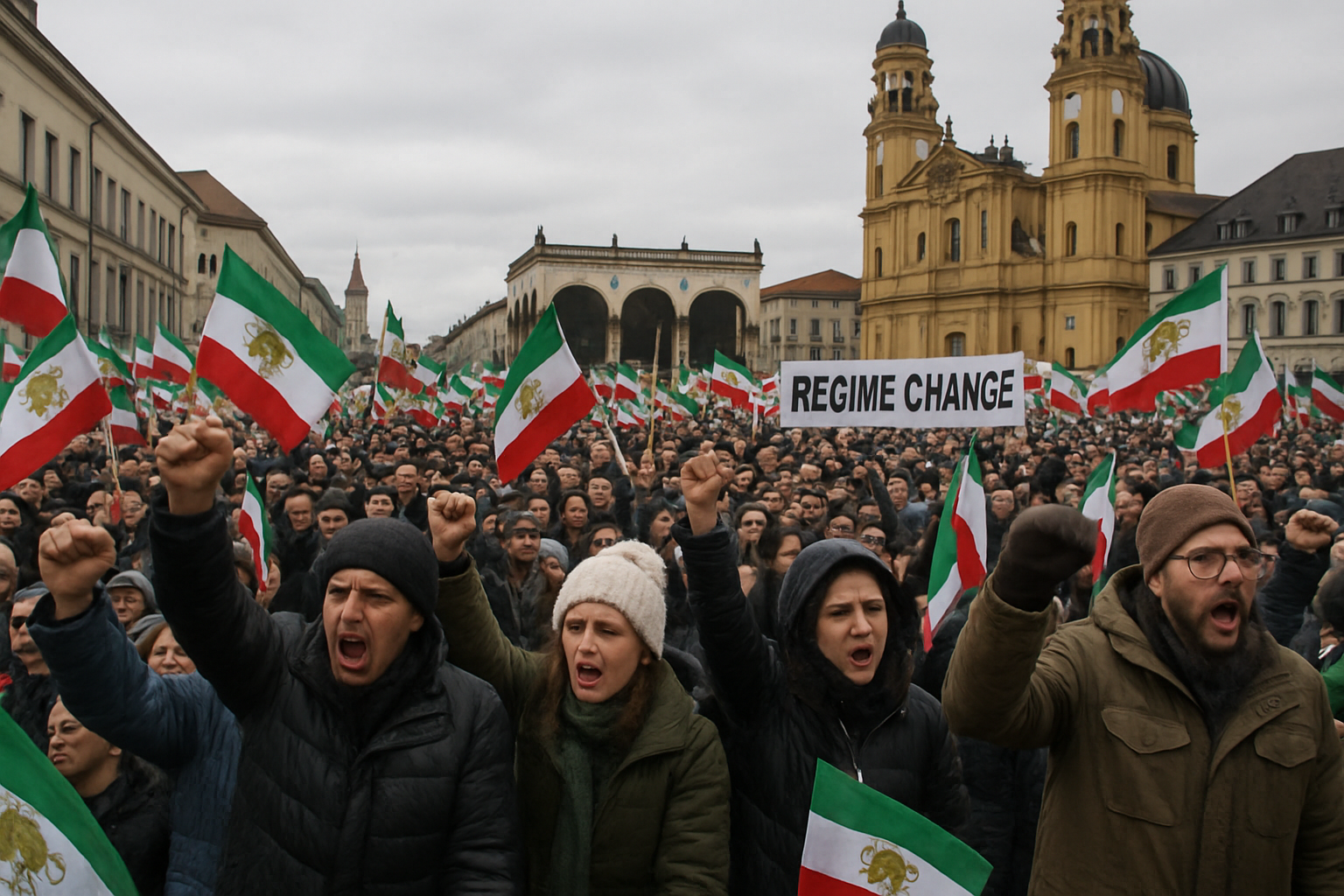
Reza Pahlavi, the son of Iran's last Shah, made his most explicit call yet for US military intervention to overthrow Iran's Islamic Republic, addressing a crowd of up to 250,000 protesters in Munich who demanded regime change while world leaders gathered for the annual Security Conference.
The unprecedented demonstration, described by Norwegian media as one of the largest Iran-related protests in European history, coincided with the 62nd Munich Security Conference, providing a dramatic backdrop as international leaders debated Middle East security and Iran's nuclear program.
Speaking to the massive crowd waving pre-revolutionary Iranian flags emblazoned with the lion and sun symbol, Pahlavi declared himself ready to lead a "transition" in Iran following what he described as the inevitable collapse of the current government. "I pledge to be the leader of the transitional phase for you, so that one day we get the chance to determine the fate of our country through a democratic and transparent path to the ballot box," he told the cheering demonstrators.
Global Day of Action
The Munich rally formed part of what Iranian opposition groups called a "Global Day of Action," with simultaneous demonstrations reported in Toronto, Lisbon, Dublin, and other major cities worldwide. According to sources familiar with the organization, Toronto expected over 200,000 participants, while Lisbon saw more than 100 protesters calling specifically for international military intervention.
The demonstrations strategically timed their peak during the Munich Security Conference, where world leaders including US Secretary of State Marco Rubio, German Chancellor Friedrich Merz, and French President Emmanuel Macron were addressing international security challenges. The proximity of the protests to high-level diplomatic discussions amplified their political impact.
"Trump, act now and end the theocracy of the ayatollahs"
— Chant from Munich demonstrators
Protesters in Munich carried symbolic body bags and flowers representing victims of the Iranian regime's violent crackdowns, while chanting "Long live the shah" and directly appealing to US President Donald Trump to "help the Iranian people." The demonstrations reflected growing frustration among Iran's diaspora community with what they view as insufficient international pressure on Tehran.
Escalating US-Iran Tensions
Pahlavi's calls for military intervention come against the backdrop of dramatically escalating US-Iran tensions. President Trump has deployed a second aircraft carrier, the USS Gerald R. Ford, to join the USS Abraham Lincoln in the Middle East, creating an unprecedented dual-carrier strike force positioned approximately 800 kilometers from Iran's coast.
The Trump administration has made its most explicit regime change comments to date, with the president declaring that "change in power in Iran would be the best thing that could happen." This represents the most direct advocacy for toppling Iran's government since Trump took office, signaling a potential policy evolution from nuclear-focused negotiations to broader political transformation objectives.
Pentagon officials have confirmed preparations for "potentially weeks-long operations against Iran" if ordered, with strike scenarios reportedly ranging from nuclear facilities to broader Revolutionary Guard infrastructure campaigns. The military buildup occurs alongside ongoing nuclear negotiations in Oman, creating a complex dual-track approach of diplomacy backed by the credible threat of force.
Domestic Crisis in Iran
The international protests reflect the deep domestic crisis facing Iran's government. Since the major uprising in 2022, Iranian authorities have arrested over 42,000 protesters, according to human rights organizations. The regime has also sentenced Nobel Peace Prize laureate Narges Mohammadi to an additional 7.5 years in prison for "gathering and collusion."
Finnish lawyer and Nobel laureate Shirin Ebadi, speaking from the diaspora, declared that she believes the Islamic government has "reached the end of its path" as the Iranian people "no longer retreat even in the face of violence." This assessment reflects growing confidence among opposition figures that the current system's days are numbered.
Nuclear Negotiations Continue
Despite the military posturing and massive protests, diplomatic efforts continue through Omani mediation. Iran currently enriches uranium at 60% purity, approaching the 90% weapons-grade threshold, while maintaining its position that ballistic missiles and regional proxy activities are "red lines" excluded from nuclear-only talks.
US Secretary of State Marco Rubio has insisted that any comprehensive agreement must address Iran's missiles, support for armed groups, and human rights record. Iranian Foreign Minister Abbas Araghchi has declared that Iran will "never abandon uranium enrichment even if war imposed," highlighting the fundamental deadlock despite recent diplomatic breakthroughs including prisoner exchanges and restored military communications.

Regional Coalition Supports Diplomacy
Despite the escalating rhetoric and massive demonstrations, an unprecedented regional coalition including Saudi Arabia, the UAE, Qatar, and Egypt continues to support the diplomatic process. This remarkable Middle Eastern consensus represents a significant shift from traditional rivalries and reflects shared concerns about regional stability.
Oman's mediation role has proven crucial, leveraging its historical neutrality and successful involvement in the 2015 JCPOA negotiations. The sultanate has enabled structured dialogue despite deep mistrust between Washington and Tehran, with recent talks achieving what officials described as a "positive atmosphere."
European Security Context
The Munich demonstrations occurred during one of the most significant Security Conferences in recent memory, with European leaders grappling with what German Chancellor Merz called the collapse of the "post-war order." The conference theme of "Era of Disruptive Politics" reflected growing concerns about challenges to international stability.
The timing was particularly significant as it coincided with the expiration of the New START nuclear treaty between the US and Russia on February 5, marking the first time in over 50 years without bilateral nuclear constraints between the superpowers. UN Secretary-General António Guterres warned of a "grave turning point" with nuclear risks at their "highest in decades."
Opposition Challenges
Despite the impressive turnout in Munich and other cities, the Iranian opposition movement faces significant organizational challenges following the brutal suppression of the 2022 protests through mass arrests and systematic crackdowns on civil society.
Pahlavi's royal lineage provides international recognition and media attention, but also connects him to Iran's pre-revolutionary past, which some younger Iranians view with skepticism. The movement must balance appeals to international intervention with demonstrations of genuine domestic support for democratic change.
Strategic Implications
The convergence of massive international protests, explicit US regime change rhetoric, and ongoing nuclear negotiations creates the most critical moment in US-Iran relations since the 1979 revolution. Success in achieving political change could prevent regional war and provide a template for 21st-century conflict resolution.
However, failure could accelerate military confrontation with global implications for energy security, given that the Persian Gulf handles 40% of the world's oil transit through the Strait of Hormuz. The stakes extend beyond bilateral relations to include nuclear governance credibility, territorial sovereignty principles, and the effectiveness of international diplomacy in addressing authoritarian challenges.
"The Iranian people deserve freedom, and the international community must act to support their legitimate aspirations for democratic governance."
— Statement from Munich demonstration organizers
Looking Forward
As nuclear negotiations continue through Omani mediation, the massive Munich demonstration and Pahlavi's explicit calls for US intervention represent a new phase in the Iranian opposition's international campaign. The protests successfully linked nuclear diplomacy to human rights concerns, creating additional complexity for potential agreements that focus solely on technical nuclear issues.
The coming weeks will test whether the international community can bridge the fundamental disagreements between Iran's demand for nuclear-only talks and US insistence on comprehensive arrangements addressing missiles, proxies, and human rights. The success or failure of these efforts will likely determine whether the momentum from the Munich protests translates into meaningful political change or becomes another chapter in the long struggle for Iranian democracy.
With Trump's June 2026 deadline for comprehensive resolution approaching, and dual-carrier strike forces positioned in the Persian Gulf, the window for diplomatic solutions appears to be narrowing. The voices of 250,000 protesters in Munich have made clear that the international Iranian diaspora will no longer accept half-measures in confronting what they view as an illegitimate regime whose time has passed.