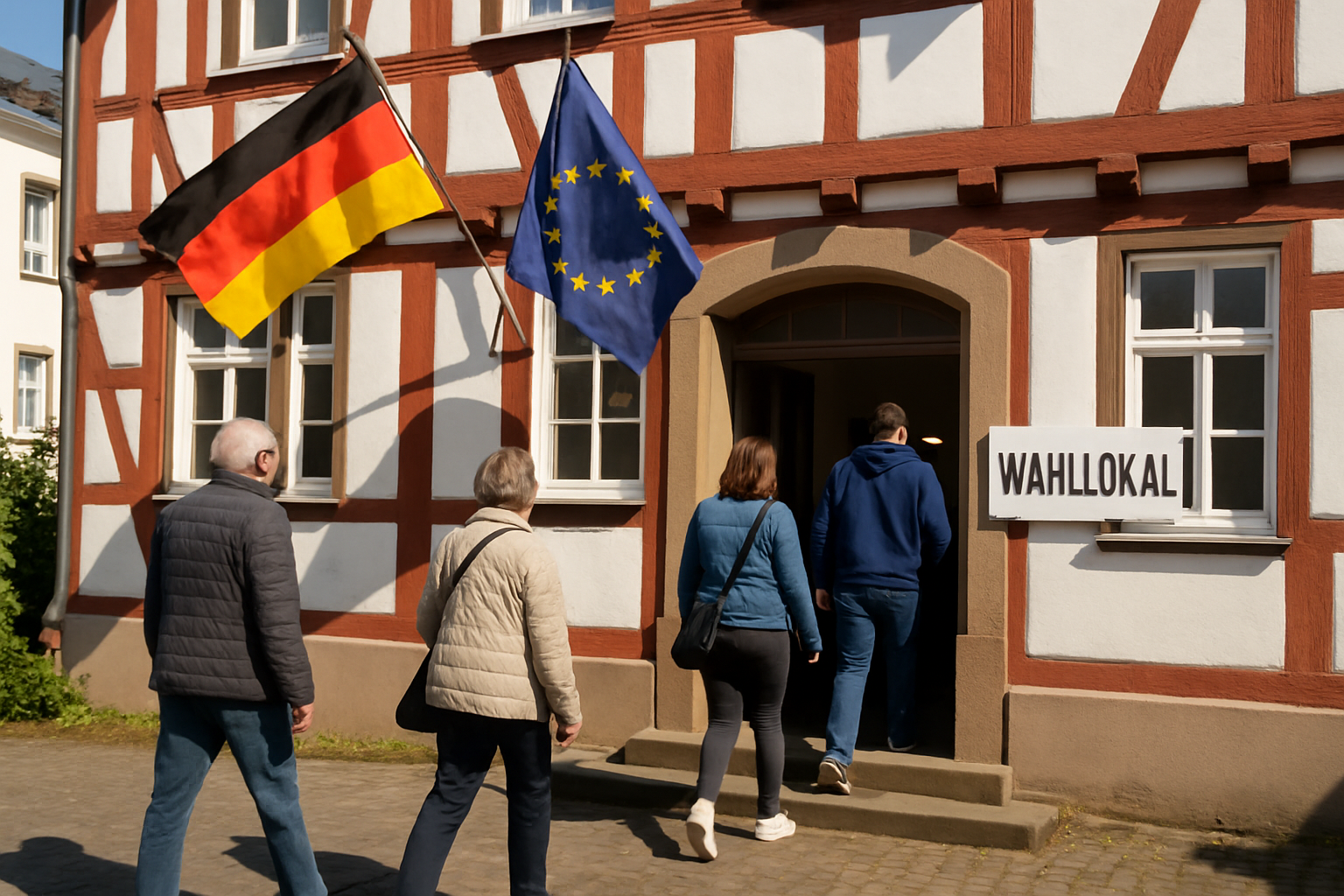
Voters in Rhineland-Palatinate headed to polling stations Sunday in a crucial state election that serves as the first major electoral test for Chancellor Friedrich Merz's conservative CDU leadership, with the party facing a formidable challenge from the far-right Alternative for Germany (AfD) in this traditionally competitive political battleground.
By midday, approximately 50 percent of eligible voters had cast their ballots, indicating strong democratic participation in an election that could reshape the political landscape of Germany's western state. Both incumbent Minister-President Alexander Schweitzer of the Social Democratic Party (SPD) and his CDU challenger Gordon Schnieder made their votes, symbolizing the intense competition between the center-left and conservative camps.
High Stakes for Merz's National Leadership
The Rhineland-Palatinate election represents far more than a regional contest—it serves as a critical barometer for Chancellor Merz's ability to consolidate conservative support across Germany while countering the growing influence of the AfD. Political analysts view this race as particularly significant given Merz's recent struggles to maintain CDU unity and his vocal opposition to far-right extremism.
Following his commanding 91.2 percent re-election as CDU party leader at the Stuttgart congress in February, where he vowed that the AfD would not "ruin our country," Merz now faces the practical challenge of translating his anti-extremist rhetoric into electoral success. The stakes are heightened by recent setbacks in Baden-Württemberg, where the CDU failed to reclaim power from the Greens, marking an early disappointment for Merz's leadership.
"This election will demonstrate whether our message of democratic renewal and responsible governance resonates with voters who are increasingly concerned about political extremism."
— Senior CDU strategist, speaking anonymously
AfD's Strategic Expansion
The Alternative for Germany enters this election with unprecedented momentum, building on their breakthrough performance in Baden-Württemberg where they secured 18 percent of the vote and became the third-largest party. Political observers note that the AfD's success in traditionally stable southwestern states challenges assumptions about their appeal being limited to eastern regions with specific post-reunification grievances.
The party's strategy in Rhineland-Palatinate focuses on capitalizing on voter dissatisfaction with immigration policies, economic uncertainty, and what they characterize as the failure of mainstream parties to address citizen concerns. This represents part of what analysts term "authoritarian innovation"—the sophisticated evolution of far-right movements from rural populism to competitive urban campaigning.
AfD's potential third-place finish would mark a significant milestone for the party's normalization within German politics, despite continued isolation from coalition building by all other major parties. The psychological impact of such a result could provide momentum for upcoming state elections across Germany throughout 2026.
SPD's Defensive Strategy
Minister-President Schweitzer's SPD campaigns from a position of incumbent strength, emphasizing government competence and stability during uncertain times. The party benefits from Schweitzer's personal popularity ratings, which consistently outperform his party's polling numbers—a phenomenon that has become increasingly important in an era of personality-driven politics.
The Social Democrats face the complex challenge of defending their record while addressing the underlying concerns that fuel support for both the CDU and AfD. Their campaign messaging emphasizes continuity, practical governance, and social cohesion, attempting to position the SPD as the reliable center-left alternative amid political polarization.
Polling data suggests the SPD can count on loyalty from traditional supporters while competing for swing voters who may be attracted to either conservative promises of change or populist appeals to frustration with the political establishment.
Coalition Implications
The election results will significantly impact potential coalition formations in Rhineland-Palatinate, with mathematical possibilities likely requiring either a continued SPD-led coalition or a potential CDU-led alternative. All established parties have ruled out cooperation with the AfD, maintaining the democratic consensus against far-right participation in government.
Political analysts anticipate that regardless of which major party finishes first, complex coalition negotiations will be necessary to achieve a governing majority. The presence of smaller parties and the AfD's expected strong showing could complicate traditional two-party or simple coalition arrangements.
Broader National Context
This election occurs within a broader European context of democratic stress and far-right gains across multiple countries. Recent developments in France, where Marine Le Pen's National Rally achieved historic municipal breakthroughs, and Sweden, where the Liberal Party entered formal cooperation with the Sweden Democrats, demonstrate the continental scope of political realignment.
Chancellor Merz's response to the Rhineland-Palatinate results will be closely watched by European leaders grappling with similar challenges. His February warning that extremist movements threaten democratic institutions takes on particular resonance as German voters make their choices.
The election also comes as Germany faces significant economic pressures, including energy costs, supply chain disruptions, and the ongoing adaptation to post-pandemic realities. These material concerns provide fertile ground for both populist appeals and calls for competent governance.
Democratic Resilience Test
Beyond party-political implications, the Rhineland-Palatinate election serves as a test of German democratic institutions' capacity to channel political tensions through peaceful electoral competition. The high turnout figures suggest continued citizen engagement with democratic processes, even amid rising polarization.
Electoral authorities report smooth operations across the state's polling stations, with robust security measures in place but no significant disruptions. The professional conduct of the election reinforces Germany's reputation for electoral integrity and administrative competence.
International observers view German state elections as bellwethers for broader European democratic health, particularly given Germany's role as the European Union's largest economy and most populous member state. Success in maintaining democratic norms while addressing citizen concerns could provide templates for other nations facing similar challenges.
Looking Ahead
Regardless of Sunday's outcomes, the Rhineland-Palatinate election will influence German political dynamics for months to come. Strong AfD performance would validate their strategy of systematic expansion beyond traditional strongholds, while CDU success would strengthen Merz's position ahead of additional state elections throughout 2026.
For the SPD, maintaining power in this western state remains crucial for demonstrating the party's continued viability as a major political force capable of effective governance. The results will also impact federal-level coalition dynamics and policy debates.
As polls close and vote counting begins, political Germany awaits results that could reshape the national conversation about democratic governance, political extremism, and the future direction of Europe's largest democracy. The ultimate test lies not just in vote tallies, but in how successfully the winning parties can govern effectively while preserving democratic institutions against mounting pressures.