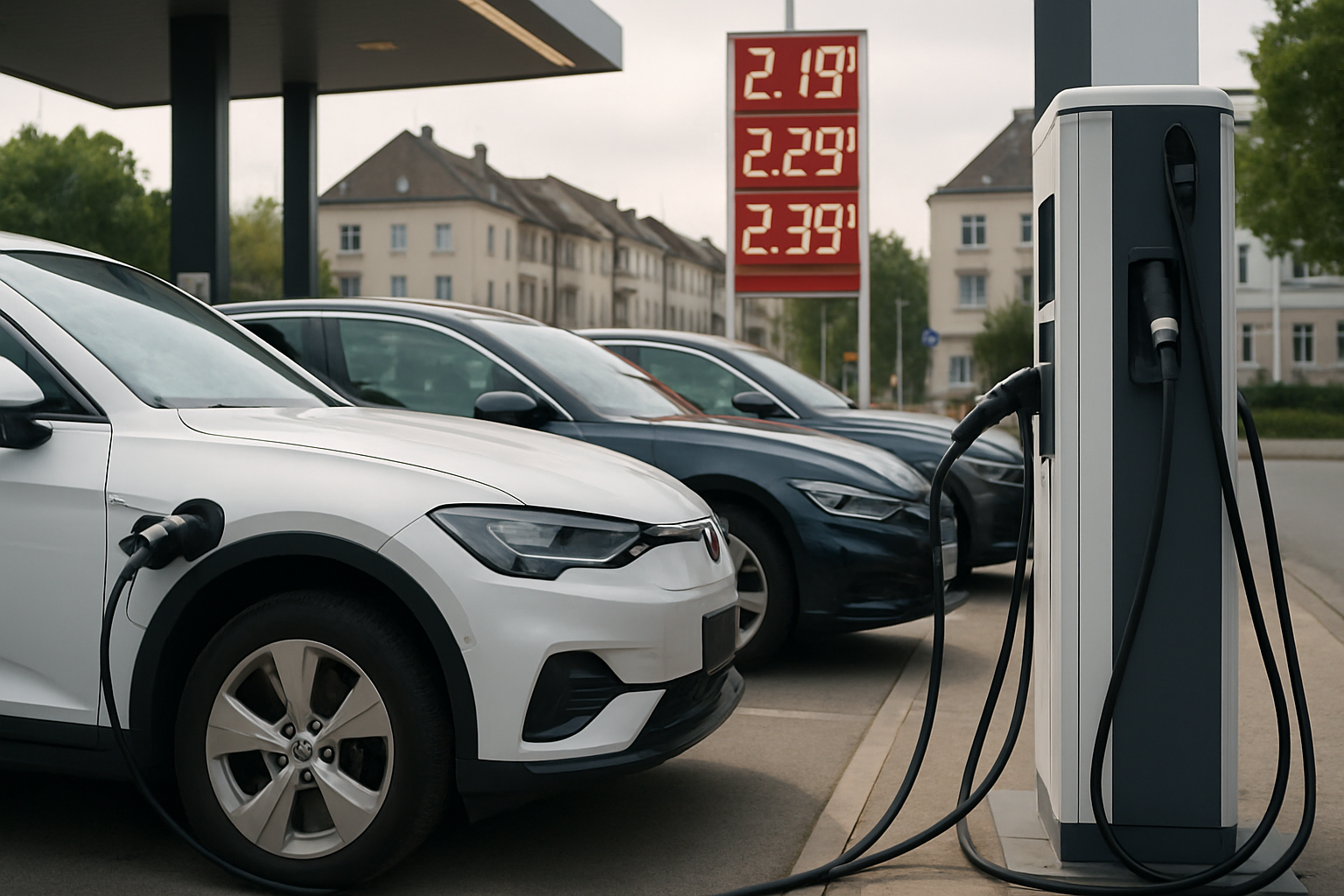
European consumers are experiencing an unprecedented surge in electric vehicle interest as fuel prices reach crisis levels following the closure of the Strait of Hormuz, which handles 40% of global oil transit. This dramatic shift represents a fundamental change in EV adoption patterns, driven by economic necessity rather than environmental concerns alone.
Crisis-Driven Market Transformation
Oil prices have breached $100 per barrel for the first time since 2022, with Brent crude peaking at $119.50 and West Texas Intermediate reaching a record $108.15 following Iran's Revolutionary Guard declaration that the Strait of Hormuz is "unsafe for shipping." This 21-mile chokepoint closure has created the most severe energy crisis since the 1970s oil shocks, fundamentally altering consumer behavior across Europe.
Online marketplaces in the UK, Germany, France, and Spain have reported massive increases in electric vehicle inquiries since the start of the Iranian conflict in February 2026. This surge represents what industry analysts call a "watershed moment" where crisis-driven demand converges with technological readiness, creating conditions for mass adoption acceleration.
European Government Emergency Responses
The crisis has prompted unprecedented government interventions across Europe. Ireland implemented an immediate €235 million package cutting diesel excise by 20 cents and petrol by 15 cents per liter. Hungary imposed immediate price caps on gasoline and diesel to counter "war-driven explosions" in fuel costs. France deployed 500 fuel station inspectors to prevent price manipulation, while Germany is strengthening antitrust laws targeting gas station gouging.
"The rising cost of petrol highlights the cheaper power available from a plug," noted a Guardian analysis of the European market shift.
— UK Guardian Environment Report
Austria has implemented a comprehensive "fuel price brake" system that redistributes excess fuel tax revenues directly to consumers as prices surge by 20%. This represents a revolutionary departure from traditional Austrian energy policy, showing the extent to which governments are intervening in market dynamics to protect citizens.
Economic Tipping Point Achieved
The fuel crisis has created what Swedish automotive data confirms as a historic tipping point where electric vehicles have become "often cheaper than gasoline and diesel cars" across European markets. This represents a fundamental shift in transportation economics, moving beyond the traditional early adopter market to mainstream economic necessity.
The International Energy Agency has deployed the largest strategic petroleum reserve release in its 50-year history—400 million barrels from 32 countries—yet this emergency measure has failed to address the fundamental supply disruption created by the Strait of Hormuz closure.
Technological Readiness Meets Crisis
The surge in EV interest comes as breakthrough technologies have addressed persistent adoption barriers. BYD's Megawatt Flash Charging technology enables 400km range charging in just 5 minutes, while their Blade Battery 2.0 functions effectively in temperatures as low as -30°C, addressing cold climate concerns prevalent across Northern Europe.
Battery longevity studies have exceeded predictions, with Tesla Model S vehicles from 2012-2014 retaining 85-92% of their capacity after 200,000+ miles, and Nissan Leaf models from 2011-2013 maintaining 75-85% capacity after a decade of operation. These findings suggest practical lifespans of 15-20 years, dramatically improving total cost of ownership calculations.
Infrastructure Investment Acceleration
The crisis has accelerated infrastructure investment across Europe. Austria has doubled its EV charging capacity with 1,000 additional stations, while Estonia leads with 88% renewable electricity and continental Europe's largest battery storage network serving 90,000 households. This infrastructure boom is enabling the rapid adoption surge currently underway.
Global Context and Supply Chain Challenges
The current crisis extends far beyond Europe, with Australia reporting hundreds of service stations running dry and the Philippines declaring a year-long "national energy emergency." Aviation has been particularly hard hit, with 18,000+ flights cancelled worldwide—the most since COVID-19—as jet fuel costs surged 122% from $85-90 to $150-200 per barrel.
However, the shift to electric vehicles faces its own supply chain vulnerabilities. China maintains 60% of critical materials production and 90% of refining capacity for lithium, cobalt, and rare earth elements essential to EV manufacturing. Memory chip shortages are driving sixfold semiconductor price increases until 2027, affecting EV control systems.
Climate Urgency Backdrop
This market transformation occurs against a backdrop of climate urgency, with January 2026 marking the 18th consecutive month of temperatures exceeding 1.5°C above pre-industrial levels. This demonstrates human-induced climate change overriding natural variability, emphasizing the environmental imperative alongside the new economic drivers for transportation electrification.
"This is a historic moment for the entire automotive market. What we're seeing is crisis-driven adoption meeting technological readiness in ways we haven't witnessed before," observed Samuel Ciszuk, energy analyst.
— Energy Security Expert Analysis
Regional Adoption Patterns
Adoption patterns reveal significant urban-rural disparities, with homeowners and rural residents enjoying advantages through home charging capabilities versus apartment dwellers facing infrastructure barriers. However, Vehicle-to-Grid technology is advancing, enabling EVs to function as mobile energy storage that can charge during off-peak renewable generation and discharge during high demand periods.
Long-Term Market Implications
Industry experts describe the current period as representing the most significant automotive sector transformation in modern history, requiring unprecedented coordination between energy systems, infrastructure development, materials supply chains, and regulatory frameworks. The crisis has transformed what was previously seen as an environmental choice into an economic necessity.
Commercial vehicle electrification is also accelerating, with Tesla announcing large-scale Semi truck production milestones and BMW beginning electric 3 Series production at its Munich facility in August 2026. Fleet operators are prioritizing total cost of ownership calculations, making them natural early adopters of advanced battery technology.
Looking Ahead
April 2026 represents a watershed moment where multiple trends converge: crisis-driven fuel costs, technological breakthroughs, infrastructure investment, and climate urgency. The European experience demonstrates how external economic shocks can rapidly accelerate technology adoption timelines that might otherwise take years to achieve through policy incentives alone.
While recovery from the current energy crisis depends on military and diplomatic resolution of Middle East tensions, the structural changes in consumer behavior and infrastructure investment are likely to persist beyond the immediate crisis. This period may be remembered as the moment when electric vehicle adoption shifted from environmental idealism to mainstream economic pragmatism across Europe.
The success of managing this transition will depend on sustained international cooperation, continued technological innovation, and recognition that transportation electrification has become essential infrastructure for both economic stability and planetary sustainability during what Earth scientists describe as the most environmentally challenging period in recorded human history.