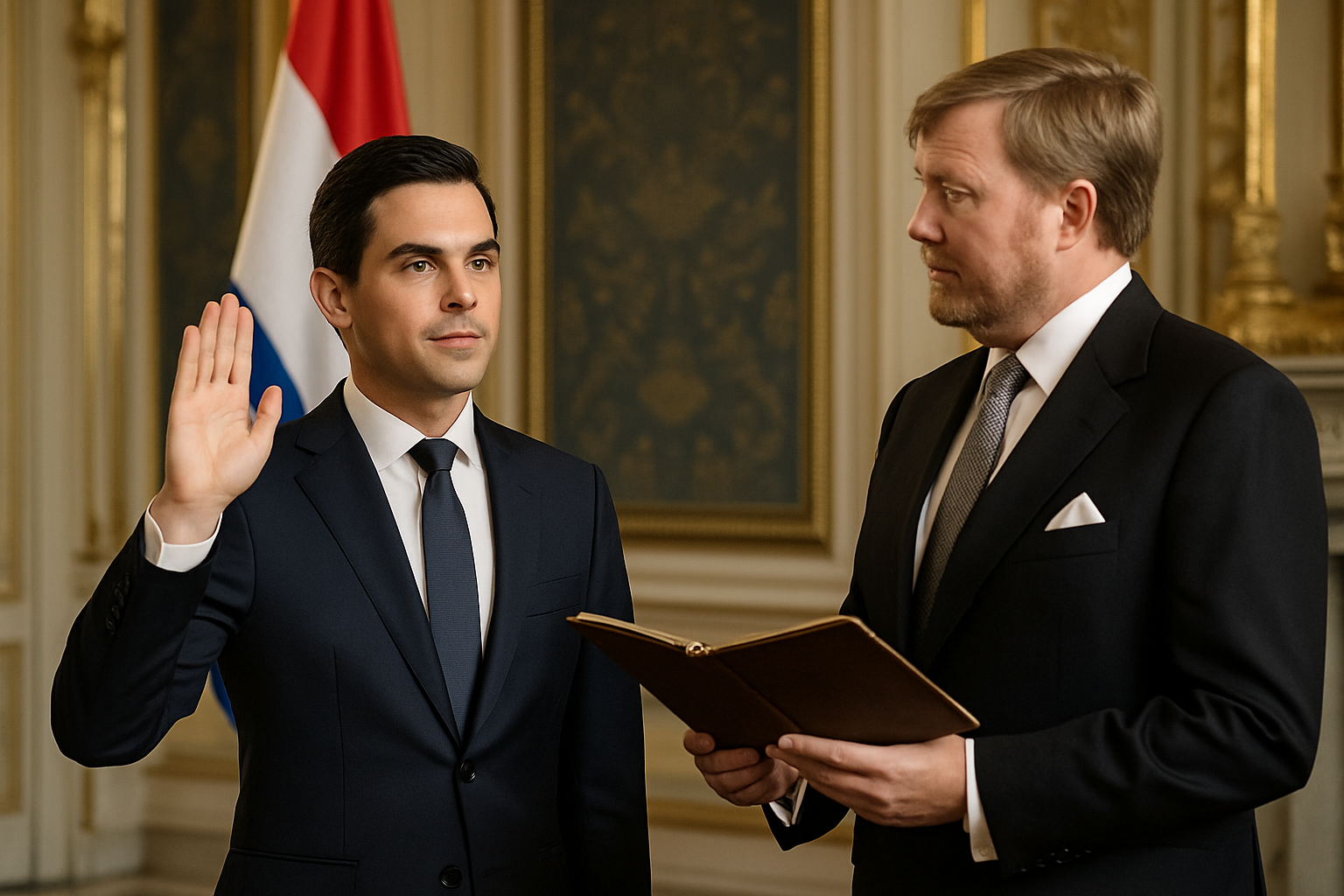
Rob Jetten made history Monday as he was sworn in as the Netherlands' youngest-ever Prime Minister at age 38, becoming both the first openly gay leader and the first from the centrist D66 party to hold the office.
King Willem-Alexander administered the oath of office to Jetten and his entire Cabinet at Huis ten Bosch palace in The Hague, marking the culmination of a remarkable political journey that saw the young leader orchestrate a stunning comeback victory against far-right challenger Geert Wilders.
The ceremony represents the third new government formation in just over four years, highlighting the political fragmentation that has characterized Dutch politics in recent years. However, Jetten's D66-VVD-CDA coalition government enters office with renewed stability after the comprehensive electoral mandate secured in October's snap elections.
From Opposition to Victory
Jetten's path to the Prime Minister's residence was far from predictable. Just months ago, his D66 party found itself in opposition after the previous coalition collapsed when Geert Wilders' far-right Freedom Party (PVV) withdrew support, triggering the snap election that ultimately became Jetten's political breakthrough.
The election campaign saw Jetten positioned as the moderate alternative to Wilders' populist appeal, advocating for continued European integration, progressive social policies, and pragmatic economic management. His message resonated particularly strongly with younger voters and urban constituencies seeking stability amid rising political polarization.
"Today marks not just a change in government, but a reaffirmation of our democratic values and our commitment to a Netherlands that works for everyone,"
— Rob Jetten, Prime Minister of the Netherlands
The victory was particularly significant given the international context of rising far-right movements across Europe. Jetten's success in defeating Wilders' PVV by a narrow margin demonstrated the continued appeal of centrist, pro-European politics in the Netherlands.
Coalition Architecture and Governance
The new Jetten I Cabinet comprises 28 members, including 18 Ministers and 10 State Secretaries, drawn from the three-party coalition of D66, the liberal VVD, and the Christian Democratic CDA. This configuration represents a return to traditional coalition politics after the instability of recent years.
The coalition agreement emphasizes several key priorities: maintaining strong support for Ukraine and NATO commitments, addressing climate change through accelerated green transition policies, and managing economic challenges including inflation and housing shortages that dominated campaign discussions.
One of the government's immediate challenges will be navigating parliamentary dynamics where Wilders' PVV remains a significant opposition force. Political observers note that while Jetten secured executive power, the underlying political divisions that enabled Wilders' rise have not disappeared.
European and International Implications
Jetten's appointment has been welcomed across European capitals as a stabilizing force for EU unity. His pro-European stance contrasts sharply with the Eurosceptic positions advocated by Wilders, potentially strengthening the Netherlands' role in key European initiatives.
The new government has already signaled its intention to maintain robust support for Ukraine, including continued military aid and diplomatic backing for EU sanctions against Russia. This position aligns with broader European consensus but may face domestic political pressure given economic costs.
German Chancellor's office issued a statement welcoming the "return of a pro-European tone from The Hague," while French President Emmanuel Macron emphasized the importance of Dutch leadership in addressing continental challenges from climate change to migration.
Historic Firsts and Symbolic Significance
Beyond the political implications, Jetten's appointment carries substantial symbolic weight. As the first openly gay Prime Minister in Dutch history, his elevation represents a milestone for LGBTQ+ representation in European leadership.
His youth – at 38, he becomes one of Europe's youngest heads of government – also reflects broader generational shifts in political leadership. Jetten has explicitly positioned himself as representing a new generation of leaders focused on long-term challenges rather than short-term political gains.
The D66 party's rise to lead government marks another historic first. Founded in 1966 as a progressive liberal party, D66 has long been a coalition partner but never before provided a Prime Minister, making Jetten's appointment a watershed moment for the party.
Challenges Ahead
Despite the celebratory atmosphere surrounding the swearing-in ceremony, Jetten inherits significant challenges. The Netherlands faces a housing crisis, with property prices making homeownership increasingly difficult for younger generations. Immigration policy remains contentious, with Wilders' continued prominence ensuring the issue stays in public focus.
Economic pressures include managing inflation, addressing wage stagnation in certain sectors, and balancing climate transition costs with competitiveness concerns. The government must also navigate complex EU negotiations on various issues while maintaining domestic political support.
The fragmented nature of Dutch politics means Jetten's coalition will require careful management to maintain unity. Previous governments have fallen due to disagreements on migration, climate policy, or economic measures – pitfalls the new Prime Minister will need to avoid.
International Template for Democratic Resilience
Political analysts across Europe are closely watching Jetten's government as a potential template for countering populist movements through effective centrist governance. His success in building a stable coalition despite political fragmentation offers lessons for other European democracies facing similar challenges.
The peaceful transfer of power, conducted with full constitutional formality despite the heated election campaign, reinforces the strength of Dutch democratic institutions. This institutional resilience stands in contrast to democratic stress visible in other parts of Europe and globally.
As Jetten begins his tenure, international observers will be monitoring whether his government can deliver on promises of effective governance while maintaining the democratic norms and European integration that formed central pillars of his campaign appeal.
The swearing-in ceremony at Huis ten Bosch palace may have lasted only a few hours, but its implications for Dutch politics, European integration, and democratic governance will likely resonate for years to come. At 38, Rob Jetten now faces the challenge of proving that youth, centrist politics, and European cooperation remain viable alternatives to populist appeals in an increasingly complex world.