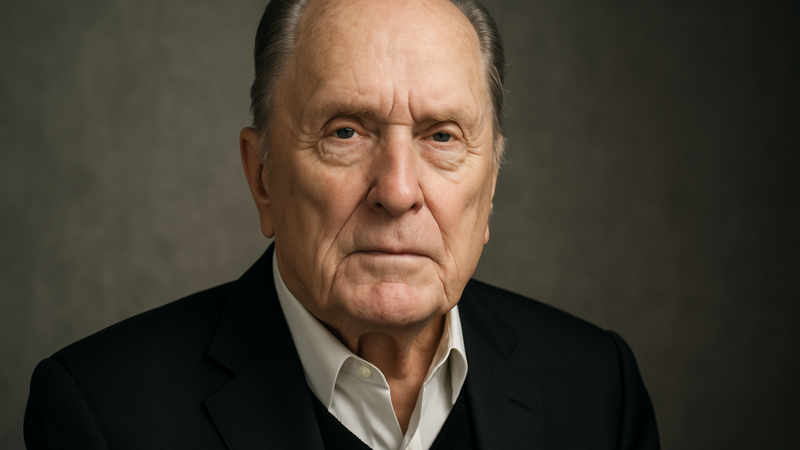
Robert Duvall, the Academy Award-winning actor whose masterful performances in "The Godfather," "Apocalypse Now," and "Tender Mercies" made him one of Hollywood's most respected character actors, died Sunday at age 95 at his home in Middleburg, Virginia.
Duvall's death was confirmed Monday by his wife, Argentine actress and filmmaker Luciana Duvall, in a statement posted on Facebook. "Yesterday I said goodbye to my beloved husband, dearest friend, and one of the greatest actors of our time. Bob passed away peacefully at home," she wrote, adding that he died "surrounded by love and comfort."
The cause of death was not disclosed, though sources close to the family indicated Duvall had been in declining health in recent months. No funeral arrangements have been announced.
A Career Spanning Seven Decades
Born January 5, 1931, in San Diego, California, Duvall forged a legendary career that spanned more than 130 films across seven decades. He became synonymous with intense, psychologically complex characters who embodied the rough-hewn American archetype with quiet authority and methodical precision.
Duvall's breakthrough came with his portrayal of the mysterious recluse Boo Radley in the 1962 adaptation of "To Kill a Mockingbird," though he gained widespread recognition for his role as Tom Hagen, the cool-headed consigliere to the Corleone family in Francis Ford Coppola's "The Godfather" (1972) and its 1974 sequel.
"For each of his many roles, Bob gave everything to his characters and to the truth of the human spirit they represented."
— Luciana Duvall, Wife
His most iconic performance may be Lieutenant Colonel Bill Kilgore in "Apocalypse Now" (1979), whose famous line "I love the smell of napalm in the morning" became one of cinema's most quoted phrases. The napalm-loving colonel's surfing-obsessed, war-intoxicated persona showcased Duvall's ability to make even the most extreme characters deeply human.
Oscar Recognition and Critical Acclaim
Duvall received seven Academy Award nominations throughout his career, winning Best Actor in 1984 for his portrayal of Mac Sledge, a down-and-out country music singer seeking redemption in "Tender Mercies." The performance exemplified his gift for depicting broken-down, fallen characters with dignity and authenticity.
His other notable Oscar nominations came for supporting roles in "The Godfather" (1973), "Apocalypse Now" (1980), and "The Judge" (2015), as well as lead actor nominations for "The Great Santini" (1981) and "The Apostle" (1998), the latter of which he also wrote and directed.
Beyond his film work, Duvall earned critical acclaim for his starring role in the television miniseries "Lonesome Dove" (1989), which won him a Golden Globe and further cemented his reputation as one of America's finest actors.
A Method Actor's Dedication
Known for his methodical character preparation and preference for authenticity over glamour, Duvall was a key figure in the New Hollywood movement of the 1970s. He frequently collaborated with directors like Coppola, appearing in "The Conversation" (1974) and other films that defined a generation of American cinema.
Duvall's range extended from forceful military leaders like Lieutenant Colonel Bull Meechum in "The Great Santini" to the title character in the HBO film "Stalin" (2002). He also portrayed historical figures such as Nazi war criminal Adolf Eichmann in the 1996 television film "The Man Who Captured Eichmann."
International Recognition and Global Impact
The news of Duvall's death has generated worldwide coverage and tributes, reflecting his international stature. Media outlets from Ireland to Japan have honored his contributions to cinema, with many noting how his performances transcended cultural boundaries.
Irish film critics described his work as embodying "grit and humility in a rough-hewn archetype that is now Hollywood history," while Japanese media praised his "restrained intensity" that shaped American cinema "across six decades."
Personal Life and Legacy
Duvall married Argentine actress Luciana Pedraza in 2004, and the couple divided their time between their Virginia farm and Argentina. Known for his love of tango dancing and horse riding, Duvall maintained a notably private lifestyle, avoiding Hollywood's glitz in favor of quieter pursuits.
Unlike many of his contemporaries, Duvall consistently chose character-driven projects over commercial blockbusters, earning him respect throughout the industry for his artistic integrity and commitment to his craft. This approach influenced generations of character actors who followed his example of thorough preparation and psychological depth.
"Bob was one of the greatest actors of our time, but more importantly, he was a devoted husband and friend."
— Industry Colleague
Hollywood Mourns a Legend
Tributes have poured in from across the entertainment industry, with many citing Duvall's influence on their own careers. His death marks the end of an era for Hollywood, as he was among the last surviving stars of the New Hollywood movement that revolutionized American filmmaking in the 1970s.
Film historians note that Duvall's career represented a bridge between classical Hollywood and modern cinema, combining old-school professionalism with the psychological realism that defined contemporary acting.
His final film appearances included roles in "Lucky" (2017) alongside Harry Dean Stanton and "Widows" (2018), demonstrating his continued vitality and commitment to his craft well into his 80s.
A Lasting Impact on Cinema
Robert Duvall's death represents the loss of not just a talented performer, but a guardian of acting traditions that emphasized authenticity, preparation, and respect for the craft. His approach to character development and his ability to disappear completely into roles set a standard that continues to influence actors today.
From the haunting silence of Boo Radley to the explosive intensity of Colonel Kilgore, Duvall created a gallery of unforgettable characters that captured the complexities of the American experience. His legacy lives on in the countless actors he inspired and the indelible performances that will continue to move audiences for generations to come.
Duvall is survived by his wife Luciana and a vast artistic legacy that spans some of the most important films in American cinema history. His death marks the end of a remarkable life dedicated to the art of storytelling and the pursuit of truth through performance.