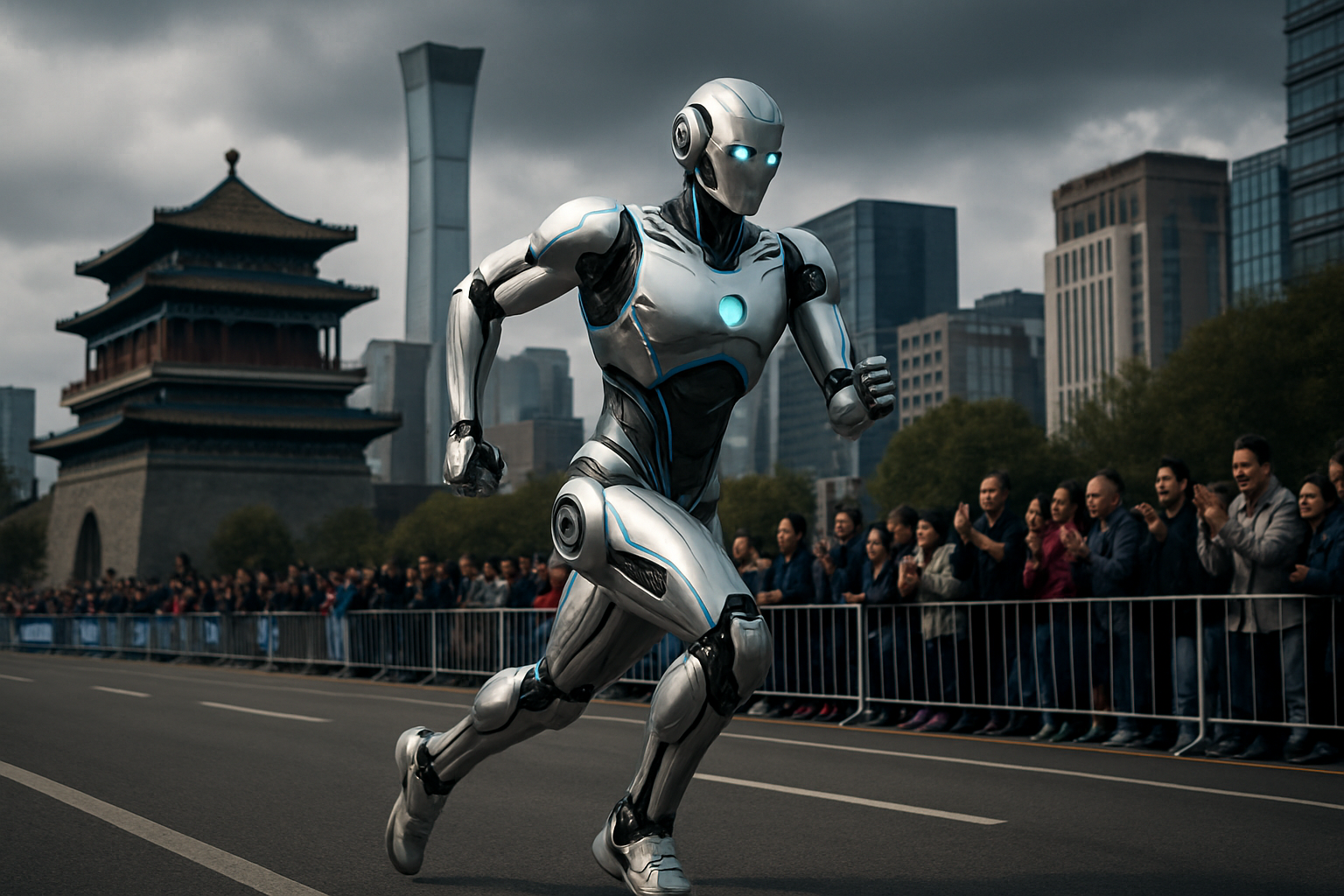
In a watershed moment for robotics and athletics, a Chinese humanoid robot has achieved the impossible by completing a half-marathon in Beijing in 50 minutes and 26 seconds—approximately seven minutes faster than the human world record—marking a revolutionary milestone in the intersection of artificial intelligence and competitive sports.
The historic achievement occurred on April 19, 2026, during Beijing's second annual robot half-marathon, where over 300 humanoid robots participated in what has become the largest competitive robotic athletic event in history. The winning robot's time represents a quantum leap in robotic athletic performance, demonstrating the dramatic evolution of Chinese robotics technology in just one year.
A Technological Marvel Unfolds
The competition showcased advanced balance systems, endurance capabilities, and sophisticated AI decision-making as robots navigated complex urban terrain and varying weather conditions. Spectators were particularly enthusiastic at the 11-kilometer mark, where they were seen cheering for a competitor dubbed "Shandian" (Lightning), highlighting the emotional connection between the human audience and their mechanical athletes.
This year's performance represents a dramatic improvement from 2025, when many robots failed to complete the course entirely. The 2026 competition demonstrated not just incremental progress but revolutionary advancement in robotics engineering, with participants showcasing adaptive intelligence that allowed them to respond to unexpected obstacles and environmental changes throughout the race.
Strategic Response to Demographic Crisis
The robotics achievement is far from merely a technological demonstration—it represents China's systematic response to what demographers call the "4-2-1 problem," where single children must support four aging parents and grandparents due to decades of population control policies. As China faces the world's most rapidly aging population, robotics has become central to maintaining productivity and economic growth.
Unitree Robotics, one of the leading companies in China's humanoid robot sector, has scaled production from 5,500 units in 2025 to over 20,000 units in 2026, representing the fastest laboratory-to-commercial transition in robotics history. This massive scaling demonstrates China's commitment to deploying AI and robotics as solutions to fundamental societal challenges.
Global Competitive Implications
The Beijing marathon results highlight a significant gap between Chinese mass production capabilities and Western experimental approaches. While Chinese companies are producing thousands of units and conducting large-scale public demonstrations, European initiatives like BMW's deployment of just two "Aeon" humanoid robots at a German facility represent the limited scope of Western robotics programs.
China's competitive advantages in this space are threefold, according to Alibaba Chairman Joe Tsai: superior power grid infrastructure capable of supporting massive AI energy demands, commitment to open-source AI development versus Western proprietary approaches, and complete domestic manufacturing chains that reduce vulnerability to geopolitical disruptions.
Infrastructure and Innovation Advantage
China's success is built on systematic infrastructure investments that create competitive advantages in the global AI and robotics race. The country controls 60% of critical mineral production and 90% of refining capacity, providing leverage during the ongoing global semiconductor crisis that has seen memory chip prices increase sixfold, affecting major manufacturers like Samsung, SK Hynix, and Micron.
Despite these global constraints, Chinese companies continue expansion through memory-efficient algorithms and alternative architectures, demonstrating the country's ability to innovate around international restrictions. This approach has enabled rapid development and deployment of advanced robotics capabilities even under challenging global supply chain conditions.
Human-Robot Collaboration Model
Significantly, the Beijing marathon featured robots competing in dedicated lanes alongside human participants, creating an inclusive technological advancement framework that suggests a future of collaboration rather than replacement. The positive spectator reception provides a template for human-AI collaboration that amplifies capabilities while preserving distinctly human qualities.
This approach contrasts sharply with concerns in other regions about AI and robotics displacing human workers. China's "human-centered automation" philosophy emphasizes reskilling and maintaining social stability, offering a model that other countries with aging populations might adopt.
International Context and Recognition
The achievement comes at a time when international organizations are grappling with the governance of rapidly advancing AI and robotics technologies. The United Nations has established an Independent Scientific Panel of 40 experts for the first global AI assessment—the most sophisticated technology governance attempt since the commercialization of the internet.
The success in Beijing provides a global template for aging societies worldwide. China's ability to maintain productivity despite population decline could fundamentally reshape assumptions about the relationship between demographics and development during 21st-century transitions.
Economic and Social Transformation
The robotics marathon occurs within a broader context of economic transformation that industry experts describe as the "SaaSpocalypse"—where hundreds of billions in traditional software market value are being eliminated as AI replaces conventional solutions. China's approach of pursuing gradual transition programs rather than massive layoffs provides a model for managing this technological disruption.
China achieved a 13.9% GDP improvement in logistics automation efficiency through systematic AI implementation, demonstrating that the robotics advancement showcased in Beijing translates into real economic benefits across multiple sectors.
Global Template for the Future
As industry experts identify April 2026 as a "civilizational choice point" that will determine whether AI serves human flourishing or becomes an exploitation tool, the Beijing marathon success provides hope for a collaborative path forward. The achievement demonstrates technology's potential to address societal challenges while creating new forms of excellence.
The marathon victory represents more than athletic achievement—it offers a glimpse of a future where artificial intelligence amplifies human potential rather than threatening it. This collaborative advancement toward shared progress provides a template that could influence how other nations approach the integration of advanced robotics into their societies.
Looking Ahead
The success of Beijing's humanoid robot marathon establishes China as the global leader in practical robotics deployment while demonstrating the potential for AI and robotics to create positive societal outcomes. As the world grapples with aging populations, labor shortages, and technological disruption, China's systematic approach combining infrastructure investment, open innovation, and human-centered deployment provides a roadmap for others to follow.
The robots that ran through Beijing's streets represent more than technological achievement—they embody humanity's evolving relationship with artificial intelligence and the potential for technology to serve human flourishing during one of history's most significant technological transitions.