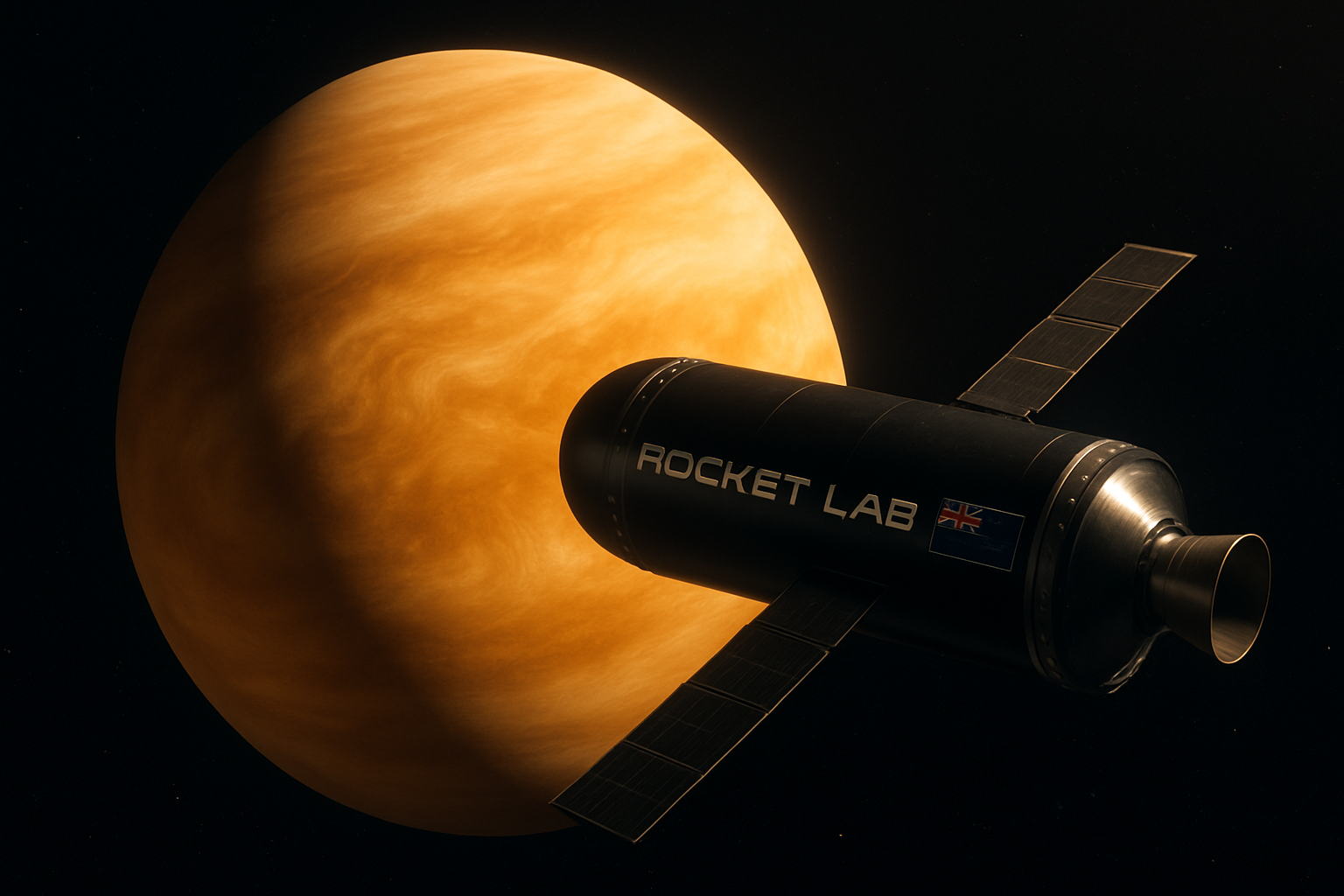
Sir Peter Beck and Rocket Lab are pioneering the world's first private mission to Venus with their revolutionary Venus Life Finder project, a sub-$17 million endeavor that could fundamentally transform our understanding of life in the solar system while establishing New Zealand as a leading force in space exploration innovation.
The Venus Life Finder mission represents a longtime dream for Beck, the visionary founder and CEO of Rocket Lab who has transformed the New Zealand-based company into a global space technology powerhouse. This groundbreaking initiative positions the mission as the world's first privately-funded exploration of Venus, marking a historic milestone in commercial space exploration and demonstrating how smaller nations can achieve extraordinary cosmic breakthroughs through innovation and strategic focus.
A Revolutionary Approach to Planetary Exploration
The Venus Life Finder mission embodies the entrepreneurial spirit that has defined the current "space economy golden age" – a period characterized by unprecedented commercial innovation and international cooperation. Unlike traditional government-led planetary missions that often cost billions and take decades to develop, Beck's approach leverages Rocket Lab's proven track record of cost-effective space solutions to deliver transformative science at a fraction of conventional costs.
Venus, Earth's closest planetary neighbor, has long fascinated scientists as a potential harbor for life. While the planet's surface temperatures exceed 460°C (860°F) – hot enough to melt lead – the atmospheric conditions 50-60 kilometers above the surface present remarkably Earth-like conditions. At these altitudes, temperatures range from 0-60°C with atmospheric pressure similar to Earth's surface, creating what researchers call the "habitable zone" of Venus's atmosphere.
The Science Behind the Search
The mission's scientific objectives focus on detecting potential biosignatures in Venus's upper atmosphere, particularly targeting phosphine gas – a compound that on Earth is primarily produced by living organisms. Previous telescope observations suggested the presence of phosphine in Venus's clouds, sparking intense scientific debate and making the Venus Life Finder mission's direct investigation critically important for astrobiology.
Beck's approach represents a paradigm shift in planetary exploration strategy. Rather than competing with NASA's multi-billion-dollar flagship missions, Rocket Lab is demonstrating how focused, cost-effective missions can achieve groundbreaking scientific results. This philosophy aligns with the broader transformation occurring across the space industry, where commercial entities are increasingly driving innovation and expanding access to space-based research.
New Zealand's Space Exploration Renaissance
The Venus Life Finder mission showcases New Zealand's remarkable emergence as a significant player in global space exploration. Under Beck's leadership, Rocket Lab has evolved from a small startup to an international space company capable of competing with established aerospace giants. The company's Electron rocket has successfully launched dozens of missions, establishing New Zealand as one of the few nations with independent orbital launch capabilities.
This achievement occurs within the context of what space analysts describe as the democratization of space technology. Countries and companies that were previously excluded from space exploration due to prohibitive costs and technical barriers are now achieving remarkable breakthroughs through innovative approaches and strategic partnerships.
Technical Innovation and Engineering Excellence
The Venus Life Finder mission's sub-$17 million budget represents extraordinary engineering efficiency compared to traditional planetary missions. NASA's previous Venus missions, such as the Magellan spacecraft, cost hundreds of millions of dollars in inflation-adjusted terms. Beck's team has achieved this cost reduction through several key innovations:
- Leveraging Rocket Lab's existing Electron launch vehicle and spacecraft technologies
- Employing miniaturized scientific instruments that maintain high performance while reducing mass and cost
- Utilizing rapid development cycles that minimize overhead and administrative costs
- Implementing commercial best practices that prioritize efficiency and results
The mission's spacecraft design incorporates cutting-edge atmospheric entry technology, advanced life detection instruments, and robust communication systems capable of transmitting data across interplanetary distances. These technical achievements demonstrate how private industry can develop sophisticated space exploration capabilities while maintaining cost-effectiveness.
Global Context and Competition
The Venus Life Finder mission occurs during a period of unprecedented global space activity. While NASA's Artemis program focuses on returning humans to the Moon and SpaceX prepares for potential trillion-dollar IPO valuations, smaller players like Rocket Lab are carving out specialized niches that contribute essential scientific knowledge to humanity's cosmic understanding.
International space cooperation continues expanding through various frameworks, including bilateral partnerships and emerging nation participation in space activities. Countries like Pakistan are sending astronauts to China's Tiangong station, Thailand chairs UN space governance committees, and European nations are investing billions in launch independence through facilities like Germany's Isar Aerospace operations in Sweden.
Scientific and Strategic Implications
The potential discovery of life in Venus's atmosphere would represent one of the most significant scientific breakthroughs in human history. Such a finding would fundamentally alter our understanding of life's prevalence in the universe, potentially indicating that biological processes can emerge in diverse environmental conditions previously thought uninhabitable.
From a strategic perspective, the mission demonstrates how innovative countries can achieve disproportionate scientific impact through focused investment and technical excellence. New Zealand's success with the Venus Life Finder could inspire other nations to pursue ambitious space exploration objectives, contributing to the continued expansion of human cosmic presence.
Economic and Industrial Impact
The Venus Life Finder mission contributes to New Zealand's growing reputation as a center for aerospace innovation. Rocket Lab's success has created high-value employment opportunities, attracted international investment, and established New Zealand as a competitive player in the global space economy projected to exceed $1 trillion by 2030.
The mission also demonstrates the economic viability of commercial planetary exploration. If successful, Beck's approach could inspire additional private missions to other planets, potentially accelerating the pace of solar system exploration while reducing costs for scientific discovery.
Looking Forward: The Future of Commercial Space Exploration
The Venus Life Finder mission represents more than a single scientific endeavor – it embodies a new model for how humanity can explore the cosmos. By combining entrepreneurial innovation, technical excellence, and scientific ambition, Sir Peter Beck and Rocket Lab are demonstrating that transformative space exploration need not require the resources of major space agencies.
As the mission progresses toward launch, the global space community will be watching closely. Success could validate the commercial approach to planetary exploration, potentially inspiring similar missions to Mars, Jupiter's moons, and other celestial bodies throughout the solar system.
The Venus Life Finder mission stands as a testament to human ingenuity and the power of innovative thinking to overcome traditional barriers. Whether or not the mission discovers life above Venus, it has already achieved something remarkable: proving that with vision, determination, and technical skill, even the most ambitious cosmic dreams can become reality.
In an era when space exploration is transitioning from government monopoly to commercial opportunity, Sir Peter Beck's Venus Life Finder mission may well be remembered as a pivotal moment when private enterprise opened new frontiers in the eternal human quest to understand our place in the universe.