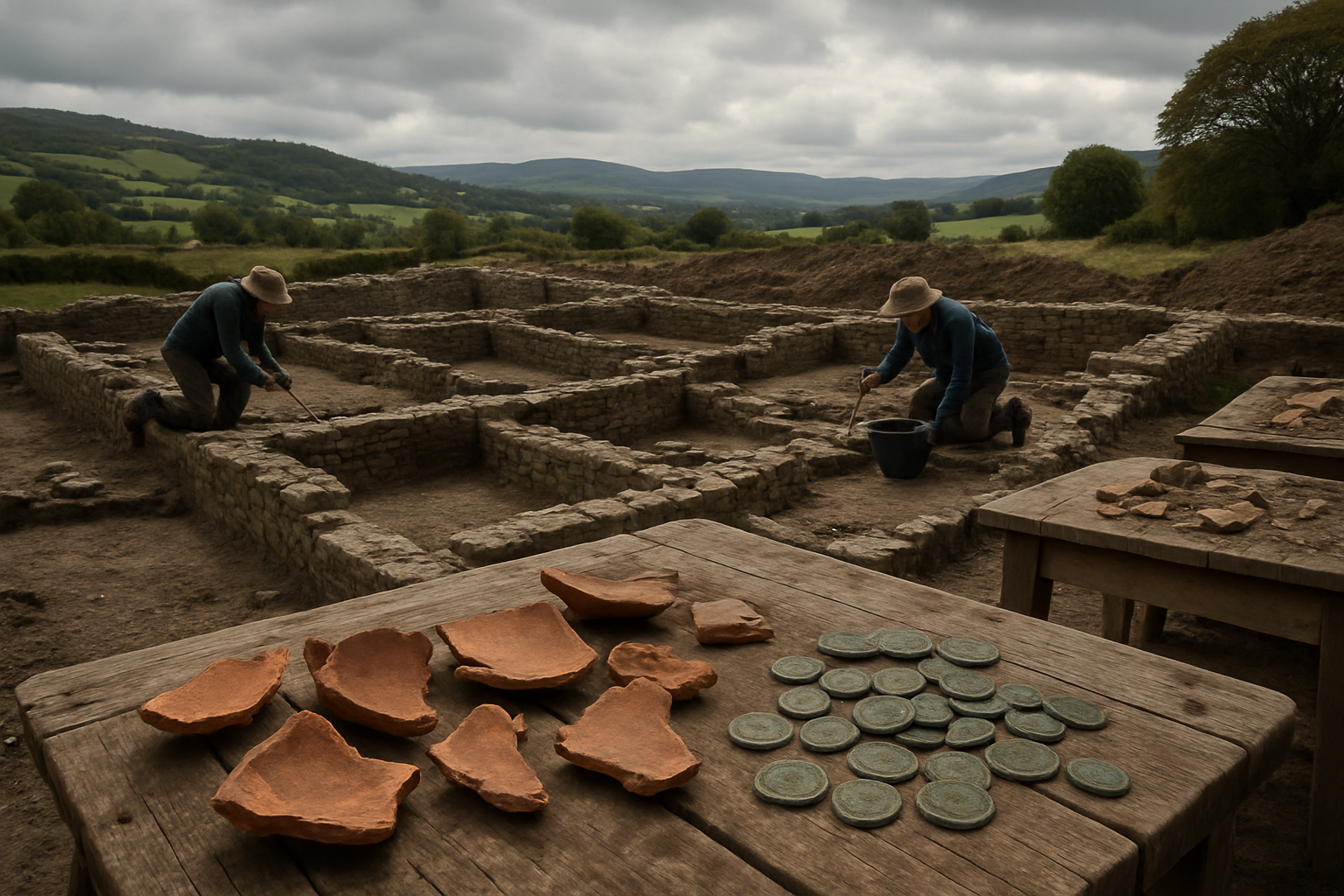
A remarkable Roman villa discovery near Cardiff, Wales, alongside enigmatic ancient Gallic burial sites in France, is fundamentally reshaping our understanding of ancient European civilizations and their sophisticated cultural practices.
The extraordinary finds, announced simultaneously across two major archaeological investigations, represent some of the most significant discoveries in European archaeology this decade. Advanced ground-penetrating radar and sophisticated analytical techniques have revealed evidence of complex ancient societies that operated with far greater sophistication than previously understood.
Wales' "Mini-Pompeii" Transforms Roman Britain Understanding
At Margam Country Park, approximately 40 kilometers west of Cardiff, archaeologists have uncovered what researchers are calling a "mini-Pompeii" - a remarkably preserved Roman villa complex dating back over 1,600 years. The discovery, made in an adjacent field to the park's medieval abbey ruins, has revealed portions of walls and foundations of several structures, including the main villa and a basilica-like building.
Dr. Alexander Langlands, Associate Professor at Swansea University, leads the research team utilizing cutting-edge archaeological methodology. "The level of preservation is extraordinary," Dr. Langlands explained. "We're seeing structural details and artifacts that provide unprecedented insights into Romano-British daily life, social structures, and economic activities."
The villa complex appears to have been a substantial agricultural estate, typical of the sophisticated Roman villa culture that developed across Britain during the empire's expansion. These estates served as centers of local elite Roman lifestyle adoption, representing the complex processes of Romanization and Romano-Celtic cultural integration.
Mysterious Gallic Burials Puzzle French Archaeologists
Simultaneously, French researchers have made equally intriguing discoveries on the grounds of a school in France, where thousands-year-old skeletons have been found buried in distinctive sitting positions within circular pits. The skeletal remains, identified as belonging to ancient Gallic peoples, represent burial practices that remain largely unexplained by current archaeological understanding.
The unusual positioning of the remains - seated in rounded excavations - suggests deliberate ritual practices that may have held significant cultural or religious meaning for these ancient Celtic communities. The discovery joins a growing body of evidence revealing the sophisticated social and spiritual practices of pre-Roman Gallic civilizations.
Stone and brick alignments discovered at the site suggest the presence of historic settlements or religious complexes, indicating these weren't isolated burial sites but part of larger organized communities with complex architectural planning.
Advanced Technology Reveals Hidden History
Both discoveries exemplify what archaeologists are calling the "2026 Archaeological Renaissance" - a period characterized by unprecedented international cooperation and revolutionary analytical techniques. The Welsh investigation employs advanced ground-penetrating radar, chemical analysis, and digital documentation methods that allow complete settlement mapping before physical excavation, preventing damage to fragile structures.
Environmental reconstruction techniques are providing detailed information about ancient climate conditions, agricultural practices, and ecosystem relationships. These methods enable researchers to understand not just what ancient peoples built, but how they lived, worked, and adapted to their environments.
Digital documentation creates permanent records enabling global scholarly access while protecting original sites and artifacts. This approach represents a fundamental shift in archaeological methodology, from extractive practices toward preservation-focused global knowledge sharing.
Climate Urgency Drives Preservation Efforts
The timing of these discoveries carries particular significance as archaeological sites worldwide face unprecedented threats from climate change. January 2026 marked the 18th consecutive month that global temperatures exceeded 1.5°C above pre-industrial levels, creating urgent preservation challenges through extreme weather, flooding, and environmental degradation.
Many archaeological sites containing ancient treasures face deterioration or complete loss due to environmental changes, making systematic documentation and preservation efforts increasingly critical. The success of these current investigations demonstrates the importance of sustained international cooperation and investment in archaeological research during this crucial preservation window.
Broader Historical Context and Implications
These discoveries contribute to a remarkable year of archaeological breakthroughs that are fundamentally altering our understanding of ancient human capabilities. The Welsh Roman villa joins other 2026 findings including 5,000-year-old Egyptian drilling machines, 350,000-year-old evidence of fire control in England, and sophisticated astronomical systems dating back 8,000 years.
The pattern of discoveries suggests ancient civilizations possessed technological and organizational capabilities that challenge traditional linear progression models of human development. Rather than simple primitive-to-advanced evolution, the evidence reveals sophisticated ancient communities capable of complex planning, advanced technical skills, and coordinated social organization.
The Roman villa discovery provides crucial insights into the extent and sophistication of Roman influence in Wales, suggesting more complex Roman presence than previously documented. Evidence of extensive Roman villa culture in Britain demonstrates how agricultural estate centers served as focal points for local elite adoption of Roman lifestyles and cultural practices.
Economic and Cultural Impact
Beyond their scholarly significance, these discoveries are generating substantial economic and cultural benefits. The Welsh Roman villa is expected to attract significant international attention, contributing to cultural tourism and positioning Wales as a premier archaeological destination. Educational partnerships and research collaborations are already developing, creating sustainable economic development opportunities.
International media coverage is enhancing diplomatic relationships between nations, as countries recognize archaeological discoveries as shared human heritage rather than purely national assets. This approach facilitates collaborative research and knowledge sharing that transcends political boundaries.
Future Research Directions
Both sites require years of careful analysis and interpretation. The Welsh Roman villa excavations will continue using non-invasive techniques to map the complete settlement before full excavation begins. Detailed chemical analysis will reveal construction techniques, dating precision, and insights into daily life practices.
The French Gallic burial sites await comprehensive analysis of burial practices, genetic studies of the remains, and comparative analysis with other European Celtic sites. Advanced forensic techniques may reveal information about ancient population movements, social structures, and cultural exchanges between different tribal groups.
International cooperation frameworks established through these investigations provide templates for future collaborative archaeological research, demonstrating how shared expertise, coordinated funding, and digital documentation can respect local cultural heritage while enabling global scholarly advancement.
Significance for Modern Understanding
These discoveries represent more than academic curiosities - they provide crucial perspectives on human adaptation, cultural innovation, and community resilience that remain relevant for contemporary challenges. The sophisticated ancient engineering, social organization, and cultural practices revealed through these investigations offer insights into sustainable living, community building, and environmental adaptation.
As humanity faces complex global challenges, understanding how ancient societies developed sophisticated solutions to environmental, social, and technological challenges provides valuable perspectives for contemporary innovation and adaptation strategies.
The remarkable preservation conditions at both sites, combined with advanced analytical techniques, position these discoveries as pivotal moments in archaeological science that will influence research methodologies and historical understanding for generations to come.