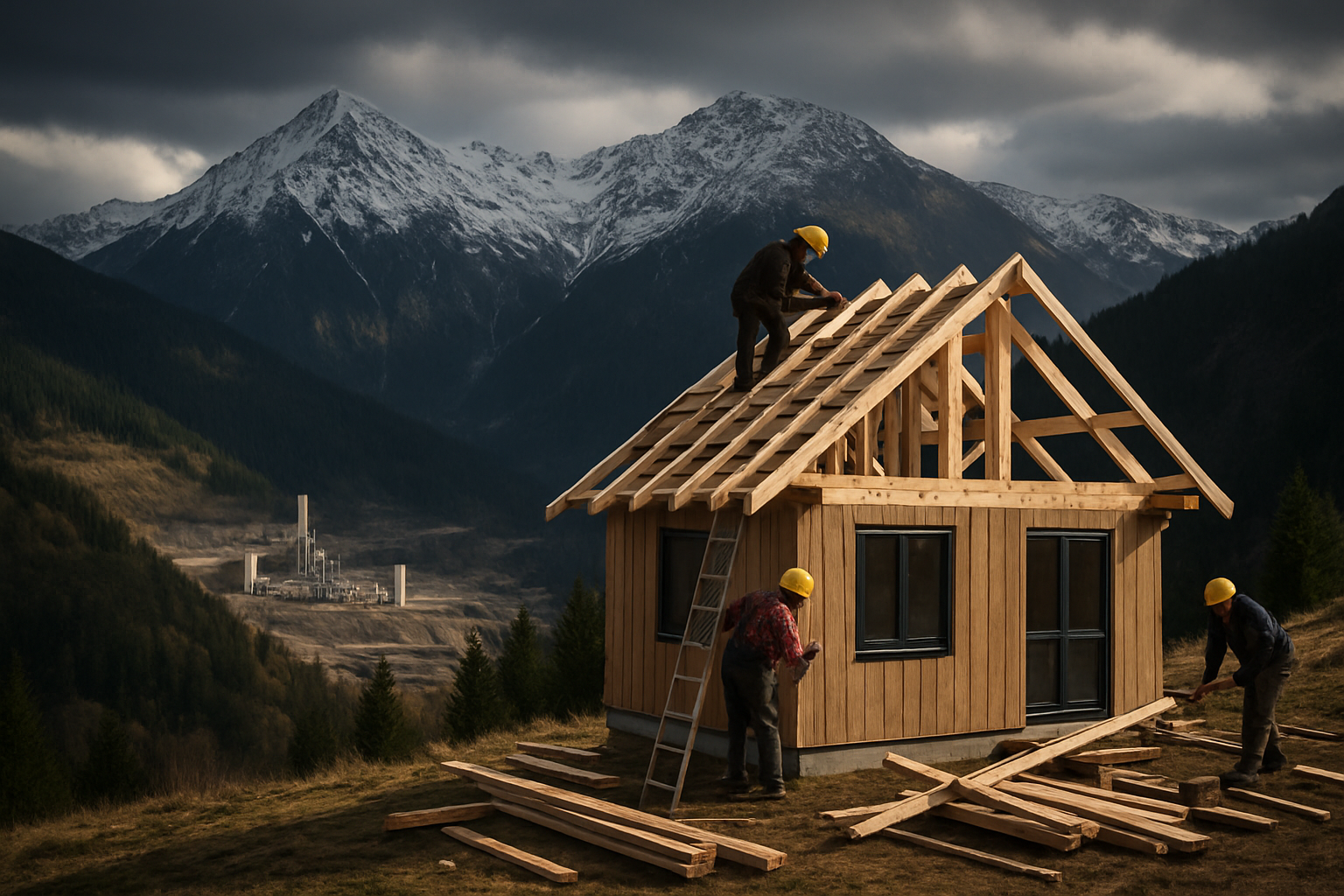
Romania demonstrates a unique balance between social responsibility and strategic economic positioning as a mountaineering group builds a mountain cabin for underprivileged children near Vârful Măgura while Brașov positions itself as Europe's primary processing hub for rare earth minerals from Greenland.
These simultaneous developments, occurring within days of each other in early March 2026, illustrate Romania's multifaceted approach to national development—combining grassroots social initiatives with high-level international partnerships that could reshape European supply chain independence.
Mountain Refuge: A People-Powered Project
The Căsuța din Munți (Mountain Cabin) project, situated near Vârful Măgura in the Cindrel Mountains, represents what its creators describe as "a project made by people, for people." Initiated by Asociația Tur Alpin, a group of mountain enthusiasts, the cabin serves a dual humanitarian purpose: organizing free summer camps for disadvantaged children and promoting sustainable mountain tourism.
According to reporting by Turnul Sfatului, the initiative has gained recognition as a unique project within Romania's social landscape. The cabin, built through volunteer labor and community donations, addresses a critical gap in recreational opportunities for children from low-income families who rarely have access to mountain experiences.
"We have become partners in a unique project in the country," stated one of the organizers, emphasizing the collaborative nature of the endeavor.
— Asociația Tur Alpin Representative
The project builds on Romania's rich tradition of mountaineering and outdoor education, while addressing contemporary social challenges. Beyond providing recreational opportunities, the cabin serves as an educational center where children learn about environmental conservation, mountain safety, and traditional Romanian cultural practices.
Brașov's Strategic Industrial Transformation
Simultaneously, Romania is positioning itself at the center of Europe's critical minerals strategy through a Romanian-American partnership that designates Brașov as a processing hub for rare earth minerals extracted from Greenland. The agreement between Romania and American company Critical Metals represents a significant milestone in European efforts to reduce dependence on Chinese-dominated supply chains.
The processing facility, planned for construction in Feldioara, Brașov County, will handle minerals transported from Greenland to serve both European and American markets. This development positions Romania as a crucial link in the transatlantic supply chain for materials essential to renewable energy technologies, electronics, and defense systems.
Hungarian media reports suggest this partnership is part of broader European Union initiatives to diversify critical mineral sources, particularly as China currently controls approximately 60% of global production and 90% of refining capacity for rare earth elements.
Romania's Economic Renaissance Context
These developments occur during a remarkable period for Romanian economic development. The country achieved a historic budget surplus in January 2026, recording 850 million lei (0.04% of GDP) compared to an 11.01 billion lei deficit in January 2025. This fiscal turnaround, characterized by 17.9% revenue growth and 6% expenditure reduction, demonstrates improved economic management and positions Romania favorably within EU frameworks.
The economic context extends beyond fiscal metrics to include Romania's emergence as a regional leader in various sectors. The country has attracted significant international investment, including €9 million in financing from Intesa Sanpaolo Bank for residential development projects, indicating growing confidence in Romanian markets.
Balancing Social Values with Strategic Objectives
The juxtaposition of the mountain cabin project and the rare earth processing facility illustrates Romania's approach to development that prioritizes both social welfare and economic competitiveness. The mountain cabin represents grassroots community organizing addressing social inequality, while the Brașov facility positions Romania as a strategic player in global supply chains.
This dual approach reflects broader Romanian development patterns documented throughout 2026, including significant investments in renewable energy, healthcare infrastructure improvements, and cultural preservation initiatives. The country has successfully balanced traditional values with modernization objectives, creating development models that other Eastern European nations are studying.
International Implications and Future Prospects
Romania's rare earth processing partnership contributes to the US-EU-Japan Critical Minerals Partnership, which includes 55 countries seeking to reduce dependence on Chinese mineral supplies. This initiative encompasses seven African alternative suppliers and represents a fundamental shift in global supply chain architecture.
The timing proves significant as global demand for rare earth minerals continues expanding due to renewable energy transitions and technology sector growth. Memory chip prices have increased sixfold due to AI development demands, while semiconductor shortages affect everything from consumer electronics to smart building technologies.
For Romania, the Brașov facility could create thousands of specialized jobs while positioning the country as an essential partner for European technological sovereignty. The project aligns with Romania's broader strategy of becoming a regional hub for advanced industries while maintaining strong social welfare commitments.
Community Engagement and Environmental Considerations
Both projects emphasize community engagement and environmental responsibility. The mountain cabin operates on principles of sustainable tourism and environmental education, while the rare earth facility must comply with stringent European environmental regulations.
The Cindrel Mountains project demonstrates how community-driven initiatives can address social needs while promoting environmental awareness. Participants in the children's camps learn about mountain ecosystems, traditional conservation practices, and the importance of preserving Romania's natural heritage.
Similarly, the Brașov facility must meet European standards for environmental protection and community consultation. The project includes comprehensive environmental impact assessments and community engagement programs to ensure local benefits while maintaining ecological responsibility.
Looking Forward: Template for Balanced Development
Romania's approach to combining social initiatives with strategic economic development offers a template for other nations seeking to balance community welfare with global competitiveness. The success of both projects could influence development strategies across Eastern Europe and beyond.
The mountain cabin project demonstrates how grassroots organizing can address social needs while preserving cultural values. The rare earth facility shows how strategic partnerships can enhance economic sovereignty while meeting international responsibilities.
As Romania continues expanding its role in European affairs, these projects illustrate the country's commitment to development that serves both immediate community needs and long-term strategic objectives. This balanced approach positions Romania as a model for sustainable development that prioritizes both people and economic progress.
The success of both initiatives will be closely monitored by international observers seeking examples of development strategies that combine social responsibility with economic competitiveness. Romania's experience may provide valuable lessons for other nations navigating similar challenges in the 21st century.