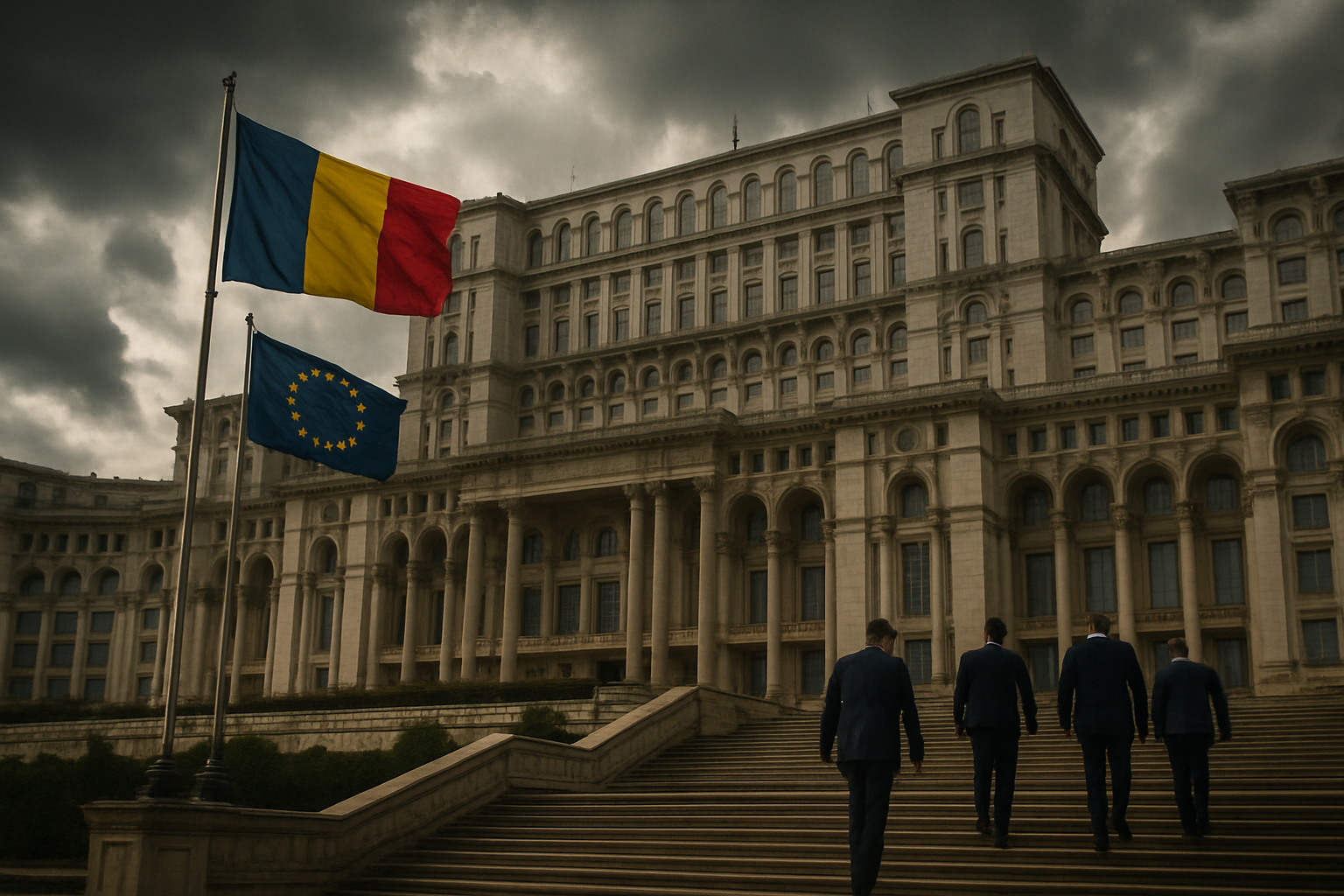
Romania's governing coalition faced a devastating collapse on Monday as the Social Democratic Party (PSD) formally withdrew political support from Prime Minister Ilie Bolojan, triggering the country's most serious political crisis in years amid disputes over crucial EU funding reforms worth €26 billion.
The dramatic political upheaval began when PSD President Sorin Grindeanu announced his party's decision to retract support for the liberal prime minister, citing fundamental disagreements over the implementation of European recovery fund reforms. The crisis threatens to derail Romania's access to critical EU funding and could force early elections at a time when the country faces significant economic challenges.
Bolojan Refuses to Resign Despite Mounting Pressure
In a defiant response to the PSD ultimatum, Prime Minister Bolojan declared he would continue serving in office despite the withdrawal of support. "I have taken note of the completely wrong and irresponsible decision of PSD. I will continue to exercise the mandate of prime minister and we will ensure the stability of governance," Bolojan stated during his first public appearance following the announcement.
The prime minister's refusal to step down sets the stage for a potential motion of no confidence, which PSD has threatened to initiate if Bolojan does not voluntarily resign. The political standoff comes at a critical juncture for Romania's European integration and reform agenda.
"The decision of PSD leadership to withdraw from this coalition that they initially voted for is completely irresponsible. We must ask ourselves what they will do next - after choosing to blow up a coalition they helped create."
— Dominic Fritz, USR President
€26 Billion EU Recovery Fund at Risk
At the heart of the political crisis lies Romania's National Recovery and Resilience Plan (PNRR), which secures €26 billion in EU funding contingent on successful implementation of structural reforms. Minister of Investments and European Projects Dragoș Pîslaru warned that more than half of the critical reforms required for PNRR are coordinated by PSD-controlled ministries.
"If the reforms are not carried out to completion, the risk exceeds 8 billion euros," Pîslaru stated, emphasizing the massive financial stakes involved in the political crisis. The warning highlights how the coalition collapse could directly impact Romania's ability to access vital European funding during a period of economic recovery.
The EU recovery funds are designed to help member states modernize their economies following the COVID-19 pandemic, with Romania's allocation representing one of the largest packages in the European Union. The funds are tied to specific reform milestones in areas including judicial independence, digitalization, and green energy transition.
Coalition Partners Rally Behind Prime Minister
Despite PSD's withdrawal, other coalition partners have declared their continued support for Bolojan's government. The Save Romania Union (USR) and the Democratic Union of Hungarians in Romania (UDMR) have indicated they will stand by the prime minister during the crisis.
USR President Dominic Fritz announced his party would "certainly remain alongside Prime Minister Ilie Bolojan" and criticized PSD for "deserting" at a crucial moment when state institutions require reform. Fritz emphasized the enormous stakes involved, stating: "I mention how big the stakes are - to lose 26 billion euros."
The UDMR has also signaled its intention to maintain support for the government, though party leader Csoma Botond warned that if PSD withdraws its ministers entirely, coalition discussions would need to restart "from zero" and would no longer be tied to "a single person."
PSD Considers Alternative Government Scenarios
PSD leadership has not ruled out alternative scenarios, including the possibility of forming a new majority without the current coalition partners. President Grindeanu suggested he would not exclude becoming prime minister himself if he could secure parliamentary support, stating he would need "only a parliamentary majority and the support of colleagues from the party."
However, Grindeanu emphasized that any new PSD-led government would maintain pro-European orientation, declaring: "We want to be part of a pro-European coalition. If that cannot happen, then we move to opposition. A majority with PSD can only be one where we will have around us only pro-European partners."
This position rules out potential cooperation with anti-European or extremist parties, limiting PSD's options for forming an alternative government majority in Romania's fragmented parliament.
Historical Context of Romanian Political Instability
The current crisis represents the latest chapter in Romania's ongoing struggles with coalition governance and political stability. The country has experienced numerous government changes and political crises since joining the EU in 2007, often related to disagreements over reform implementation and European integration requirements.
Previous tensions between PSD and Bolojan emerged over budget priorities, with PSD demanding a 4 billion lei social protection package while the prime minister pursued deficit reduction measures. Grindeanu had previously criticized Bolojan's approach as a "feldsher attitude - first cut, then measure," reflecting deeper philosophical differences about economic policy.
The crisis occurs during what observers have characterized as "the most challenging period for continental democracy since World War II," with traditional coalition governments facing pressure across Europe from economic challenges and rising political fragmentation.
European Integration Stakes
Romania's political crisis has significant implications beyond national borders, as the country plays a strategic role in European security and economic integration. Recent achievements include Romania's OECD membership approvals and ongoing negotiations for deeper EU integration, all of which could be jeopardized by prolonged political instability.
The timing is particularly sensitive given ongoing geopolitical tensions in Eastern Europe and the need for coordinated European responses to regional security challenges. International observers are closely monitoring the situation, given Romania's position as a key NATO ally and EU member state on the alliance's eastern flank.
European Commission officials have previously emphasized the importance of political stability for successful implementation of recovery fund programs, making the current crisis a potential obstacle to Romania's European integration trajectory.
What Comes Next
The immediate future of Romanian governance depends on several critical factors. If Bolojan maintains his position, PSD will likely proceed with a motion of no confidence, which would require majority parliamentary support to succeed. The government's survival depends on maintaining support from USR, UDMR, and potentially other smaller parties.
Should the government fall, President Nicușor Dan would need to designate a new prime minister candidate, likely triggering complex coalition negotiations in Romania's fragmented parliament. The process could take weeks or months, during which time EU fund absorption and reform implementation would be suspended.
The crisis also raises questions about Romania's capacity for stable governance and its ability to meet European partnership obligations during challenging times. Resolution of the current political standoff will be closely watched as a test of Romanian democratic institutions and European integration commitment.
As the situation continues to evolve, the stakes extend far beyond domestic politics, encompassing Romania's relationship with European partners, its economic recovery prospects, and its role in regional security architecture during a period of unprecedented continental challenges.