Four suspects were arrested Friday after an arson attack involving an explosion damaged a synagogue in Rotterdam, Netherlands, with police sources suggesting the perpetrators may have planned to target a second Jewish house of worship, highlighting escalating antisemitic violence across Europe.
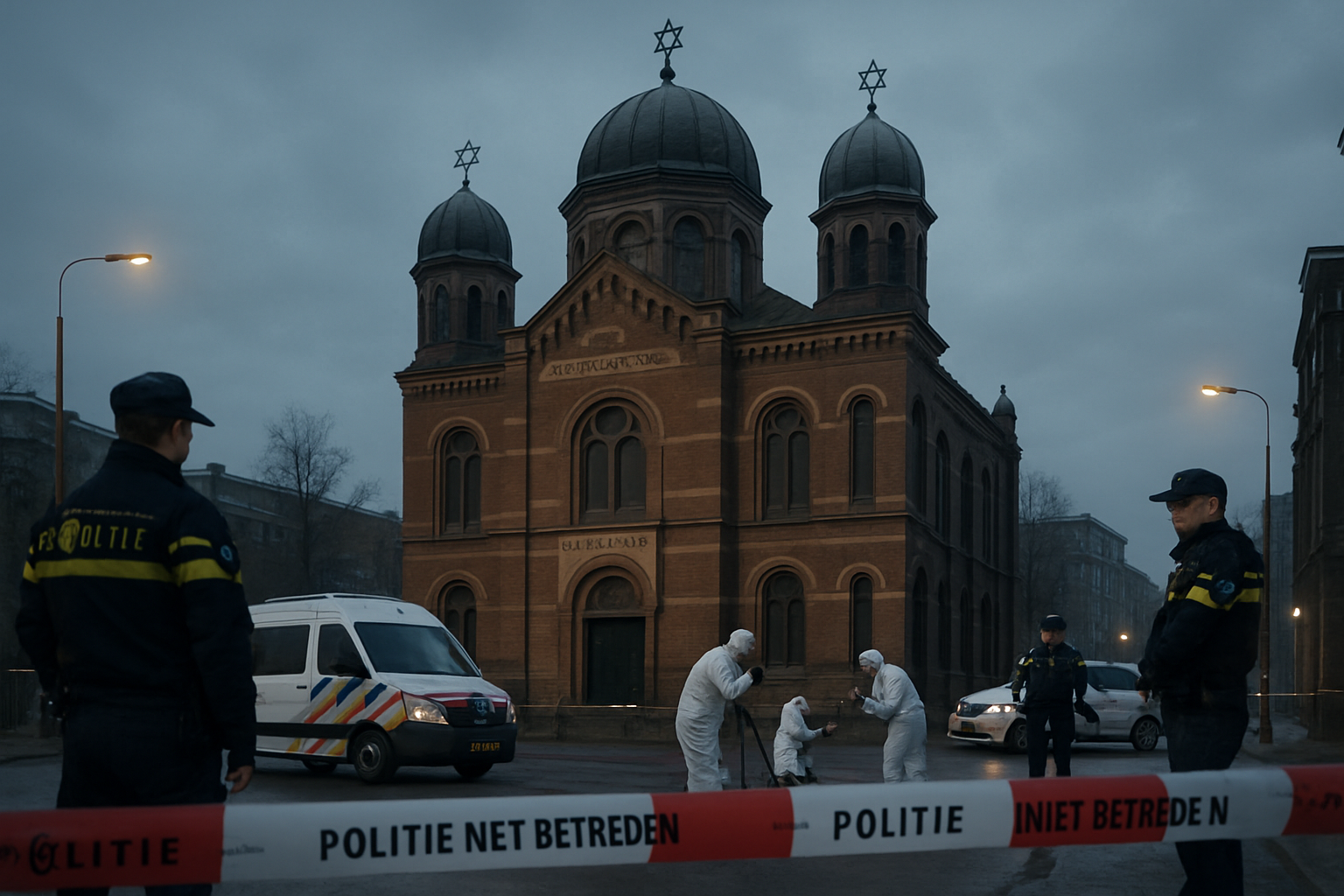
The attack occurred Thursday evening when suspects detonated an explosive device outside the synagogue before setting it ablaze, causing significant structural damage to the building's facade and doors. No injuries were reported as the synagogue was unoccupied at the time of the incident, but the brazen assault has sent shockwaves through Rotterdam's Jewish community and raised urgent questions about the safety of Jewish institutions across the continent.
Details of the Rotterdam Attack
According to multiple law enforcement sources, the perpetrators used what appears to be a coordinated approach involving both explosive devices and accelerants to maximize damage to the synagogue building. Dutch police confirmed that forensic teams discovered evidence of deliberate arson, with witness reports describing a significant explosion followed by rapidly spreading flames.
The synagogue, located in a residential area of Rotterdam, suffered extensive damage to its entrance and front section. Broken windows in surrounding buildings testified to the force of the explosion, while thick smoke and flames were visible from several blocks away.
"This was clearly a targeted attack on our community," said a spokesperson for the Rotterdam Jewish community, who requested anonymity due to security concerns.
— Rotterdam Jewish Community Representative
Police sources indicated that the four arrested suspects may have been planning to attack a second synagogue in the city, suggesting a broader conspiracy aimed at terrorizing the Jewish community. The suspects were apprehended near another Jewish house of worship, though authorities have not released details about their identities or potential motives.
European Context of Rising Antisemitism
The Rotterdam attack represents the latest incident in an alarming surge of antisemitic violence across Europe that has accelerated dramatically since late 2025. The assault follows a devastating pattern of attacks on Jewish communities worldwide, including the December 14, 2025, Bondi Beach Hanukkah festival massacre in Australia that killed 15 people, and the February 21, 2026, Brisbane synagogue ramming attack.
Ireland's Jewish Council documented 143 antisemitic incidents between September 2025 and February 2026, while Belgium recently experienced an explosion at a synagogue in Liège on March 9, 2026. The systematic nature of these attacks has prompted intelligence agencies across Europe to investigate potential coordination and state-level involvement.
Most significantly, British counter-terrorism police recently arrested four men—one Iranian national and three dual British-Iranian citizens—suspected of conducting surveillance operations targeting Jewish community locations and individuals across London. The arrests revealed sophisticated Iranian intelligence networks operating throughout Europe, with similar operations documented in Denmark, Germany, and France.
Security Response and Community Impact
Dutch authorities immediately enhanced security measures at Jewish institutions throughout the Netherlands following the Rotterdam attack. Police increased patrols around synagogues, schools, and community centers, while implementing intelligence-led monitoring protocols in areas with significant Jewish populations.
The attack has created a climate of fear within Dutch Jewish communities, many of whom have already been grappling with increased security concerns following global antisemitic incidents. Community leaders report that some members have begun altering their daily routines and avoiding the display of religious symbols in public.
Mental health services have been made available to affected community members, while interfaith groups across Rotterdam have expressed solidarity with the Jewish community. The attack has also prompted renewed discussions about the adequacy of current hate crime legislation and enforcement mechanisms in the Netherlands.
International Intelligence Connections
European intelligence agencies have documented increasingly sophisticated networks targeting Jewish communities, with particular concern about Iranian state involvement. The timing and methodology of recent attacks suggest coordination that extends beyond individual extremist actions to systematic campaigns designed to terrorize and destabilize Jewish communities across multiple countries.
The Rotterdam attack's technical sophistication—involving both explosive devices and accelerants—mirrors tactics seen in other recent incidents and represents an evolution from previous forms of antisemitic violence. Intelligence sources note similarities to attack methods documented in training materials associated with state-sponsored terrorist organizations.
"The level of planning and coordination we're seeing in these attacks indicates resources and expertise that go beyond individual hate crimes."
— European Counter-terrorism Official (speaking anonymously)
Political and Legal Response
The Dutch government has condemned the attack in the strongest terms, with Prime Minister Mark Rutte calling it "an assault on our democratic values and religious freedom." Justice Minister Dilan Yeşilgöz announced that the case would be treated as a terrorist incident, enabling enhanced investigative powers and potentially more severe sentences for those convicted.
The European Union has also responded, with the European Commission issuing a statement expressing solidarity with the Netherlands and calling for enhanced cooperation among member states to combat antisemitic violence. EU officials indicated that the bloc is considering additional funding for security measures at Jewish institutions across Europe.
Legal experts note that the Rotterdam case will likely serve as a test for the Netherlands' hate crime prosecution capabilities, particularly given the apparent premeditation and potential for additional planned attacks. The investigation is being conducted under terrorism protocols, which allow for extended detention periods and enhanced surveillance of suspect networks.
Broader Implications for European Security
The Rotterdam attack highlights fundamental challenges facing European democracies as they attempt to balance religious freedom with security concerns in an increasingly polarized environment. The systematic targeting of Jewish communities across multiple countries represents a serious challenge to the principles of tolerance and pluralism that underpin European society.
Security experts warn that the current wave of antisemitic violence may be entering a new phase characterized by greater coordination, technical sophistication, and potential state backing. This evolution requires enhanced international cooperation and intelligence sharing to effectively counter transnational threats to vulnerable communities.
The incident also raises questions about the effectiveness of current monitoring systems for detecting and preventing such attacks. Despite increased security awareness following previous incidents, the perpetrators were apparently able to plan and execute a complex attack involving explosive devices without detection.
Community Resilience and Moving Forward
Despite the trauma of the attack, Rotterdam's Jewish community has demonstrated remarkable resilience, with religious services continuing under enhanced security protocols. Community leaders emphasize their determination not to be intimidated by terrorist tactics, while working closely with law enforcement to ensure the safety of all members.
The broader Dutch Jewish community has rallied support, with synagogues across the country implementing enhanced security measures while maintaining their commitment to open worship and community activities. The response reflects a broader pattern seen in other countries where Jewish communities have faced similar attacks—a combination of necessary security precautions with steadfast refusal to abandon religious and cultural practices.
Educational initiatives aimed at combating antisemitism are being expanded, with particular focus on schools and universities where incidents of harassment and discrimination have been reported. These efforts involve not only Jewish organizations but also interfaith groups and secular institutions committed to protecting minority communities.
Investigation Continues
The investigation into the Rotterdam synagogue attack remains ongoing, with police continuing to examine evidence from the scene and analyze potential connections to other antisemitic incidents across Europe. Authorities are working with international partners to determine whether the suspects had connections to broader networks or received support from foreign actors.
The four arrested suspects remain in custody pending formal charges, with prosecutors indicating that additional arrests are possible as the investigation expands. Dutch intelligence services are conducting comprehensive background checks and examining digital evidence that may reveal the scope of the conspiracy.
The case represents a critical test for European law enforcement's ability to effectively investigate and prosecute complex antisemitic terrorism cases while maintaining democratic principles and due process rights. Success in bringing the perpetrators to justice and dismantling any associated networks will be crucial for maintaining public confidence in the security apparatus and demonstrating that such attacks will not be tolerated.
As Europe grapples with this latest manifestation of antisemitic violence, the Rotterdam attack serves as a stark reminder of the ongoing threats facing Jewish communities and the urgent need for comprehensive strategies to protect religious minorities while preserving the open, pluralistic societies that define modern European democracy.