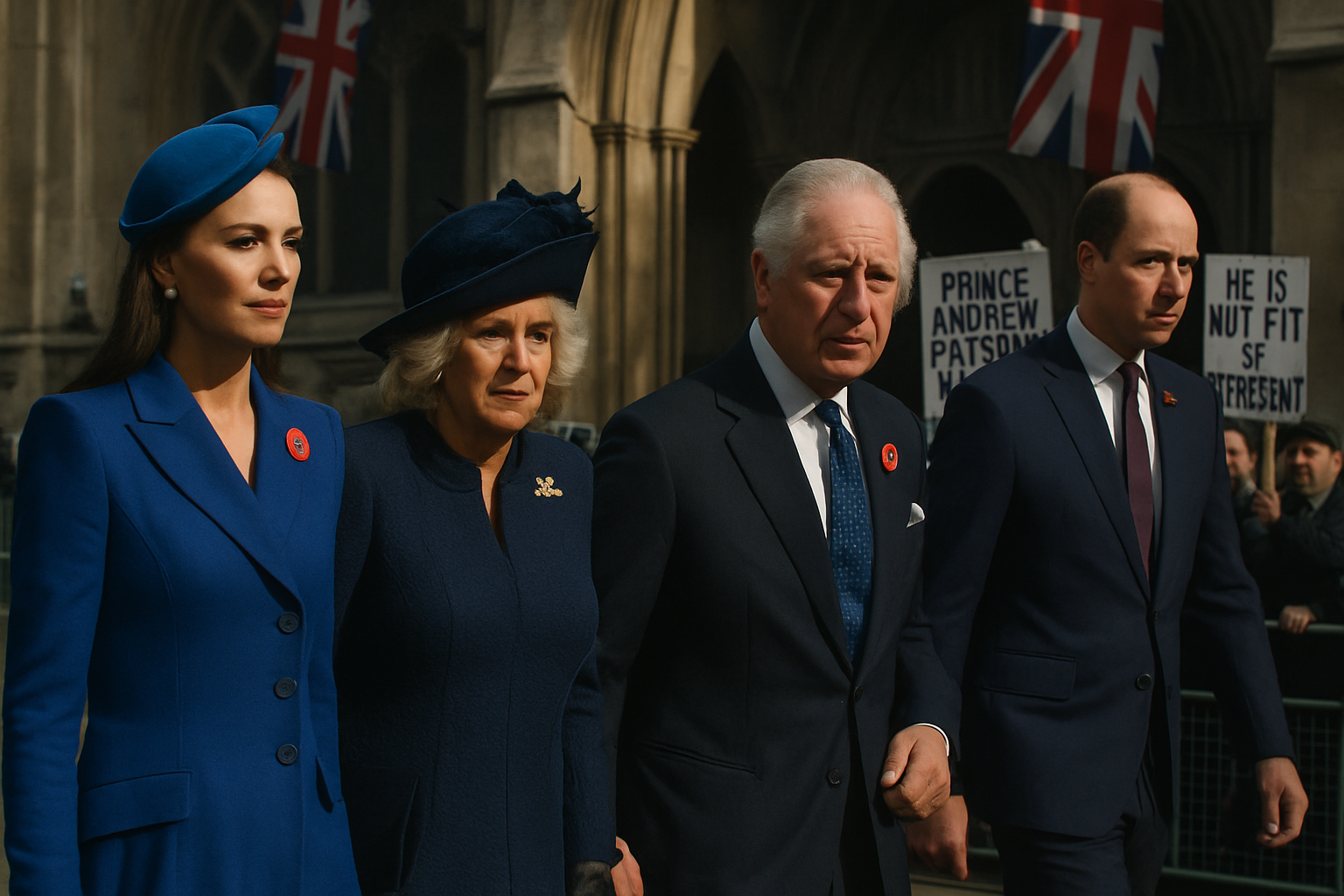
King Charles III delivered his Commonwealth Day address at Westminster Abbey on March 10, 2026, celebrating the organization's "enduring spirit" while facing unprecedented public hostility as protesters outside targeted the royal family over Prince Andrew's criminal investigation.
The largest royal gathering in London since Andrew Mountbatten-Windsor's historic arrest on February 19, 2026, was marked by hostile crowds surrounding Westminster Abbey. Greek media reports described "intensive disapproval" directed at Prince William and Catherine, Princess of Wales, as they arrived for the ceremony, with organized demonstrations explicitly referencing the Prince Andrew scandal that has engulfed the monarchy.
Video footage captured by Cypriot media outlets showed concentrated crowds booing and jeering the royal couple outside Westminster Abbey, with protesters carrying signs demanding accountability for Andrew's alleged connections to Jeffrey Epstein. The demonstration represents the most significant public confrontation the royal family has faced since Andrew's arrest made him the first senior British royal detained since King Charles I in 1647.
Commonwealth Day Ceremony Proceeds Amid Crisis
Despite the hostile atmosphere outside, King Charles proceeded with the traditional Commonwealth Day service inside Westminster Abbey, delivering remarks that praised the Commonwealth's "enduring spirit" and its role in promoting global cooperation. The ceremony, attended by senior royals and Commonwealth representatives, maintained its ceremonial protocols while the monarchy faces its gravest constitutional crisis in centuries.
The King's speech made no direct reference to the ongoing Andrew investigation, but royal observers noted the symbolic importance of emphasizing Commonwealth unity during a period when the monarchy's moral authority faces unprecedented scrutiny. The annual service traditionally celebrates shared values across the 54-nation Commonwealth, though this year's event occurred against the backdrop of criminal proceedings against the monarch's brother.
Westminster Abbey's security was significantly enhanced for the March 10 ceremony, with Metropolitan Police establishing expanded perimeters around the historic venue. Despite these measures, protesters successfully maintained their presence throughout the service, with their chants reportedly audible inside the abbey during quieter moments of the ceremony.
Andrew Scandal Deepens Public Anger
The public hostility reflects mounting anger over Prince Andrew's February 19, 2026 arrest on suspicion of misconduct in public office related to Jeffrey Epstein connections. Thames Valley Police detained Andrew for 11 hours at Aylsham Police Station before releasing him under investigation, marking the first arrest of a British royal family member in modern history.
Central to the investigation are allegations that Andrew shared classified Afghanistan intelligence, including sensitive Helmand province data on gold, uranium, and oil reserves, with convicted sex offender Jeffrey Epstein during a December 24, 2010 email exchange. The alleged breach occurred during Andrew's tenure as UK Special Representative for International Trade and Investment, potentially violating trade envoy protocols and the Official Secrets Act.
The scandal has intensified following revelations from newly released Epstein documents showing extensive correspondence between Andrew and Epstein's associates. Government sources confirm the investigation encompasses Andrew's use of official diplomatic positions to facilitate personal relationships with Epstein, including during state visits with Queen Elizabeth II.
Constitutional Monarchy Under Pressure
King Charles III has maintained an unprecedented stance of supporting the criminal investigation against his brother, declaring that "the law must take its course" with his "full and wholehearted support and cooperation." This represents a seismic shift in royal protocol, with the monarch publicly backing police action against a family member to preserve institutional integrity.
Parliamentary sources indicate active government consideration of legislation to remove Andrew from the royal line of succession, which would require an Act of Parliament plus consultations across the 14 Commonwealth realms where Charles serves as head of state. Defence Minister Luke Pollard has confirmed the government is working with Buckingham Palace to prevent Andrew from being a "heartbeat away from the throne."
The succession removal process, unprecedented in modern British history, reflects the gravity of the situation facing the monarchy. Andrew currently remains eighth in line to the throne despite losing all royal titles and patronages in January 2022 and relocating from Royal Lodge Windsor to Sandringham Estate in February 2026.
International Investigation Context
The Andrew case represents one element of what European law enforcement describes as the "largest international elite criminal network exposure in recent memory," spanning six countries investigating Jeffrey Epstein connections. The coordinated international effort has already resulted in multiple high-profile resignations and investigations across Europe and North America.
Crown Princess Mette-Marit of Norway faces potential criminal proceedings after appearing over 1,000 times in Epstein documents, while the Council of Europe took the unprecedented step of stripping former Secretary-General Thorbjørn Jagland of diplomatic immunity to enable corruption investigations. France has established specialized prosecutors to examine Epstein connections among French citizens.
The investigation has revealed systematic attempts by Epstein's network to cultivate relationships with political and royal figures across multiple continents, using official diplomatic channels and state functions to establish and maintain these connections. British authorities are examining whether Andrew's case represents part of this broader pattern of elite network cultivation.
Public Trust and Royal Legitimacy
Polling data shows 72% of the British public support Andrew's arrest and investigation as proof that no one is above the law, contrasting sharply with previous decades when royal scandals were handled privately within palace walls. The Commonwealth Day protests reflect this shifted public mood, with citizens demanding accountability rather than deference.
Royal experts note that the monarchy's survival depends on demonstrating its commitment to democratic principles and rule of law. The King's decision to support the investigation over family loyalty represents a calculated strategy to preserve the institution's legitimacy, though success is not guaranteed given the severity of the allegations.
The hostile reception at Commonwealth Day demonstrates the challenge facing the royal family in maintaining public support during an active criminal investigation. Unlike historical royal scandals involving personal conduct, the Andrew case involves potential criminal behavior using official state functions, making it impossible to treat as a private family matter.
Legal Proceedings Continue
Thames Valley Police continue their investigation with no definitive timeline for completion. The Crown Prosecution Service is reviewing evidence to determine whether formal charges should be brought against Andrew, with misconduct in public office carrying serious penalties including potential imprisonment.
Metropolitan Police have also been examining Andrew's former protection officers from his working royal period (2001-2011), seeking information about what they "saw or heard" during his official duties. Property searches at both Sandringham Estate and Andrew's former Royal Lodge Windsor residence have been completed.
The investigation's outcome will establish crucial precedents for constitutional monarchies globally regarding accountability for royal family members. Legal experts emphasize that British royals, unlike some European counterparts, do not enjoy constitutional immunity from criminal prosecution, making this a genuine test of democratic institutions.
Commonwealth Implications
The timing of the public hostility during Commonwealth Day carries particular symbolic weight, as the event celebrates the voluntary association of nations that largely emerged from the former British Empire. The monarchy's role as the symbolic head of the Commonwealth depends on moral authority that the Andrew scandal directly challenges.
Several Commonwealth nations have privately expressed concern about the scandal's impact on their constitutional arrangements, though no formal moves have been made to alter relationships with the Crown. However, the succession removal legislation being considered would require extensive consultations across all Commonwealth realms where Charles is head of state.
The successful resolution of the crisis could strengthen the Commonwealth by demonstrating the monarchy's commitment to accountability and rule of law. Conversely, continued controversy could accelerate existing republican movements in several Commonwealth nations, fundamentally altering the organization's structure and purpose.
As investigations continue and public pressure mounts, the events of March 10, 2026, may be remembered as a pivotal moment when the British monarchy faced its most severe test of legitimacy since World War II, with the outcome determining whether the institution can adapt to 21st-century expectations of democratic accountability.