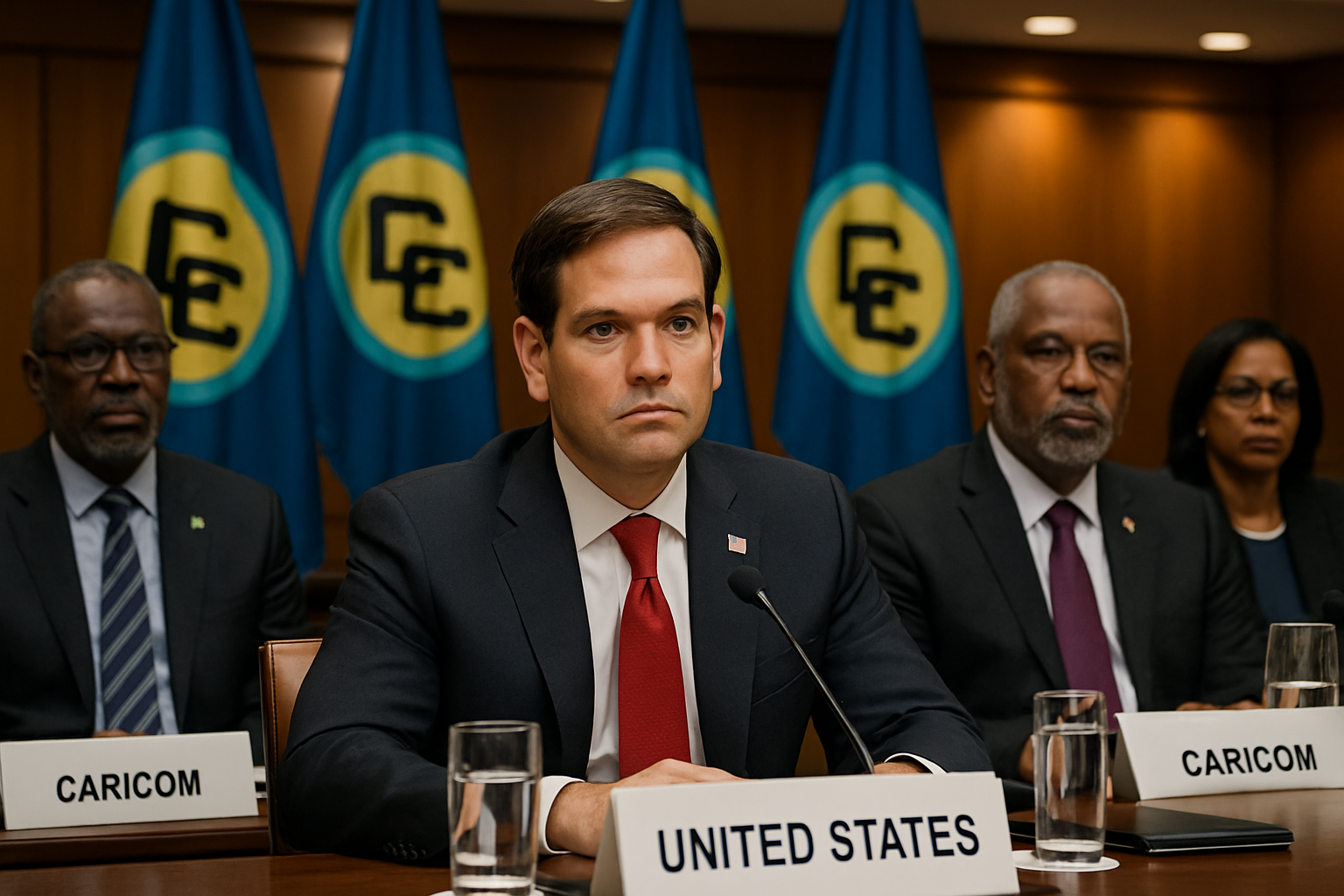
US Secretary of State Marco Rubio made a historic diplomatic appearance at CARICOM's 50th anniversary summit in Saint Kitts and Nevis, marking a pivotal moment in Caribbean-American relations as the Trump administration seeks to strengthen regional partnerships amid ongoing security challenges and evolving geopolitical dynamics.
The high-profile visit to Basseterre positioned Rubio as the highest-ranking US official to visit Saint Kitts and Nevis, underlining the strategic importance the Trump administration places on Caribbean cooperation. Arriving as a special guest to the summit chaired by Prime Minister Dr. Terrance Drew, Rubio addressed over 200 regional and international leaders during what Chairman Drew described as CARICOM's "decisive hour."
Strategic Partnership Initiatives
During the summit, Rubio pledged comprehensive US support across multiple sectors, emphasizing regional security cooperation, economic development, and energy partnerships. The Secretary of State outlined enhanced collaboration frameworks designed to strengthen Caribbean economies while addressing shared security concerns, particularly in counter-narcotics operations and maritime security.
The diplomatic engagement comes as part of the broader "Corolario Trump" strategy—a 21st-century update of the Monroe Doctrine that combines military deterrence with selective economic partnerships. This approach has already yielded significant results in Venezuela, where US-backed regime change led to a dramatic expansion in oil cooperation and political prisoner releases.
Regional Divisions and Sovereignty Concerns
However, Rubio's mission unfolded against a backdrop of unprecedented regional divisions over US military operations in Caribbean waters. The February 13 drone strike in Saint Vincent and the Grenadines' territorial waters, which seized $500 million worth of cocaine without prior diplomatic notification to Prime Minister Dr. Godwin Friday, has raised serious questions about territorial sovereignty and international law compliance.
"Don't talk to me about zone of peace."
— Kamala Persad-Bissessar, Trinidad Prime Minister
The controversy intensified when Trinidad's Prime Minister Kamla Persad-Bissessar delivered a startling defense of US military operations while dismissing CARICOM's traditional "zone of peace" policy. Her remarks created what observers described as a fundamental breach of Caribbean diplomatic norms, with opposition parties calling her statements "revolting and bizarre."
Operation Southern Spear's Caribbean Impact
The summit discussions occurred amid ongoing concerns about Operation Southern Spear, the comprehensive US counter-narcotics campaign that has resulted in over 145 deaths since September 2025. Three Saint Lucian fishermen were reportedly killed in separate US operations, creating anxiety within fishing communities throughout the region's traditional maritime zones.
CARICOM Secretary General Dr. Carla Barnett made an urgent appeal for coordinated foreign policy among member states, highlighting the organization's struggle to maintain unity while individual nations face competing pressures from great power relationships and domestic security needs.
Energy Diplomacy and Economic Cooperation
A significant focus of Rubio's bilateral discussions centered on energy partnerships, particularly Trinidad's plans to restart the Petrotrin refinery in Guaracara. Prime Minister Persad-Bissessar revealed that the refinery project was central to her talks with Rubio, reflecting broader US energy cooperation strategies that have proven successful in Venezuela.
The energy discussions build on Energy Secretary Chris Wright's groundbreaking February visit to Venezuela, which ended the 2019 oil embargo through comprehensive cooperation agreements. Venezuelan oil exports have surged 60% to 800,000 barrels daily, with the US displacing China as the top customer—a model the Trump administration hopes to replicate across the Caribbean.
Cuba Crisis and Regional Response
The summit also addressed Cuba's unprecedented energy crisis, with the island facing complete aviation isolation through March 11 and 51% of the population experiencing scheduled blackouts. Chairman Drew called for coordinated CARICOM responses to the humanitarian situation, though members remain divided between engagement and pressure approaches toward the communist island.
The Cuban crisis, largely attributed to Trump's maximum pressure campaign that forced Mexico and Venezuela to halt oil shipments, serves as both a demonstration of American economic power and a warning about the consequences of opposing US regional interests.
Future Engagement Framework
Looking ahead, Rubio's mission established a framework for sustained high-level diplomatic engagement. Guyana President Irfaan Ali and Trinidad Prime Minister Persad-Bissessar are scheduled to meet with President Trump in Miami on March 7, focusing on security cooperation and economic development initiatives.
This represents the continuation of unprecedented US-Caribbean diplomatic engagement, with potential implications extending far beyond the immediate region. The success or failure of these partnerships could serve as a template for American influence operations globally, particularly in countering Chinese economic penetration in developing nations.
Institutional Challenges and Caribbean Unity
The summit exposed fundamental questions about CARICOM's institutional relevance for the next fifty years. Jamaica Prime Minister Andrew Holness clarified that "CARICOM is not a political union" and cannot override national sovereignty, highlighting integration limits when member states face competing international pressures.
What should have been a celebration of fifty years of Caribbean integration instead became a forum for fundamental disagreements about the organization's direction and its ability to maintain unity while accommodating diverse perspectives on security cooperation, territorial sovereignty, and great power relationships.
Strategic Implications
Rubio's Caribbean mission represents a critical test of small island developing state autonomy amid intensifying great power competition. The outcome will determine whether CARICOM can maintain institutional unity while individual members pursue varying degrees of cooperation with external powers, or whether the organization requires fundamental restructuring to remain relevant.
The summit's legacy extends beyond Caribbean regional politics to broader questions of international law, territorial sovereignty, and the balance between security cooperation and national autonomy in an era of renewed great power competition. As the Trump administration continues to implement its Western Hemisphere strategy, the Caribbean increasingly serves as a laboratory for testing new forms of American influence and partnership in the 21st century.