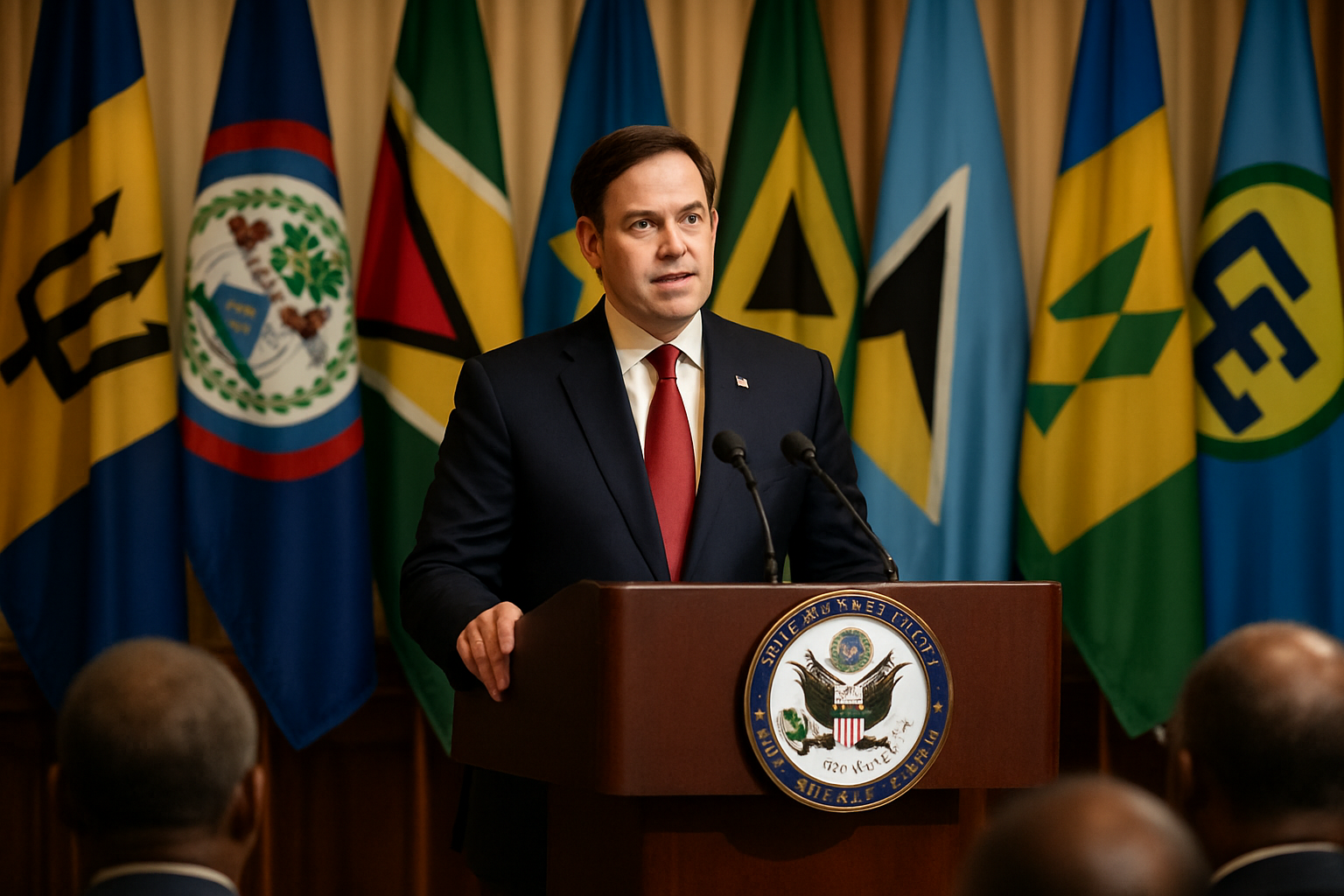
US Secretary of State Marco Rubio defended the Trump administration's controversial military operation that led to the capture of Venezuela's Nicolás Maduro during a closed-door session with Caribbean Community (CARICOM) leaders at their historic 50th summit in Basseterre, St. Kitts and Nevis, brushing aside regional concerns about legality while promoting closer US-Caribbean cooperation.
The high-profile diplomatic encounter, occurring at the milestone 50th Regular Meeting of the Conference of Heads of Government, exposed unprecedented divisions within CARICOM over US military operations in the region, sovereignty concerns, and the appropriate response to Venezuela's political transformation under Acting President Delcy Rodríguez.
Rubio's Defense of Venezuela Operation
According to a transcript later released by the US State Department, Rubio told the gathering of 15-member Caribbean Community leaders that both Venezuela and the wider region are better off following Maduro's January 2026 removal. Despite differing views within the region about the operation's legality, the top US diplomat cited what he described as "substantial" progress by Venezuelan interim authorities, including changes that would have been "unimaginable" weeks earlier.
The secretary's remarks came as Venezuela has undergone rapid economic and political transformation, with oil exports surging 60% to 800,000 barrels daily and the US displacing China as Venezuela's top customer. Over 750 political prisoners have been released under a comprehensive amnesty law covering the period from 1999-2026, representing the most ambitious political reconciliation effort in recent Latin American history.
Regional Divisions Over Security Cooperation
The summit revealed sharp divisions among Caribbean nations regarding Operation Southern Spear, the US military campaign that has resulted in 145+ deaths since September 2025. Trinidad and Tobago Prime Minister Kamla Persad-Bissessar delivered what observers called a "scathing address" defending her country's support for US military operations while dismissing CARICOM's traditional "zone of peace" policy.
"Don't talk to me about zone of peace," Persad-Bissessar reportedly told fellow leaders, creating what opposition figures described as a "fundamental breach of Caribbean diplomatic norms." The remarks highlighted the tension between some nations' desire for enhanced security cooperation with Washington and others' concerns about sovereignty violations.
"We believe that perhaps the most urgent security threat in the region—that includes us, but obviously affects you—are these transnational criminal networks."
— Marco Rubio, US Secretary of State
Sovereignty Concerns and Maritime Operations
Several Caribbean leaders raised concerns about a February 13 US drone strike in Saint Vincent and the Grenadines' territorial waters that seized $500 million worth of cocaine without prior diplomatic notification. SVG Prime Minister Dr. Godwin Friday, who serves as OECS Chairman, received no official information about the operation beforehand, raising questions about respect for territorial sovereignty.
The incident has created anxiety among Caribbean fishing communities, with reports that three Saint Lucian fishermen were killed in separate US operations. The Royal SVG Police issued guidance for fishermen to maintain operations while staying in communication with authorities, highlighting the impact of increased militarization on traditional maritime activities.
Cuba Crisis and Regional Response
CARICOM Chairman Dr. Terrence Drew acknowledged the organization faces a "decisive hour" amid mounting global pressures, specifically referencing Cuba's unprecedented humanitarian crisis. The island nation is experiencing its worst energy shortage since the 1990s Special Period, with complete aviation isolation through March 11, 2026, and 51% of the population experiencing scheduled blackouts.
The Cuban crisis has created additional divisions within CARICOM, with some members advocating humanitarian assistance and diplomatic engagement while others support maintaining pressure aligned with US policy. Chairman Drew called for coordinated regional responses to the economic isolation affecting regional stability.
Energy Cooperation and Economic Transformation
During bilateral meetings on the summit sidelines, Trinidad and Tobago Prime Minister Persad-Bissessar revealed that restarting the former Petrotrin (Guaracara) refinery was a central focus of her discussions with Rubio. The talks represent part of broader US efforts to deepen energy and security cooperation throughout the Caribbean as Washington seeks to counter Chinese influence in the region.
The energy discussions take place against the backdrop of Venezuela's remarkable economic transformation, with Energy Secretary Chris Wright's February visit to Caracas resulting in comprehensive cooperation agreements that formally ended the 2019 oil embargo. The partnership has enabled Venezuela to dramatically increase production while providing the US with alternative energy sources.
Institutional Challenges for CARICOM
What should have been a celebration of CARICOM's 50-year milestone became a forum for fundamental disagreements about the organization's direction and relevance. Jamaica Prime Minister Andrew Holness clarified that "CARICOM is not a political union" and cannot override member sovereignty, highlighting the limits of regional integration when nations face competing security and economic pressures.
The summit exposed questions about whether CARICOM can maintain unity while accommodating diverse member perspectives on external relationships, or if the organization requires fundamental restructuring to remain relevant in an increasingly polarized geopolitical environment.
Future Diplomatic Engagement
Looking ahead, Guyana President Dr. Irfaan Ali and Trinidad PM Persad-Bissessar are scheduled to meet with President Donald Trump in Miami on March 7, representing continued high-level diplomatic engagement between Caribbean leaders and Washington. These meetings will likely focus on security cooperation, economic development, and the evolving partnership framework between the US and Caribbean nations.
Rubio's presence at the summit, which made him the highest-ranking US official ever to visit St. Kitts and Nevis, underscores the Trump administration's renewed focus on the Western Hemisphere as part of what officials call the "Corolario Trump" strategy—a 21st-century update to the Monroe Doctrine combining military pressure, economic incentives, and selective diplomatic engagement.
Regional Security Architecture Evolution
The summit outcomes will likely determine whether CARICOM can maintain institutional unity while individual members pursue different approaches to security cooperation and economic partnerships. The organization faces the challenge of balancing national sovereignty principles with practical security needs in an era of increased transnational criminal activity and great power competition.
As Caribbean leaders navigate these complex dynamics, the success or failure of finding consensus on regional security cooperation will influence not only the future of CARICOM but also serve as a template for how small island developing states can maintain autonomy while engaging with major powers in an increasingly multipolar world.
The 50th CARICOM summit has thus become a watershed moment that may define Caribbean integration for the next five decades, testing whether the organization can adapt to contemporary security challenges while preserving the sovereignty and independence that have been cornerstones of Caribbean diplomacy since the Cold War era.