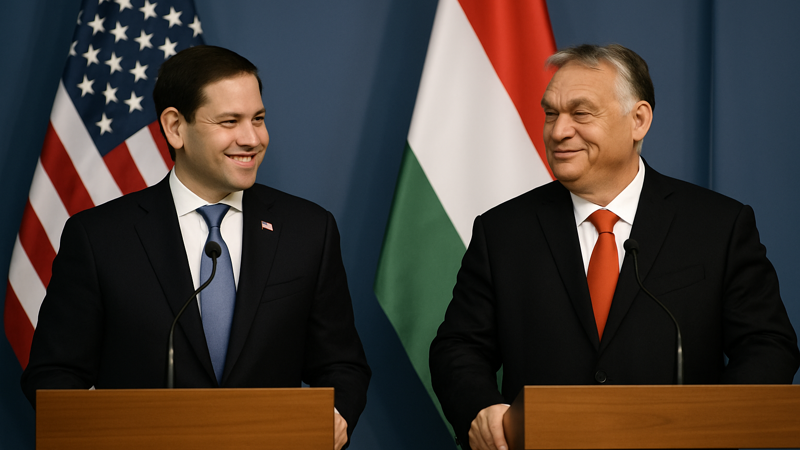
US Secretary of State Marco Rubio concluded his whirlwind European tour with an unprecedented show of support for Hungarian Prime Minister Viktor Orban, declaring that President Trump is "profoundly attached to your success" ahead of Hungary's critical April 12 elections.
The Budapest meeting, held at the Carmelita Monastery on February 16, 2026, represents a dramatic departure from traditional US diplomatic neutrality in European elections. Rubio's explicit endorsement of Orban comes at a crucial moment when the Hungarian leader faces his most challenging electoral battle since returning to power, with his Fidesz party trailing in recent polls for the first time in over a decade.
Strategic Alliance Reinforced
During his Budapest press conference, Rubio delivered one of the most direct diplomatic endorsements in recent US-European relations history. "I can tell you with certainty that President Trump is profoundly attached to your success, because your success is our success," Rubio declared, standing alongside Orban at the Hungarian government headquarters.
The Secretary of State's comments went beyond traditional diplomatic courtesy, explicitly linking American interests to Orban's electoral fortunes. "Your victory is our victory," Rubio emphasized, making clear the Trump administration's investment in maintaining Orban's leadership of the European Union member state.
Orban described the discussions as "cordial, friendly, and serious," while conveying Trump's invitation for a future visit. The Hungarian Prime Minister has positioned himself as one of Trump's closest European allies, frequently clashing with Brussels over migration, rule of law, and sanctions policy.
Electoral Context and International Stakes
The timing of Rubio's endorsement carries significant weight as Orban, 62, confronts his most formidable political challenge since 2010. Recent polling data shows his Fidesz party being overtaken by opposition coalitions, marking an unprecedented shift in Hungarian politics. The April 12 parliamentary elections could determine not only Hungary's domestic trajectory but also its role within European Union frameworks.
European officials have expressed concern about what they characterize as explicit American interference in EU member state elections. The endorsement follows a pattern of Trump administration support for nationalist and conservative leaders across Europe, departing from the traditional US approach of maintaining neutrality in allied nations' democratic processes.
France 24's International Affairs Editor Kethevane Gorjestani noted that "Donald Trump has been endorsing like-minded, conservative nationalist leaders around the world," representing a significant departure from precedent where US presidents typically avoid taking sides in other countries' domestic politics.
Broader European Tour Implications
Rubio's Budapest visit formed part of a broader European diplomatic mission that included meetings with Slovakia's Prime Minister Robert Fico, another leader viewed as sympathetic to Trump's approach. The Secretary of State's tour follows his participation in the Munich Security Conference, where he attempted to repair transatlantic relations damaged by previous Trump administration statements.
The tour's selective engagement pattern—focusing on leaders considered most aligned with Trump's worldview—signals a fundamental shift in American diplomatic strategy toward Europe. Rather than engaging broadly with established EU leadership, the administration appears to be cultivating relationships with specific leaders who share its skepticism toward Brussels-based governance.
During his Budapest appearance, Rubio avoided giving definitive answers about Hungary's exemption from oil sanctions, suggesting that such arrangements depend heavily on the "personal relationship between Orban and Trump." This approach represents a significant departure from multilateral policy frameworks traditionally governing transatlantic relations.
Policy Implications and Reactions
The explicit American support comes as Hungary continues to maintain positions at odds with broader EU consensus on multiple issues. Budapest has consistently opposed aspects of sanctions against Russia, maintained economic relationships that other EU members have severed, and taken independent stances on migration and judicial reforms that have triggered Article 7 procedures.
Portuguese media characterized Orban as facing "the most difficult challenge since his return to power," noting that his ultranationalist positions, while resonating with his base, have created friction with European institutions and fellow member states. The American endorsement provides crucial international legitimacy as opposition forces unite around democratic governance and rule of law themes.
Swiss analysis suggests the meeting demonstrates "demonstrative proximity to those forces that torpedo Brussels' unity," indicating how American support could further complicate European Union cohesion efforts. The endorsement potentially strengthens Orban's domestic narrative that Hungary represents an alternative model within the EU framework.
Strategic Context and Future Relations
The Rubio-Orban meeting occurs against the backdrop of evolving transatlantic relations under the second Trump presidency. The administration has signaled preference for bilateral relationships over multilateral frameworks, particularly with leaders who share its approach to sovereignty, migration, and economic policy.
For Orban, the American endorsement provides crucial external validation as domestic polling suggests growing electoral challenges. The Hungarian leader has consistently positioned himself as a defender of traditional European values against what he characterizes as liberal overreach from Brussels institutions.
European observers note that the American engagement strategy could influence other member states' approaches to their relationships with Washington versus Brussels. The selective support for certain leaders over others represents a departure from traditional American support for European integration and institutional cooperation.
Implications for European Governance
The explicit American support for Orban ahead of crucial elections raises fundamental questions about external influence in EU member state democratic processes. While the United States has historically maintained relationships across European political spectrums, the level of explicit electoral support represents an unprecedented intervention in EU internal affairs.
As the April 12 elections approach, the American endorsement will likely feature prominently in Hungarian campaign discourse. Opposition parties may frame the election as a choice between European integration and American-aligned isolationism, while Orban's supporters will emphasize the strength of bilateral relationships with the world's largest economy.
The success or failure of this diplomatic strategy will influence American engagement approaches throughout Europe, potentially reshaping transatlantic relationships for the remainder of the Trump presidency and beyond. The precedent established in Hungary may extend to other European elections where Washington perceives strategic interests in particular outcomes.