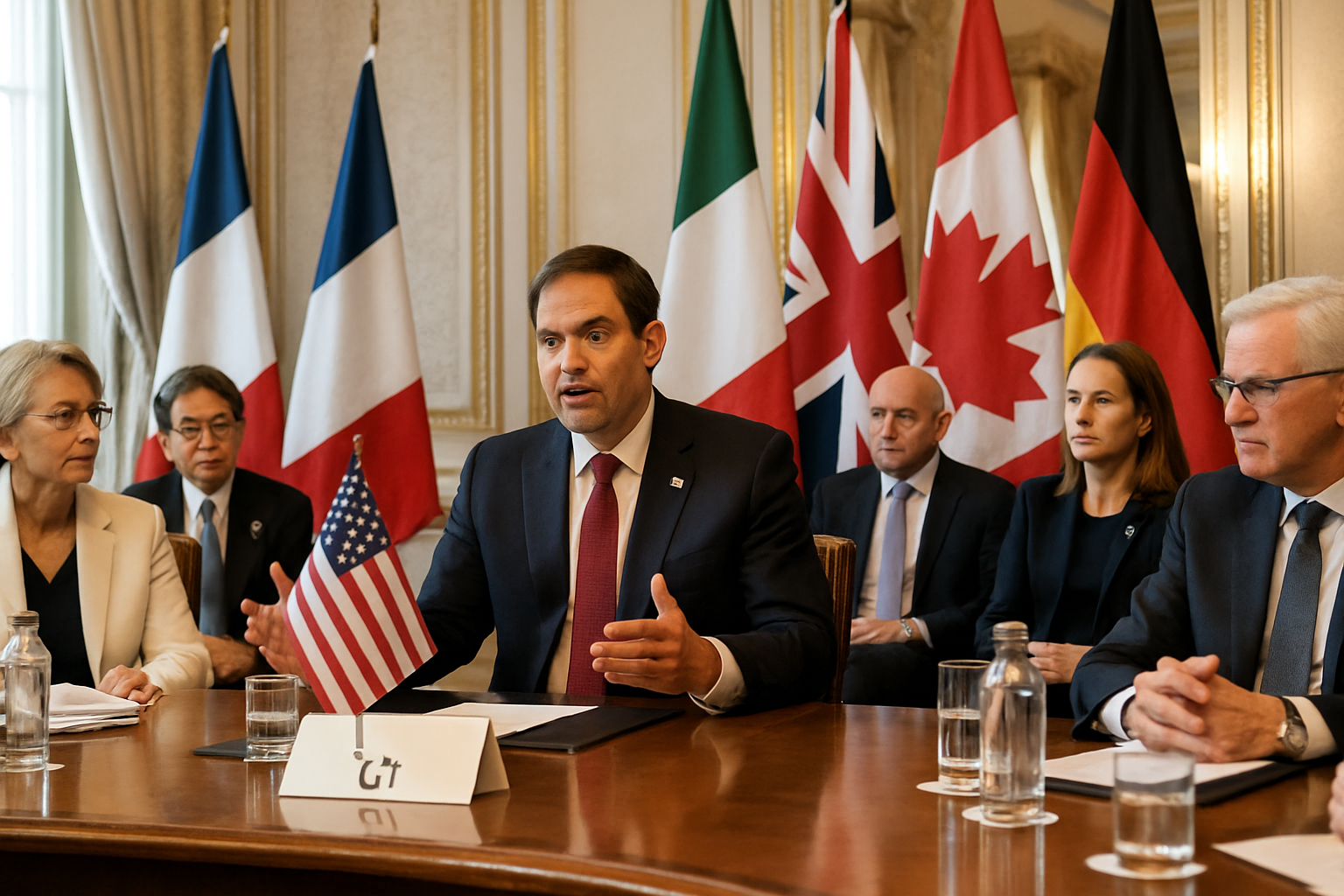
US Secretary of State Marco Rubio told G7 allies meeting in France that America's military operations against Iran will wrap up "within weeks, not months" without requiring ground troops, as the international coalition adopted a joint declaration demanding Iran halt attacks on civilian populations and restore freedom of navigation in the Strait of Hormuz.
Speaking to reporters after meeting with G7 counterparts, Rubio stated that Washington was "on or ahead of schedule in that operation, and expect to conclude it at the appropriate time here — a matter of weeks, not months." The comments represent the most definitive timeline provided by US officials since Operation Epic Fury began, marking the largest coordinated US-Israeli military campaign since the 2003 Iraq invasion.
Strategic Assessment and Military Deployment
Rubio emphasized that the United States can achieve all its military objectives without deploying ground forces, relying instead on the unprecedented dual-carrier deployment of the USS Gerald R. Ford and USS Abraham Lincoln, which represents approximately one-third of the active US Navy fleet positioned in the Arabian Sea. "While he said Washington could achieve its aims without ground troops, he acknowledged that it was deploying some to the region to give the president maximum optionality and maximum opportunity to adjust the contingencies, should they emerge," according to Pakistani news sources.
The Pentagon has already dispatched two contingents of thousands of Marines to the region, with the first contingent due to arrive by the end of March aboard a massive amphibious assault ship. Thousands of elite airborne soldiers from the 82nd Airborne Division are also being deployed to coordinate regional operations, marking the largest US deployment to the Gulf since the Iraq War.
G7 Diplomatic Response
The G7 foreign ministers issued a coordinated statement calling for an immediate halt to attacks against civilian populations during the ongoing Middle East conflict. The declaration specifically addressed Iran's Revolutionary Guard Corps' systematic targeting campaign, dubbed "Operation True Promise 4," which has resulted in casualties across Gulf states and the first attack on European territory since World War II when Iranian drones struck RAF Akrotiri in Cyprus.
French Foreign Minister Jean-Noël Barrot used the gathering to rebuke Russian Foreign Minister Sergei Lavrov's recent television appearance, stating: "You do not defend international law by launching a war of aggression." The comment reflects the complex diplomatic calculations as G7 nations attempt to balance alliance solidarity with broader regional stability concerns.
Global Economic Crisis Deepens
The Iran crisis has triggered the most severe global energy emergency since the 1970s oil shocks. Oil prices have surged past $100 per barrel for the first time since 2022, reaching peaks of $119.50 for Brent crude and $108.15 for WTI—representing an 18.98% single-day jump that set records. Iran's declaration that the Strait of Hormuz is "unsafe for shipping" has effectively blocked 40% of global seaborne oil transit through the critical 21-mile chokepoint.
The International Energy Agency (IEA) has coordinated the largest petroleum reserve release in its 50-year history, deploying 400 million barrels from 32 countries—double the amount released during the 2022 Ukraine crisis. Japan is releasing 80 million barrels for the first time since the 2011 Fukushima disaster, while Germany has confirmed participation in the coordinated response.
Humanitarian Toll and Regional Impact
The conflict has generated unprecedented humanitarian and economic disruptions worldwide. Aviation authorities have cancelled over 18,000 flights globally—the most extensive disruption since COVID-19—with eight Middle Eastern countries simultaneously closing their airspace. Dubai International Airport, the world's busiest with 86 million annual passengers, remains completely shut down due to missile damage.
Regional casualties continue to mount from Iran's systematic targeting campaign. The UAE reported one civilian killed in Abu Dhabi, Kuwait documented 32 injuries from airport strikes, and Qatar recorded eight wounded despite successfully intercepting 65 missiles and 12 drones using Patriot defense systems. The Iranian Red Crescent has documented 787+ civilian casualties from US-Israeli strikes, including a devastating attack on a girls' school in Minab that killed 53-85 students and staff.
Nuclear Diplomacy Collapse
The military escalation followed the complete breakdown of US-Iran nuclear negotiations despite achieving what Iranian Foreign Minister Abbas Araghchi called "broad agreement on guiding principles"—the most significant diplomatic progress since the collapse of the Joint Comprehensive Plan of Action (JCPOA) in 2018. The fundamental disagreement proved insurmountable: Iran insisted on nuclear-only talks excluding ballistic missiles and regional proxies as "red lines," while Rubio demanded comprehensive agreements addressing missiles, armed groups, and human rights violations.
Iran continues uranium enrichment at 60% purity with over 400 kilograms of enriched material, approaching weapons-grade levels and providing sufficient material for multiple nuclear weapons if weaponized. The crisis occurs amid a broader nuclear governance breakdown, with the New START treaty between the US and Russia having expired in February 2026—the first time in over 50 years without nuclear constraints between the superpowers.
International Evacuation and Alliance Strain
The crisis has prompted the largest international evacuation since the Arab Spring of 2011, with multiple European governments activating emergency protocols. Cyprus implemented its ESTIA evacuation plan for the first time, coordinating the extraction of over 2,000 EU nationals from the UAE following the Iranian drone strikes—representing a watershed moment in EU crisis management.
The unprecedented regional coalition of Saudi Arabia, UAE, Qatar, and Egypt that had supported diplomatic efforts now faces severe strain as Iranian attacks directly target their territories. Egyptian President Abdel Fattah el-Sisi condemned attacks on "sisterly countries" and warned of "comprehensive chaos," highlighting how the alliance consensus is fracturing under direct military pressure.
Financial Markets in Turmoil
Global financial markets have experienced severe disruptions, with Pakistan's KSE-100 index recording its largest single-day decline in history at -8.97%, while South Korea's KOSPI fell 12%, triggering circuit breakers as the Korean won hit a 17-year low. Consumer impacts are being felt worldwide, with Bangladesh implementing fuel rationing for 170 million people, Pakistan adopting wartime austerity measures including four-day government work weeks, and multiple European nations implementing emergency fuel price controls.
Strategic Implications
UN Secretary-General António Guterres has characterized the current crisis as the "greatest test of multilateral cooperation in the modern era." The rapid transition from diplomatic engagement to military confrontation demonstrates what experts describe as the fragility of crisis management in the multipolar era.
As Rubio concluded his meetings in France, the success or failure of containing this escalation will likely provide a template for 21st-century nuclear crisis resolution. Success could strengthen diplomatic precedents and reinforce international cooperation frameworks, while failure may accelerate military solutions and encourage nuclear proliferation worldwide, fundamentally undermining diplomatic credibility for decades to come.
The coming weeks will prove decisive not only for Middle Eastern stability but for the broader architecture of international crisis management in an increasingly volatile and interconnected world. The stakes extend far beyond the immediate conflict, potentially reshaping how the international community addresses nuclear proliferation, territorial sovereignty, and energy security for generations.