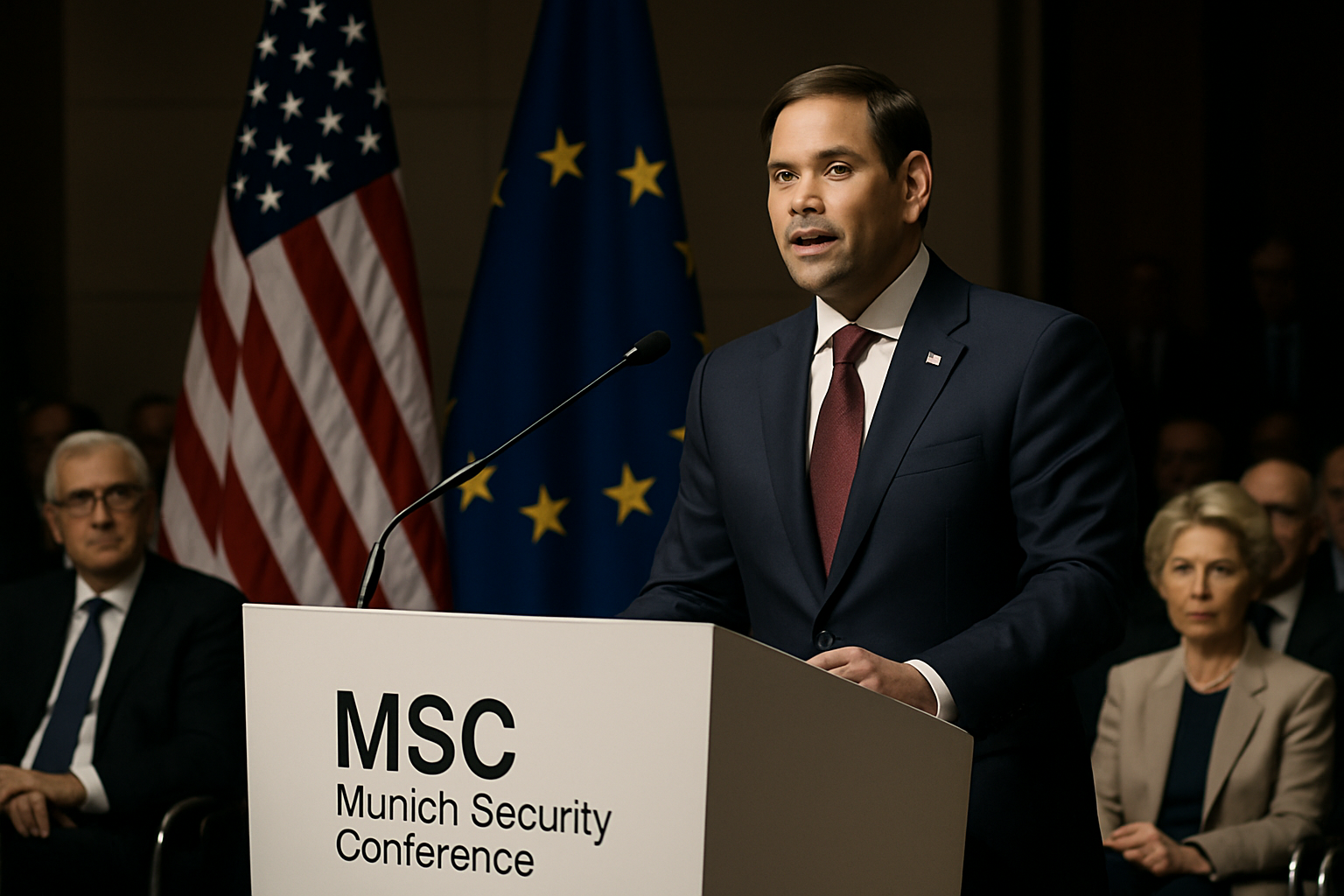
Secretary of State Marco Rubio cast the United States as the "child of Europe" in a landmark address at the Munich Security Conference on Saturday, delivering a message of unity aimed at repairing transatlantic relations strained by a year of diplomatic tensions under the Trump administration.
Speaking to an audience of European leaders and security officials at the 62nd Munich Security Conference, Rubio struck a notably more conciliatory tone than Vice President JD Vance's controversial appearance at the same forum last year, when he delivered sharp criticism of European allies for shirking defense responsibilities and allowing what he characterized as left-wing cultural influence.
The speech represented a calculated diplomatic reset attempt, with Rubio emphasizing that the United States and Europe are "made to be together" while still delivering pointed criticism of what he termed European allies' "foolish policies" on migration, climate, and defense spending.
A Softer Approach After Year of Tension
The Secretary of State's address came against the backdrop of what German officials have described as the deepest strain in transatlantic relations since the Cold War. Last year's appearance by Vance was widely characterized by European diplomats as an "unprecedented breach" in alliance relations, with some officials describing the US approach as a "wrecking ball" against international systems.
"In a time of headlines heralding the decline of the West, we gather here not to mourn but to revitalize an alliance that has weathered every storm for nearly eight decades."
— Marco Rubio, US Secretary of State
European leaders welcomed Rubio's more diplomatic approach, though many noted the absence of concrete commitments. British Prime Minister Keir Starmer, who also addressed the conference, called for European countries to reduce their "excessive dependence" on the United States in defense matters, reflecting a growing European consensus on strategic autonomy.
French President Emmanuel Macron, in his closing remarks at the conference, emphasized that "without Europeans, there will be no peace" regarding ongoing negotiations over Ukraine, while declaring that Europe must become a "geopolitical power providing its own security."
Strategic Tensions Remain Despite Diplomatic Overtures
Despite the warmer rhetoric, significant tensions persisted beneath the surface of Rubio's diplomatic charm offensive. The Secretary of State notably missed a critical meeting with German, French, and Polish leaders regarding Ukraine support, citing scheduling conflicts. European officials interpreted this absence as signaling declining American interest in European-led initiatives.
Rubio's speech also made no mention of Russia, raising questions among European allies about the Trump administration's approach to the ongoing conflict in Ukraine and broader European security concerns. This omission was particularly notable given the conference's focus on the "Era of Disruptive Politics" and challenges to the international order.
The American delegation's presence sparked some diplomatic tensions, with reports of crowd boos directed at US officials over the presence of ICE agents at the conference venue. This incident highlighted ongoing European concerns about American immigration enforcement practices and their intersection with diplomatic protocol.
European Leaders Chart Independent Course
While welcoming Rubio's conciliatory tone, European leaders used the conference platform to assert their own vision for continental security and strategic autonomy. German Chancellor Friedrich Merz delivered opening remarks declaring that the "post-war order no longer exists" and calling for immediate action to "repair and revive transatlantic trust together."
The conference revealed unprecedented discussions among European capitals about alternative security arrangements, including quiet explorations of French nuclear deterrent capabilities serving broader European interests. These conversations, the first of their kind since the end of the Cold War, reflect deep concerns about the reliability of American security guarantees under changing geopolitical circumstances.
"Europe has no alternative but to become independent while maintaining alliance relationships."
— Ursula von der Leyen, European Commission President
Romanian Defense Minister emphasized the necessity for the EU to produce more defense capabilities internally, while the UK announced plans to double its troop presence in Norway from 1,000 to 2,000 over three years as part of NATO's new Arctic Sentry mission.
Ukraine Context Shapes Alliance Dynamics
The conference occurred during a critical phase of the Ukraine conflict, with recent diplomatic breakthroughs in Abu Dhabi achieving a 314-prisoner exchange and the restoration of US-Russia military communications after a four-year suspension. However, military escalation continued simultaneously, with Russian forces accelerating territorial gains and launching what Ukrainian officials called the "most powerful blow of 2026" against energy infrastructure.
European support for Ukraine remained robust, with the EU approving a historic €90 billion loan package—the largest financial assistance package ever provided to a single nation. Sweden and Denmark announced an additional €246 million air defense package, demonstrating sustained European commitment despite political pressures.
The Trump administration has established a June 2026 deadline for Ukraine peace negotiations, with talks potentially moving to Washington—a development that suggests possible direct presidential involvement in the diplomatic process.
Nuclear Governance Crisis Complicates Security Architecture
The conference took place amid a broader nuclear governance crisis, with the New START treaty between the US and Russia expiring on February 5—the first time in over 50 years without bilateral nuclear constraints between the superpowers. UN Secretary-General António Guterres warned of a "grave turning point" with nuclear risks at their "highest level in decades."
This nuclear policy vacuum coincided with ongoing US-Iran nuclear negotiations and China's continued nuclear expansion, creating what experts described as the most complex nuclear governance challenge since the Cold War era.
Economic and Security Partnerships Advance
Despite diplomatic tensions, the conference highlighted several areas of continued US-European cooperation. The Trump administration announced significant partnerships with European allies, including a critical minerals alliance involving the US, EU, and Japan with 55 countries participating to challenge Chinese dominance in rare earth elements production and refining.
Energy security emerged as another area of cooperation, particularly given global natural gas price increases of 24% in Europe and 78% in the US. The conference addressed coordinated responses to energy infrastructure attacks and supply chain vulnerabilities.
Looking Ahead: Challenges and Opportunities
The Munich Security Conference traditionally serves as a barometer for transatlantic relations, and this year's proceedings revealed both the depth of current strains and potential pathways for renewed cooperation. While Rubio's diplomatic approach represented a marked improvement from previous inflammatory rhetoric, fundamental disagreements persist over burden-sharing, strategic priorities, and approaches to global governance.
The success of upcoming diplomatic initiatives—including Ukraine peace negotiations, Iran nuclear talks, and broader efforts to reshape international institutions—will largely determine whether the alliance can adapt to 21st-century challenges or continue to fragment under the pressure of competing national interests.
"We believe America and Europe belong together, but we must be honest about the work required to make this partnership effective for both sides."
— Marco Rubio, US Secretary of State
The conference established important templates for crisis management and alliance coordination during what organizers characterized as "the most critical period for determining international order since World War II." Whether these frameworks can bridge growing transatlantic divisions remains to be seen as both sides navigate an increasingly complex global security environment.
As the conference concluded, participants agreed on the urgent need for sustained diplomatic engagement and practical cooperation, even as they acknowledged that the path forward would require unprecedented levels of innovation and compromise from all parties involved.