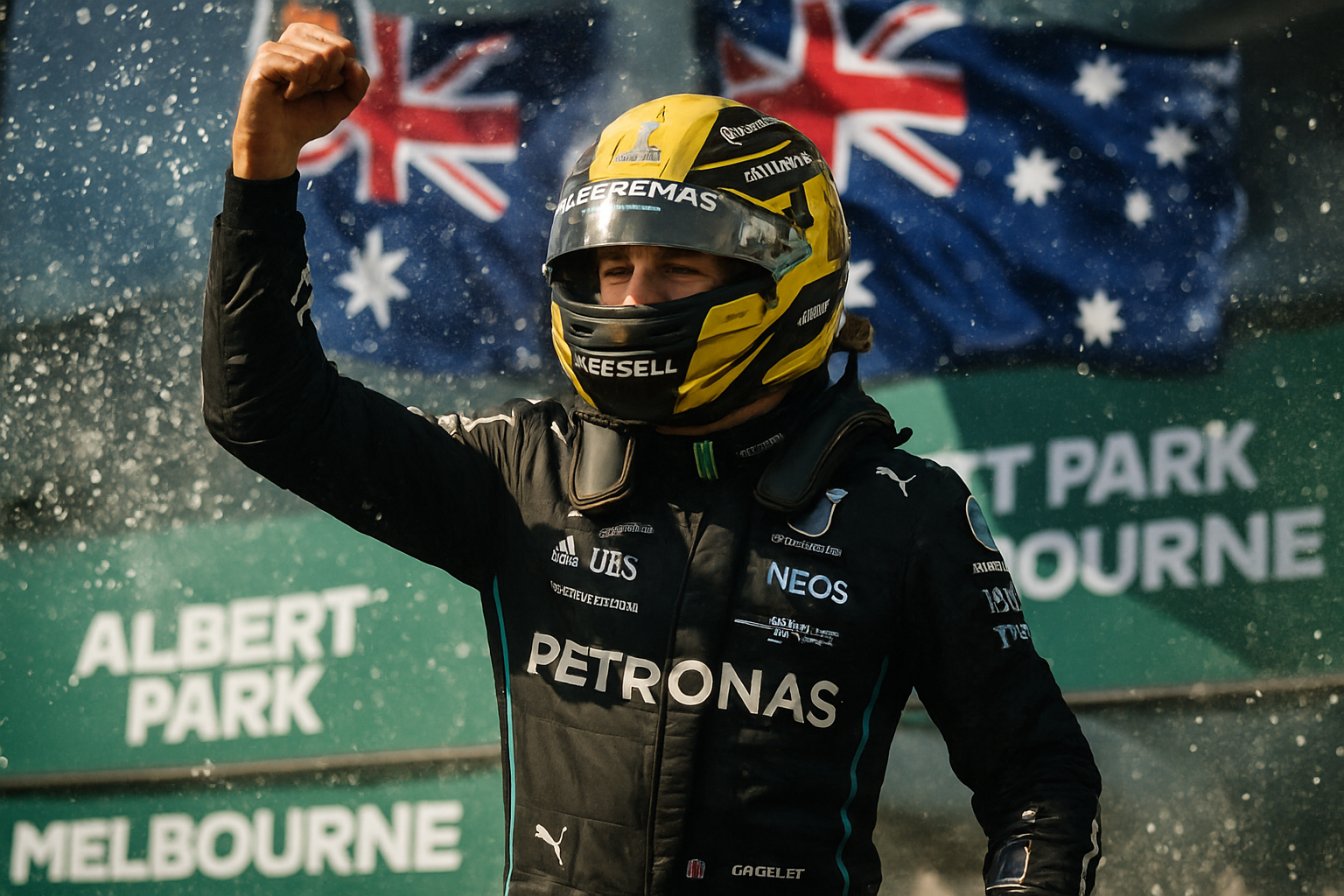
George Russell delivered a masterclass performance to win the 2026 Australian Grand Prix season opener at Albert Park Circuit, leading teammate Kimi Antonelli to a commanding Mercedes 1-2 finish that signals the Silver Arrows' dramatic return to championship contention during Formula 1's most revolutionary season in decades.
The British driver, starting from pole position, controlled the race from lights to flag to claim his first victory of the season by nearly three seconds over Antonelli, with Charles Leclerc completing the podium for Ferrari. The result marks Mercedes' first front-row lockout victory since the 2022 Brazilian Grand Prix and establishes an early 43-point constructors' championship lead.
Mercedes Dominance in New Regulatory Era
Russell's victory validates Mercedes' superior adaptation to 2026's unprecedented technical regulations, which feature simultaneous chassis and power unit rule changes for the first time in over two decades. The team's W17 car exceeded all expectations during qualifying and race weekend, with Russell describing the performance as "beyond our projections."
"Everyone's very quick to criticise things. You need to give it a shot," Russell told the post-race press conference, defending the new regulations against criticism from rivals including four-time world champion Max Verstappen and defending champion Lando Norris. "We're 22 drivers. When we've had the best cars and we've been happiest, everyone moans the racing's rubbish. Now drivers aren't perfectly happy and everyone said it was an amazing race. So you can't have it all."
Race Drama and Disappointments
The race began with heartbreak for local fans as Australian driver Oscar Piastri crashed out during the formation lap, ending his hometown participation before the race even started. The McLaren driver's accident dealt a devastating blow to thousands of Melbourne supporters who had filled Albert Park Circuit wearing McLaren orange specifically to support their hero.
Max Verstappen faced his most significant qualifying setback in recent memory, starting from 20th position after crashing in Q1. The Red Bull driver's championship title defense got off to the worst possible start, highlighting his team's adaptation struggles to the new regulations that have reshuffled the competitive order.
"It was an amazing race to watch. The new regulations have definitely changed the dynamics, and I think we're seeing the beginning of what could be a very exciting season."
— Charles Leclerc, Ferrari
Antonelli's Remarkable Recovery
Kimi Antonelli's second-place finish represents one of the most impressive debuts in recent F1 history. The 19-year-old Italian driver recovered from a major practice crash that required extensive car repairs to secure his maiden podium. The incident demonstrated both his mental fortitude and Mercedes' technical capabilities in rebuilding a heavily damaged car overnight.
Antonelli's seamless integration alongside Russell suggests Mercedes has assembled a formidable driver pairing for their championship aspirations. The young driver jumped onto the track with just three minutes remaining in Q1 after the crash repairs, showcasing remarkable resilience to qualify second behind Russell.
Technical Revolution Reshapes F1
The 2026 season represents Formula 1's most comprehensive regulatory overhaul in history, with the introduction of revolutionary technical changes and VAR (Video Assistant Referee) technology for the first time in motorsport. The new hybrid power units feature a 50% thermal and 50% electric power split, creating cars that drivers describe as "much more sensitive" and requiring complete adaptation of driving techniques.
German media analysis suggests the new regulations have created a more artificial racing spectacle, though early overtaking maneuvers indicate successful progress in addressing previous seasons' processional racing concerns. The simultaneous technical reset has potentially disrupted traditional hierarchies, with eleven teams now competing following Cadillac's entry creating the most unpredictable season in recent memory.
Global Challenges and Resilience
The Australian Grand Prix proceeded despite the worst aviation crisis since COVID-19, with over 18,000 flights cancelled worldwide due to Middle Eastern conflicts. Teams implemented unprecedented contingency plans including enhanced fuel loading and alternative routing strategies, demonstrating Formula 1's operational resilience in challenging global circumstances.
The season opener at Albert Park showcased the circuit's extensive improvements, including larger bridges and enhanced shade areas to accommodate growing F1 crowds. These facility enhancements combined with the technical revolution create a perfect platform for what promises to be the most unpredictable championship battle in years.
Championship Implications
Russell's victory and Antonelli's podium provide Mercedes with crucial early-season momentum. With Russell scoring 25 points and Antonelli earning 18, the team holds a commanding early lead in the constructors' championship. The result marks a dramatic reversal of fortunes for a team that struggled competitively in recent seasons under Red Bull's dominance.
Ferrari's third-place finish with Leclerc keeps them in contention, while Red Bull faces an uphill battle with Verstappen's disappointing start. The technical reset has clearly benefited Mercedes and could signal a fundamental shift in the competitive landscape that defines the 2026 season and beyond.
Looking Forward
As Formula 1 embarks on its most technically challenging era, Russell's Australian Grand Prix victory serves as an early indicator of how the new regulations might reshape the sport. The Mercedes driver's call for patience with the revolutionary changes reflects a sport in transition, balancing technical innovation with competitive excitement.
The season opener has established Mercedes as early championship favorites, validated the potential for closer competition under new regulations, and demonstrated Formula 1's ability to deliver compelling racing even amid global challenges. With traditional hierarchies disrupted and new technical possibilities emerging, the 2026 championship promises to be one of the most unpredictable in the sport's storied history.