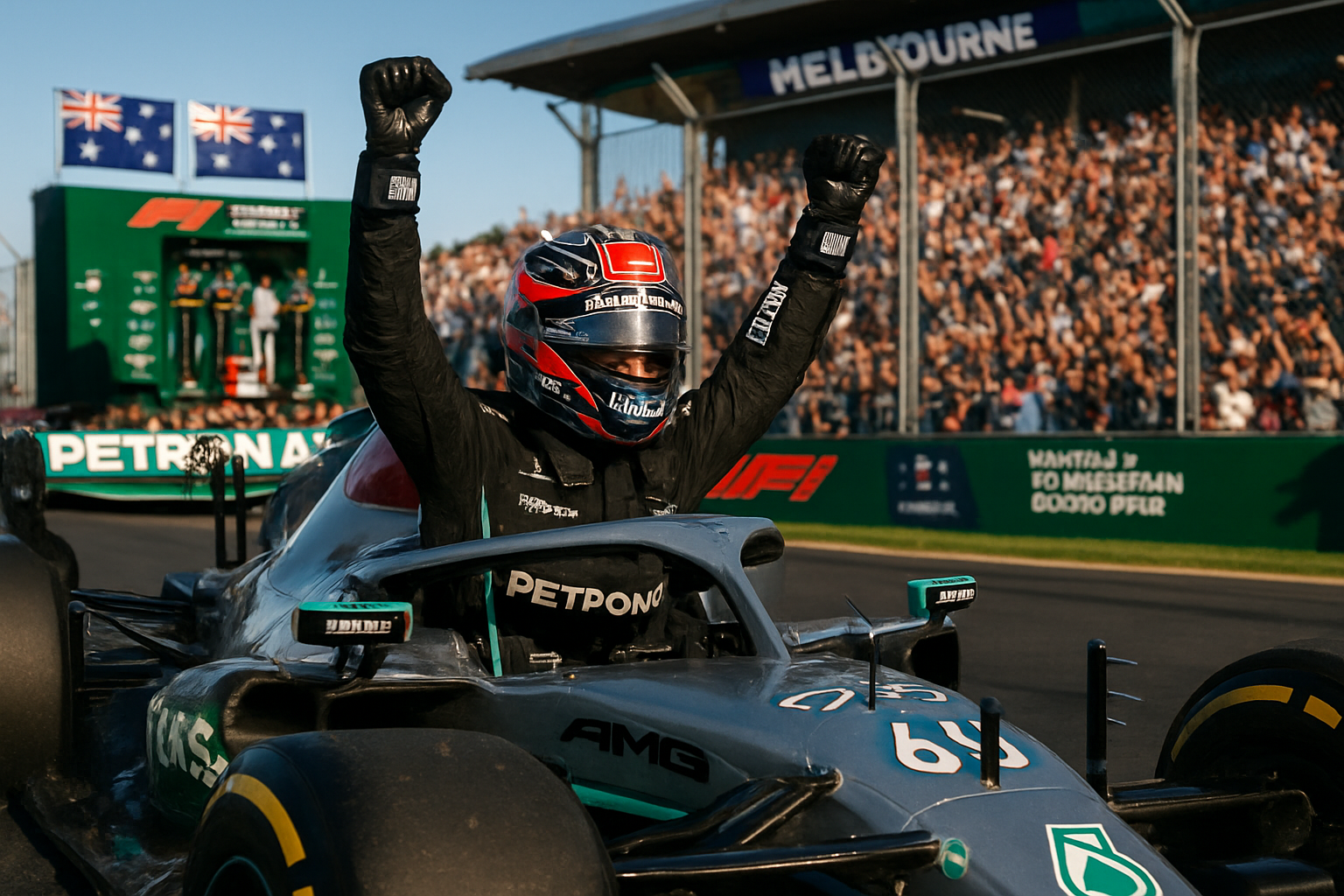
George Russell delivered a commanding victory for Mercedes at the Australian Grand Prix, leading teammate Kimi Antonelli home for a dominant 1-2 finish that launched Formula 1's most revolutionary season in decades with authority and style at Melbourne's Albert Park Circuit.
The British driver controlled the 58-lap race from pole position, crossing the finish line with a 2.974-second advantage over his Italian teammate to give Mercedes their first front-row lockout victory since the 2022 Brazilian Grand Prix. Charles Leclerc claimed the final podium position for Ferrari, while Lewis Hamilton finished fourth in his Ferrari debut season.
Dramatic Pre-Race Setback for Piastri
The race weekend was marred by heartbreak for local favourite Oscar Piastri, who crashed out during the formation lap in a devastating blow to the Melbourne crowd. The McLaren driver, who had qualified fifth for his home race, suffered a spin during the reconnaissance lap that ended his participation before the race even began.
Thousands of Australian fans wearing McLaren orange had packed the improved Albert Park facilities specifically to support their hometown hero, only to witness their dreams evaporate in cruel fashion. The incident highlighted the challenging nature of F1's new regulations, which have created cars described as "much more sensitive" requiring complete driver adaptation.
Mercedes' Technical Masterclass
Russell's victory underlined Mercedes' superior adaptation to Formula 1's most comprehensive regulatory overhaul in history. The 2026 season features simultaneous chassis and power unit regulation changes for the first time in over two decades, creating what industry insiders describe as a "massive challenge even for the biggest teams."
"Having dominated qualifying, pole-sitter Russell's first win at Albert Park underlined Mercedes' promising preseason form,"
— The Japan Times
The German constructor's W17 chassis demonstrated remarkable pace throughout the weekend, with Russell posting the fastest practice times and securing pole position by nearly 0.8 seconds from third-place qualifier Isack Hadjar. The performance validated Mercedes' technical approach to the new hybrid power units, now featuring 50% thermal and 50% electric power distribution.
Revolutionary Season Debut
The 2026 campaign represents F1's entry into a new era, with the sport introducing VAR (Video Assistant Referee) technology for the first time in motorsport history. The comprehensive tracking system provides enhanced race officiating capabilities through multiple camera angles and advanced data analysis, enabling more informed steward judgments.
The regulatory changes extend far beyond the cars themselves. Teams have had to completely restart their development programs, with Ferrari's Charles Leclerc having topped pre-season testing in Bahrain with a time of 1:31.992 – nearly a full second faster than his closest rivals during winter preparations.
Verstappen's Championship Setback
The race provided a stark contrast for defending champion Max Verstappen, who endured one of the most significant qualifying setbacks of his career after crashing during Q1. The Red Bull driver started from 20th position, highlighting his team's struggles to adapt to the new technical regulations.
Verstappen's difficulties were compounded by what Romanian media described as "chaos" at Melbourne, with the Dutchman reportedly requesting FIA intervention to ensure the sport returns to being "Formula 1 on steroids" after his frustrating first experience with the new rules package.
Global Aviation Crisis Adds Drama
The season opener proceeded despite unprecedented global challenges, with Formula 1 teams successfully navigating the worst aviation crisis since COVID-19. Over 18,000 flights were cancelled worldwide due to Middle Eastern conflicts, forcing teams to implement complex contingency plans including enhanced fuel loading and alternative routing strategies to reach Melbourne.
The crisis, which saw Dubai International Airport completely shut down after missile damage, tested F1's operational resilience. Teams developed unprecedented logistical solutions, with some considering maritime transport options to ensure the championship could begin on schedule.
Antonelli's Remarkable Recovery
Kimi Antonelli's second-place finish was particularly impressive given his dramatic practice crash that required extensive car repairs. The 19-year-old Italian rookie showcased remarkable mental fortitude, jumping onto the track with just three minutes remaining in Q1 before securing second position for Sunday's race.
The Mercedes junior driver's performance demonstrates the team's technical capabilities and depth, providing a strong foundation for their championship aspirations. His seamless integration alongside Russell suggests Mercedes has successfully assembled one of F1's most formidable driver pairings.
New Era Challenges and Opportunities
Russell's victory speech emphasized the need to give F1's new era "a chance," acknowledging early criticism of the revised regulations. The winner stressed that fundamental changes require time to fully develop their potential, urging patience as teams and drivers adapt to the revolutionary technical package.
The race featured numerous overtaking maneuvers and strategic battles that had been missing in recent seasons, suggesting the new regulations have successfully addressed processional racing concerns. Early indications point toward a more competitive championship with traditional hierarchies potentially disrupted by the technical reset.
Championship Implications
Mercedes' commanding 1-2 finish sends a clear message to their rivals that the Silver Arrows have successfully emerged from their recent competitive difficulties. The result marks a significant shift in F1's competitive landscape, with Mercedes positioned as early championship favorites ahead of Ferrari and Red Bull.
With eleven teams now competing following Cadillac's entry, every point becomes crucial in what promises to be the most unpredictable F1 season in recent memory. Russell's 25-point maximum haul, combined with Antonelli's 18 points, gives Mercedes an early 43-point advantage in the constructors' championship.
Looking Forward
The Australian Grand Prix has established the template for F1's new era – a combination of technical innovation, competitive uncertainty, and operational challenges that will define the 2026 season. Mercedes' early dominance provides them with valuable momentum, but with revolutionary regulations creating unprecedented variables, nothing can be taken for granted.
As F1 heads to its next destination, Russell's triumph at Albert Park will be remembered as the moment Mercedes announced their return to championship contention, launching what could become one of the sport's most fascinating and unpredictable seasons in decades.