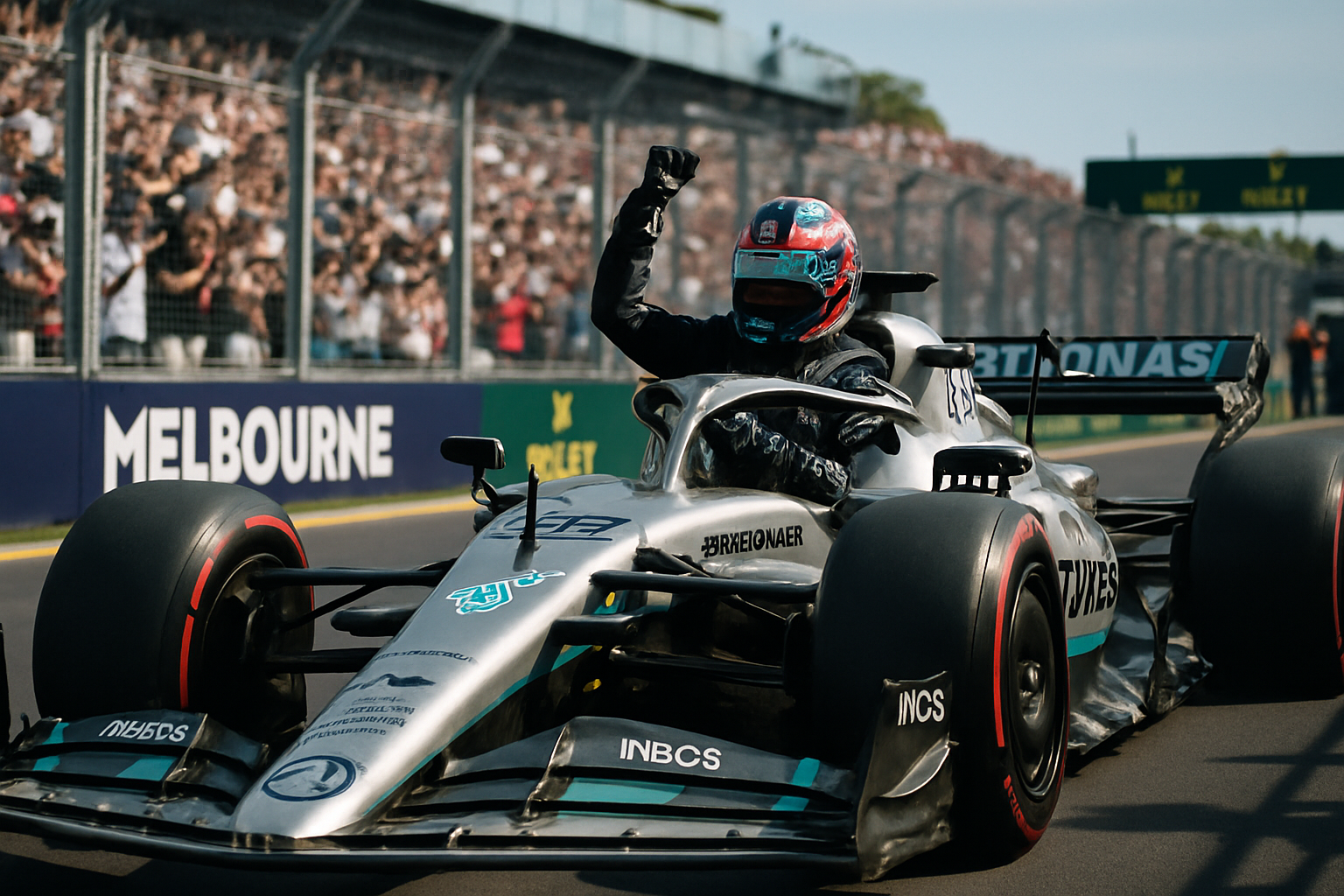
George Russell delivered a sensational pole position lap for Mercedes at the Australian Grand Prix, leading a stunning front-row lockout as Formula 1's most revolutionary season in decades got underway with dominant qualifying performance at Albert Park Circuit in Melbourne.
The British driver secured his position at the front of the grid with a commanding performance that left rivals nearly eight-tenths of a second behind, underlining Mercedes' promising adaptation to the sport's most comprehensive technical overhaul in over 20 years. Russell's pole lap proved nearly 0.8 seconds faster than third-place Isack Hadjar's Red Bull, demonstrating the Silver Arrows' remarkable recovery from recent seasons.
Mercedes Front-Row Dominance Returns
Russell's teammate, young Italian sensation Kimi Antonelli, completed Mercedes' front-row lockout despite suffering a dramatic crash during practice sessions earlier in the day. The 19-year-old rookie showed remarkable resilience, recovering from his accident to secure second place on the grid, trailing Russell by just 293 milliseconds.
"Un gran día. Sabíamos que el coche tenía mucho potencial," Russell celebrated after his pole position. "Estoy deseando que llegue la carrera de mañana, creo que podemos ofrecer unas carreras bastante emocionantes al público."
— George Russell, Mercedes Driver
The Mercedes W17 demonstrated superior adaptation to the 2026 technical regulations, which represent the first time in F1 history that both chassis and power unit rules have been changed simultaneously. This technical revolution has created what many consider the most unpredictable season opener in the sport's history.
Verstappen's Qualifying Disaster
The session's most shocking moment came when three-time world champion Max Verstappen crashed out dramatically in Q1, spinning into the tire barriers at Turn 8. The incident will force the defending champion to start from the back of the grid in 20th position, marking one of the most significant qualifying setbacks of his career.
Verstappen's crash highlighted the adaptation challenges teams face with the new regulations, as Red Bull struggles to recapture their previous dominance. The Dutch driver's absence from the sharp end of qualifying opens up unprecedented opportunities for other teams to capitalize on Sunday's race.
Revolutionary Season Begins
The 2026 season represents F1's most significant regulatory overhaul in decades, with revolutionary changes affecting every aspect of car design and race operations. For the first time in motorsport history, the FIA has introduced VAR (Video Assistant Referee) technology, providing enhanced race officiating through comprehensive tracking systems.
These technical changes have created a fundamental reset of the competitive landscape, with traditional hierarchies potentially disrupted. Mercedes' qualifying dominance suggests their technical approach to the new regulations may prove superior to their recent championship rivals.
Antonelli's Remarkable Recovery
Perhaps the most compelling story of qualifying was Kimi Antonelli's recovery from his practice crash. The young Italian suffered a significant accident that required extensive repairs to his Mercedes, with mechanics working frantically to rebuild his car in time for qualifying.
Antonelli jumped onto the track with just three minutes remaining in Q1, demonstrating both his skill and Mercedes' technical capabilities. His second-place qualifying position, achieved under intense pressure, showcased the mental fortitude that has marked him as one of F1's most promising young talents.
Local Hero Piastri Thrills Melbourne Crowd
McLaren's Oscar Piastri provided additional excitement for the Melbourne crowd, qualifying fifth and delighting his home fans. The Australian driver's strong performance continued his impressive adaptation to F1, while also highlighting McLaren's competitive pace under the new regulations.
Piastri's teammate notably accused Mercedes of having previously run with "sandbags" during winter testing, suggesting the German team had been deliberately concealing their true pace. Saturday's qualifying performance appeared to validate these suspicions about Mercedes' competitive strength.
Championship Implications
Russell's pole position and Mercedes' front-row lockout signal a potential return to championship contention for the Silver Arrows after several seasons dominated by Red Bull. The dramatic performance swing suggests the new technical regulations have successfully achieved their intended goal of reshuffling competitive order.
With Verstappen starting from the back and Mercedes showing superior pace, Sunday's Australian Grand Prix promises to deliver the unpredictable racing that F1 officials hoped the regulatory changes would create. The season opener provides the first competitive indication of how the 2026 technical revolution will impact the championship battle.
Technical Innovation on Display
The 2026 cars feature dramatic changes to both chassis design and power unit configuration, creating vehicles that drivers describe as "much more sensitive" and requiring complete adaptation of driving techniques. The simultaneous overhaul of both systems represents an unprecedented challenge for even the most experienced teams.
Mercedes' qualifying success suggests their engineers have successfully navigated these technical challenges, developing a car that Russell described as exceeding their expectations. The W17's performance advantage over established competitors indicates the team's development approach may prove decisive throughout the season.
Looking Ahead to Race Day
Sunday's Australian Grand Prix presents Mercedes with their best opportunity in years to secure a victory, with Russell and Antonelli starting from the front row while their primary championship rivals face significant challenges. Verstappen's recovery drive from 20th position will provide additional drama throughout the field.
The race will serve as the first true test of the new technical regulations' impact on wheel-to-wheel racing, with the hope that closer competition and more unpredictable performance will create enhanced entertainment for global audiences. Melbourne's improved Albert Park facilities provide the perfect stage for F1's revolutionary new era to begin.
As Formula 1 embarks on its most technically advanced and potentially competitive season in recent memory, Russell's pole position and Mercedes' resurgence suggest that 2026 could mark a fundamental shift in the sport's competitive landscape, delivering the excitement and unpredictability that fans and officials have long desired.