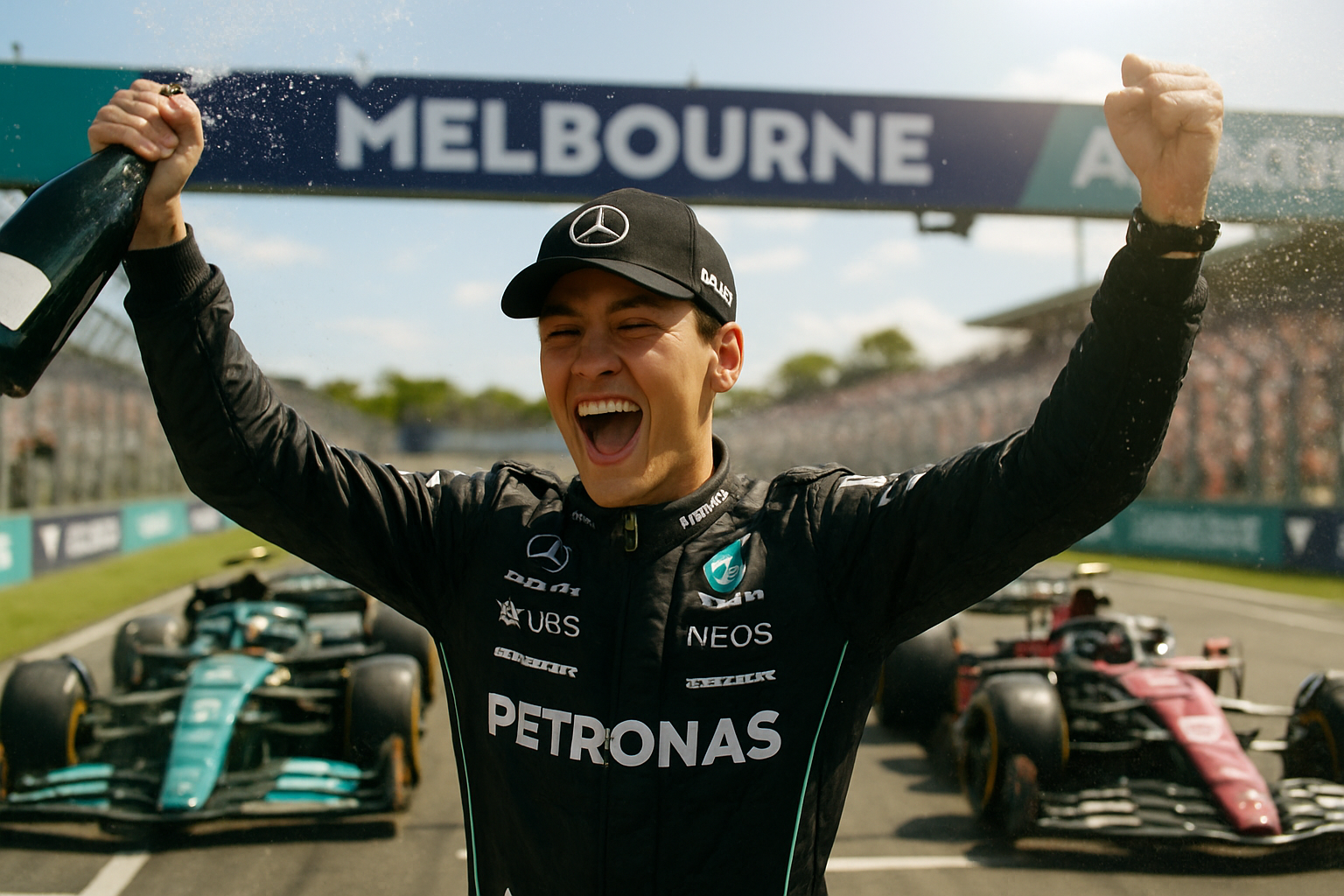
George Russell delivered a masterful performance to win the 2026 Australian Grand Prix on Sunday, leading teammate Kimi Antonelli to a commanding Mercedes 1-2 finish that marked the dawn of Formula 1's most revolutionary new era in over two decades.
The British driver secured a dominant victory at Albert Park Circuit in Melbourne, crossing the line with a comfortable margin over his 19-year-old Italian teammate in what represents Mercedes' return to championship contention after years in Red Bull's shadow. Charles Leclerc completed the podium for Ferrari in third place, with Lewis Hamilton finishing fourth on his Ferrari debut.
Mercedes Seizes the Initiative
Russell's victory validated Mercedes' technical approach to the sport's most comprehensive regulatory overhaul in history, as Formula 1 simultaneously changed both chassis and power unit regulations for the first time in over 20 years. The W17 car exceeded all expectations, with Russell describing the performance as beyond the team's projections during winter testing.
"This feels incredible," Russell said after the race. "The car was absolutely fantastic today, and to have Kimi up there with me for a 1-2 finish is the perfect way to start what we hope will be a championship-challenging season."
The result marked Mercedes' first front-row lockout victory since the 2022 Brazilian Grand Prix, signaling a dramatic shift in the competitive landscape. Russell's pole position from Saturday's qualifying had already demonstrated the Silver Arrows' superior adaptation to the new technical regulations.
Verstappen's Nightmare Weekend
The weekend's most dramatic storyline belonged to three-time world champion Max Verstappen, whose Red Bull suffered a catastrophic qualifying crash that left him starting from 20th position – the most significant qualifying setback of his recent career. The Dutchman managed a spirited recovery drive to finish sixth, but the result highlighted Red Bull's adaptation struggles with the revolutionary new regulations.
Verstappen's crash during Q1 at Turn 8 sent shockwaves through the paddock, demonstrating how the new cars demand complete driver adaptation. The technical revolution has created what drivers describe as "much more sensitive" machines requiring fundamental changes to driving techniques developed over decades.
Antonelli's Remarkable Recovery
Perhaps the most impressive performance came from Mercedes rookie Kimi Antonelli, who secured second place despite a major practice crash that required extensive car rebuilding. The 19-year-old Italian demonstrated remarkable mental fortitude, jumping onto the track with just three minutes remaining in Q1 to secure his front-row starting position.
"Kimi showed today why we have such faith in him," team principal Toto Wolff commented. "To recover from that crash and then deliver such a composed drive alongside George shows maturity beyond his years."
Antonelli's seamless integration alongside Russell suggests Mercedes has assembled a formidable driver pairing for their championship aspirations in this new era.
Piastri's Heartbreaking Exit
The race began with tragedy for hometown hero Oscar Piastri, whose McLaren crashed out during the formation lap before the race even started. The Melbourne native, who had qualified fifth and drawn massive support from the Australian crowd, saw his dreams evaporate in devastating fashion with thousands of fans wearing McLaren orange specifically to support their local hero.
The incident dealt a significant blow to McLaren's championship aspirations, with the MCL38 having shown competitive pace during qualifying weekend. Piastri's exit represented a cruel twist for the Melbourne native during what should have been a celebration of his home race.
Technical Revolution Takes Hold
The 2026 season represents Formula 1's most comprehensive regulatory overhaul, with the simultaneous introduction of new chassis and power unit regulations creating unprecedented challenges even for the biggest teams. The revolutionary changes include advanced hybrid power units operating at 50% thermal and 50% electric efficiency, fundamentally different aerodynamic packages, and enhanced safety protocols.
Most significantly, the season marks the introduction of VAR (Video Assistant Referee) technology to Formula 1 – the first time such a system has been implemented in motorsport history. The comprehensive tracking system enables enhanced incident review through multiple camera angles and advanced data analysis, providing stewards with more informed decision-making capabilities.
Teams have described the current season as starting "from scratch" with both chassis and power unit development, creating the most unpredictable competitive landscape in Formula 1's modern era. Traditional hierarchies face potential disruption as teams navigate the technical reset.
Global Challenges Overcome
The Australian Grand Prix proceeded successfully despite a global aviation crisis that saw over 18,000 flights cancelled worldwide due to Middle Eastern conflicts. Formula 1 teams implemented unprecedented contingency plans including enhanced fuel loading and alternative routing strategies to ensure the season opener proceeded as scheduled.
The crisis highlighted the sport's operational resilience and commitment to delivering the championship despite extraordinary circumstances affecting international travel and logistics.
Championship Implications
Mercedes' early 43-point constructors' championship lead (Russell 25 points, Antonelli 18 points) sends a strong signal of their return to championship contention. The Silver Arrows appear to have unlocked the secrets of the new technical regulations ahead of their rivals, potentially reshaping the competitive order for years to come.
With eleven teams now competing following Cadillac's entry, the 2026 season promises to be the most unpredictable in Formula 1 history. The technical revolution has created a level playing field that could produce surprise results throughout the campaign.
Ferrari showed promising pace with Leclerc's podium finish and Hamilton's points on his debut, while Red Bull faces the challenge of recovering from their adaptation difficulties. McLaren will need to regroup after Piastri's disappointing home race exit.
Looking Ahead
As Formula 1 embarks on this new era combining technical innovation with enhanced safety measures and global accessibility, Russell's victory establishes an early template for success. The British driver emphasized patience with the revolutionary regulations while demonstrating that early adaptation advantages can produce significant rewards.
The season opener proved that Formula 1's new era successfully addresses previous concerns about processional racing, with the early race featuring genuine overtaking opportunities and competitive uncertainty. Mercedes' triumph represents not just a victory for the team, but validation of the sport's technical evolution.
With the championship now wide open following this dramatic season opener, Formula 1 fans can expect an exhilarating campaign as teams continue adapting to the most significant regulatory changes in the sport's modern history. Russell's commanding victory has set the stage for what promises to be one of the most competitive and unpredictable seasons in Formula 1's storied legacy.