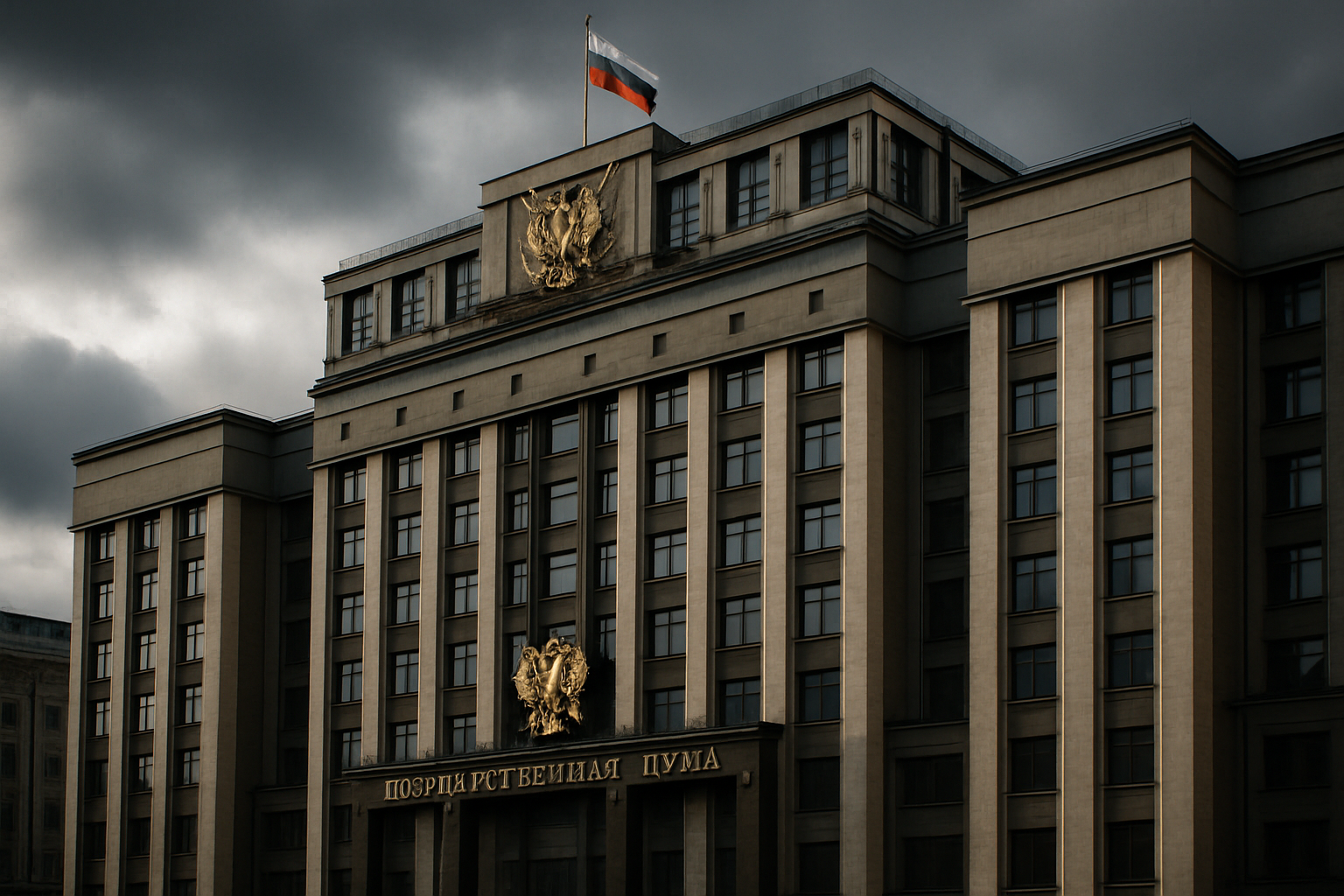
The Russian State Duma has approved sweeping new legislation granting the Federal Security Service (FSB) unprecedented authority to shut down internet services, mobile communications, and even postal services, marking a dramatic expansion of surveillance powers that critics warn could effectively silence dissent.
The legislation, passed in both second and third readings on Tuesday, February 17, 2026, amends Russia's telecommunications law to require mobile operators to block cellular services and internet connections upon FSB demand. The bill represents the latest escalation in Russia's campaign to establish greater control over digital communications amid ongoing international tensions.
Expanded Emergency Powers
According to reports from The Moscow Times and Meduza, the bill would enable the FSB to block regular phone calls, text messages, and even postal services. The legislation moved through parliament with unusual speed, being adopted simultaneously in second and third readings, bypassing the typical extended deliberation process.
The initial version of the bill required FSB "requests" to telecommunications providers, but by the second reading, these had been strengthened to mandatory "demands." The change in language reflects the increasingly authoritarian nature of the powers being granted to Russia's principal security agency.
Under the new law, telecommunications services can be suspended in cases "established by normative legal acts of the president and government, for the purpose of protecting citizens and the state from emerging security threats." Notably, the legislation does not specify what constitutes a qualifying security threat, effectively giving the FSB broad discretionary power.
Pattern of Digital Control
This legislation comes as part of a broader pattern of Russian digital control measures that have intensified significantly over the past year. In February 2026, Russia also implemented a complete ban on WhatsApp messaging service, affecting over 100 million users, while promoting state-controlled alternatives like the "Max" messenger platform.
"The bill would also allow the FSB to block regular calls, text messages and even postal services, officials said Tuesday."
— The Moscow Times, February 17, 2026
The timing of this legislation is particularly significant given Russia's ongoing military operations in Ukraine and increasing isolation from Western digital platforms. Previous measures have included sophisticated "degradation" strategies against platforms like Telegram, where service quality is systematically reduced rather than completely blocked, making circumvention more difficult.
Historical Context of Russian Surveillance
The new powers build upon Russia's existing digital infrastructure control mechanisms, which have been developed systematically since 2022 as part of what the Kremlin calls its "sovereign internet" initiative. This approach aims to create a digital ecosystem less dependent on Western technology and more amenable to state surveillance.
The FSB, as the successor to the Soviet KGB's domestic security functions, has been granted increasingly broad powers in recent years. The agency has been implicated in numerous high-profile cases, including the recent scientific confirmation of its role in the assassination of opposition leader Alexei Navalny using exotic toxins.
Previous telecommunications control measures in Russia have targeted specific platforms or content, but this new legislation represents an unprecedented grant of blanket authority to shut down entire categories of communication services without requiring specific justifications or judicial oversight.
International Implications
The legislation comes at a critical time for Russian-Western relations, as diplomatic efforts continue through trilateral talks involving Ukraine, Russia, and the United States. The Abu Dhabi framework talks achieved a historic 314-prisoner exchange and restoration of US-Russia military communications after a four-year suspension, creating momentum for potential peace negotiations scheduled for Geneva on February 17-18, 2026.
However, the expansion of FSB surveillance powers suggests Russia is simultaneously preparing for increased domestic control even as it engages in international diplomacy. The new law could effectively enable the government to impose communications blackouts during periods of civil unrest or international crisis.
Technical Implementation Challenges
While the legislation grants broad powers on paper, implementing comprehensive communications shutdowns presents significant technical challenges. Russia's vast territory, spanning eleven time zones, relies on complex telecommunications infrastructure that includes satellite connections, undersea cables, and regional networks that may prove difficult to coordinate centrally.
The legislation particularly affects remote regions like the Nenets Autonomous Okrug, Magadan Oblast, and Sakhalin Oblast, which depend heavily on satellite and undersea cable infrastructure with limited redundancy. These areas have already experienced service disruptions during previous platform restrictions, highlighting the vulnerability of peripheral regions to centralized control measures.
Opposition and Civil Society Impact
Human rights organizations have long warned that Russia's expanding digital control measures represent a systematic effort to eliminate independent communication channels and alternative information sources. The new FSB powers would complete this process by giving security services the ability to impose comprehensive communications blackouts when deemed necessary.
The legislation effectively reverses decades of telecommunications liberalization in Russia, returning the state to Soviet-era levels of control over information flows. Combined with existing restrictions on traditional media and civil society organizations, the new powers create the infrastructure for comprehensive information isolation.
The speed with which the legislation was passed—simultaneous second and third readings—suggests that Russian authorities view these powers as urgently necessary, possibly in anticipation of domestic challenges or international developments that could require rapid information control.
Global Context and Precedent
Russia's moves toward comprehensive communications control occur within a broader global context of increasing tension between digital sovereignty assertions and international communication rights. Other authoritarian regimes have implemented similar measures, but few have granted security services such broad discretionary authority over civilian communications infrastructure.
The legislation represents a test case for how modern authoritarian systems can use legal frameworks to justify comprehensive surveillance and control measures. The lack of specific threat criteria or judicial oversight mechanisms means that the FSB's authority under this law is essentially unlimited, constrained only by technical capabilities and political considerations.
As Russia continues to face international isolation over its military operations in Ukraine, the new FSB powers provide a domestic tool for managing potential civil unrest or opposition activities. The ability to shut down communications networks could prove crucial for maintaining political control during periods of international pressure or domestic dissatisfaction.
Future Implications
The passage of this legislation marks a watershed moment in Russia's relationship with digital communications and civil liberties. The FSB's new powers represent the most comprehensive grant of communications control authority to a security service by any major power in the modern era.
The effectiveness of these new powers will likely be tested during upcoming diplomatic negotiations and potential domestic challenges. As Russia engages in international peace talks while simultaneously expanding domestic surveillance capabilities, the tension between diplomatic engagement and authoritarian control measures will become increasingly apparent.
For ordinary Russians, the legislation creates an environment of permanent uncertainty about communications access, potentially affecting everything from business operations to family communications. The psychological impact of knowing that all forms of communication—including postal services—can be cut off at any time represents a return to Soviet-era levels of state control over daily life.
The international community will be watching closely to see how these powers are implemented and whether they represent a new model for authoritarian control in the digital age. The success or failure of Russia's comprehensive communications control experiment could influence similar efforts by other authoritarian regimes worldwide, making this legislation significant far beyond Russia's borders.