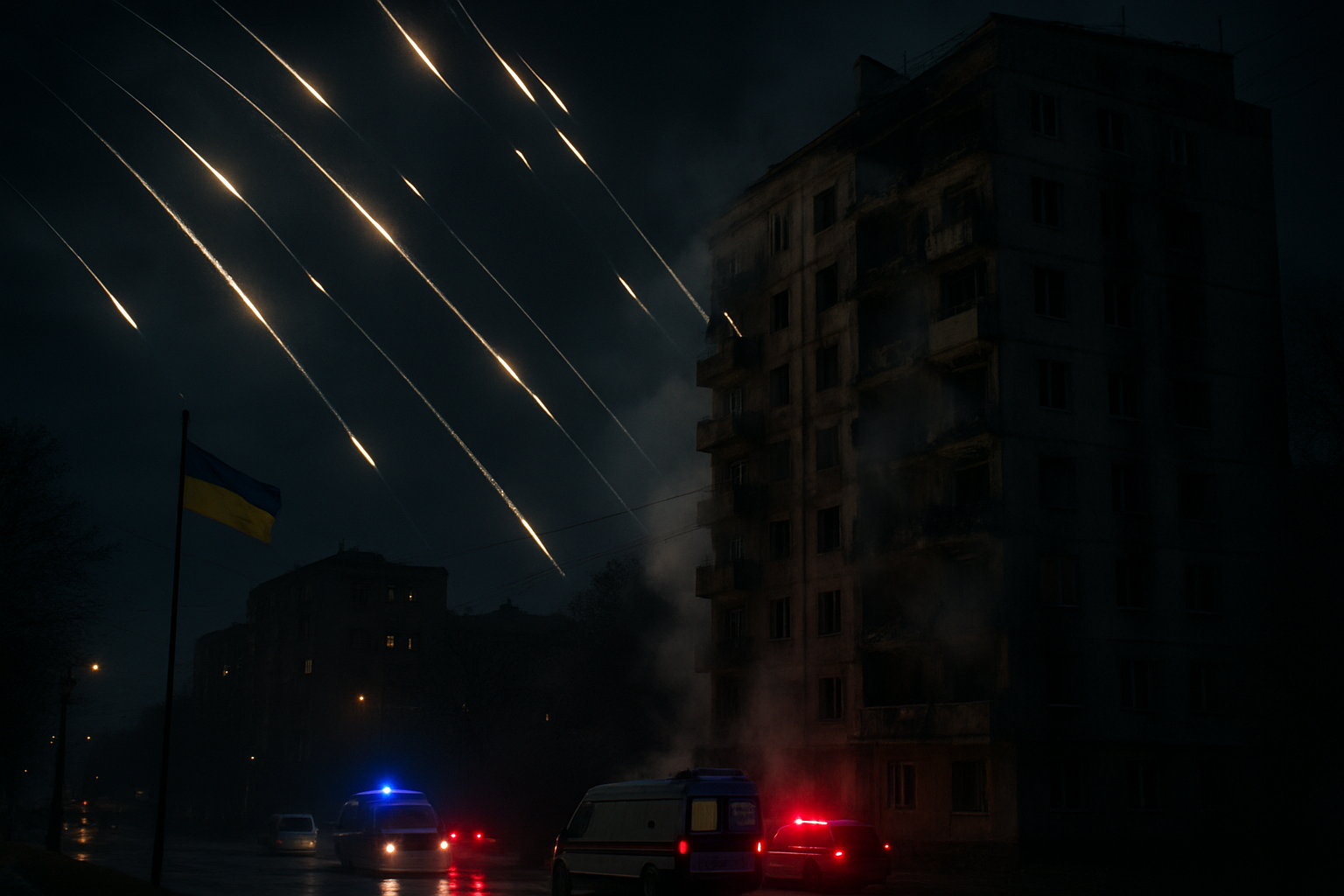
Russia launched one of its largest coordinated attacks of 2026 against Ukraine overnight Saturday into Sunday, deploying approximately 300 drones and 50 missiles in strikes targeting energy infrastructure and civilian areas across multiple regions, according to Ukrainian military officials.
The assault, occurring just two days before the fourth anniversary of Russia's full-scale invasion on February 24, 2022, represents a significant escalation in what Ukrainian authorities describe as systematic "energy terrorism" targeting civilian infrastructure during winter months.
Scale and Scope of the Attack
Ukrainian air defense forces successfully intercepted 33 missiles and 274 drones of various types by 10:00 AM Sunday, according to Ukraine's armed forces. The attacks affected multiple oblasts including Kyiv, Odesa, and the Mykolaiv region, with energy facilities bearing the brunt of the assault.
In Mykolaiv, Russian Shahed-type drones damaged critical energy infrastructure, leaving approximately 16,000 consumers without power. The systematic targeting of energy facilities continues Russia's documented strategy of weaponizing winter conditions against Ukrainian civilians.
"Over the past week, Russia launched about 1,300 attack drones, more than 1,400 guided aerial bombs, and 96 missiles of various types at Ukraine. Moscow continues to invest more in strikes than in diplomacy."
— President Volodymyr Zelensky
Casualties and Civilian Impact
The overnight attacks resulted in multiple civilian casualties across affected regions. In Kyiv Oblast, rescue operations in Putrivka village saved eight people, including a child, from under rubble following missile and drone strikes. Tragically, one person died while being transported to the hospital, while five others were hospitalized with injuries.
The human toll extends beyond immediate casualties. Damage was recorded across five districts of the Kyiv region, with one woman reported injured in the broader assault. Emergency services worked through the night to rescue civilians trapped beneath debris.
Separately, in a devastating incident in the western city of Lviv, a police officer was killed and 24 people were wounded in twin explosions that authorities are treating as a terrorist attack. The explosions occurred while patrol officers were responding to a late-night break-in report at a store, with a suspect identified as a Ukrainian citizen now detained.
Strategic Timing and Diplomatic Context
The timing of the massive assault is particularly significant, occurring amid ongoing diplomatic efforts to resolve the conflict. The attack comes just days after the conclusion of Geneva peace talks on February 17-18, which achieved what U.S. Special Envoy Steve Witkoff described as "significant progress" on ceasefire monitoring mechanisms, though fundamental territorial disputes remain unresolved.
This pattern of major military escalation immediately before or after diplomatic initiatives has become characteristic of Russia's approach. Similar massive attacks preceded the Geneva talks and previous negotiations, suggesting a coordinated strategy to strengthen bargaining positions through humanitarian pressure.
The assault also occurs against the backdrop of unprecedented nuclear governance challenges. The New START treaty between the United States and Russia expired on February 5, 2026, marking the first time in over 50 years that the two nuclear superpowers lack bilateral nuclear constraints.
Energy Infrastructure Under Siege
Russia's systematic targeting of Ukrainian energy infrastructure represents what international observers have termed "energy terrorism" - the deliberate destruction of civilian power and heating systems during extreme winter conditions to maximize humanitarian suffering.
The current campaign has already left over 1,170 buildings in Kyiv without heating during temperatures reaching minus-30°C. Ukrainian nuclear power plants were previously forced to halt electricity production for the first time during the conflict following grid attacks, creating unprecedented risks to European energy security.

The International Atomic Energy Agency (IAEA) has repeatedly warned about the risks posed by attacks on Ukraine's nuclear infrastructure, with Foreign Minister Dmytro Kuleba stating that such strikes put "all of Europe at risk of a nuclear incident."
International Response and Military Support
The international community has responded with unprecedented levels of support for Ukraine's defense capabilities and civilian population. The European Union recently approved a historic €90 billion loan package - the largest single-nation assistance program in EU history - though Slovakia, the Czech Republic, and Hungary refused participation, highlighting persistent divisions within the bloc.
Military assistance continues to flow from multiple allies. Sweden and Denmark have committed €246 million for air defense systems, including advanced Tridon Mk2 platforms. Germany has provided 35 Patriot missiles through the Ramstein coordination group. The World Bank has allocated $40 million specifically for energy restoration efforts.
Over 17.8 million Ukrainians are currently accessing winter support programs, underscoring the massive humanitarian challenge posed by Russia's infrastructure targeting campaign.
Ongoing Military Dynamics
The overnight assault occurs amid continued intensive military operations along the front lines. Russian forces have accelerated territorial gains, capturing 481 square kilometers in January 2026 compared to 260 square kilometers in December 2025, according to military analysts.
President Zelensky has disclosed that 55,000 Ukrainian soldiers have been officially killed in action, with a "large number" still missing. International estimates suggest actual casualties may be two to three times higher when including undocumented deaths and missing personnel.
Ukrainian forces continue to demonstrate long-range operational capabilities despite defensive pressures. Recent strikes have targeted Russian military production facilities deep inside Russia, including a ballistic missile factory in the Udmurt Republic located 1,400 kilometers from the border.
Diplomatic Breakthrough Amid Military Escalation
Despite the continued military escalation, significant diplomatic progress has been achieved in recent weeks. The breakthrough Abu Dhabi talks in February resulted in the largest prisoner exchange since the conflict began - 314 individuals were swapped, the first such exchange in five months.
More significantly, the United States and Russia restored military communications after a four-year suspension, establishing Pentagon deconfliction protocols that extend globally to operations in Syria, the Arctic, and Africa. This represents the most substantial U.S.-Russia military agreement since the conflict began.
However, fundamental territorial disputes remain unresolved. Eastern Ukrainian territories currently under Russian control represent the core disagreement, with Russia demanding territorial recognition and insisting that any Putin-Zelensky talks must occur in Moscow. Ukraine maintains its territorial integrity position and seeks comprehensive long-term security guarantees.
Looking Toward the Anniversary
As Ukraine approaches the fourth anniversary of Russia's full-scale invasion on February 24, the conflict shows no signs of abating. The Trump administration has established a June 2026 deadline for a comprehensive peace agreement, with talks potentially moving to Washington for presidential-level engagement.
The coming weeks will prove critical in determining whether the diplomatic momentum generated by recent prisoner exchanges and communications restoration can translate into breakthrough progress on territorial disputes, or whether the conflict will continue to intensify.
"The positions between Ukraine and Russia still differ on key points, but we are preparing to continue negotiations in the near future."
— Ukrainian Presidential Office Head Andriy Budanov
Broader Strategic Implications
The current phase of the conflict represents more than a bilateral dispute between Ukraine and Russia. The outcome will have far-reaching implications for European security architecture, international law enforcement, and the principles of territorial sovereignty in the 21st century.
Success in achieving a sustainable peace agreement could end Europe's deadliest conflict since World War II and provide a template for modern conflict resolution. Failure may lead to further military escalation with global implications for how territorial disputes are resolved through diplomatic versus military means.
The systematic targeting of civilian infrastructure during extreme winter conditions raises serious questions about adherence to the Geneva Conventions and international humanitarian law. The international community's response to these challenges will help determine the effectiveness of global governance mechanisms in protecting civilian populations during armed conflicts.
As Ukraine enters its fifth year of conflict, the resilience of its population, the strength of international support, and the potential for diplomatic innovation remain the key factors that will determine whether 2026 becomes the year of peace or continued warfare in Europe.