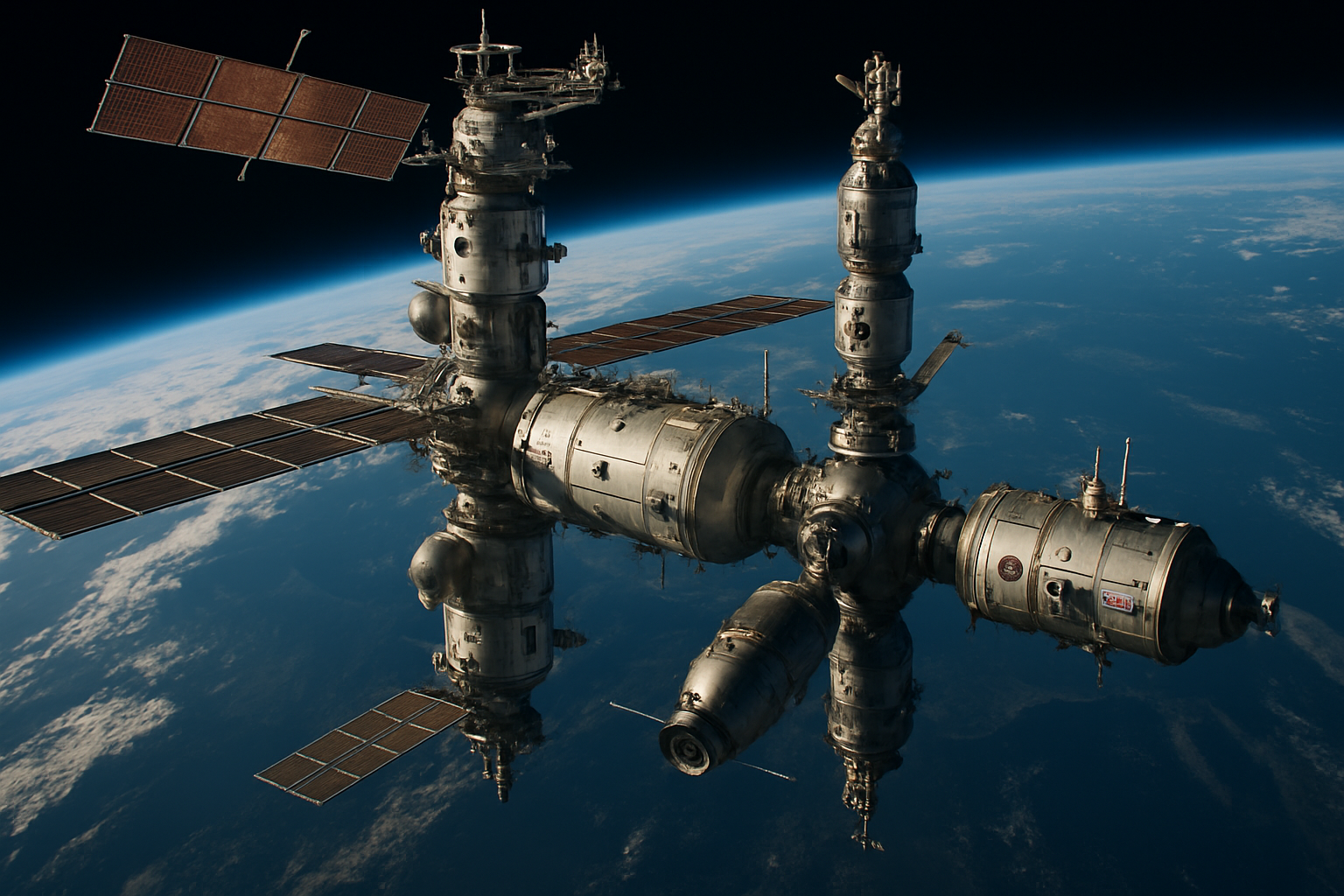
Russia is developing revolutionary technologies to enable safe crewed Mars expeditions while simultaneously expanding international space cooperation capabilities through its planned orbital station, according to recent announcements from Roscosmos leadership.
Dmitry Bakanov, head of Russia's space agency Roscosmos, revealed on Monday that his country is developing cutting-edge technologies that will enable manned expeditions to Mars without endangering astronauts. This ambitious announcement comes as the global space industry transitions into what experts are calling the "space economy golden age," with unprecedented international cooperation alongside intensifying competition.
Mars Mission Technology Breakthrough
The Mars mission technologies being developed by Roscosmos represent a significant advancement in deep space exploration capabilities. While specific technical details remain classified, the announcement suggests Russia is addressing critical challenges that have long hindered human Mars exploration, including radiation protection, life support systems for extended missions, and the psychological challenges of multi-year journeys to the Red Planet.
This development aligns with growing global interest in Mars exploration, as evidenced by recent breakthroughs in space medicine research. French astronaut Sophie Adenot's record eight-month ISS mission has provided invaluable data on long-duration spaceflight effects, including lung tissue cultivation research and studies of Space-Associated Neuro-Ocular Syndrome (SANS), which directly inform protocols for Mars expeditions where Earth evacuation would be impossible.
Russian Orbital Station Plans
Bakanov also outlined Russia's strategy for enhanced international space cooperation once the Russian Orbital Station is deployed. According to recent statements, over ten countries are ready to launch cosmonauts to space with Russia's support, though current International Space Station capacity constraints limit broader cooperation with all friendly nations.
"Things will be different, once the Russian Orbital Station is launched"
— Dmitry Bakanov, Roscosmos Chief
This announcement comes as the ISS approaches its planned deorbiting timeline, with gradual deorbiting scheduled to begin in 2028 and controlled ocean descent planned for 2030. The Russian station would provide continuity for human spaceflight operations and enable expanded international partnerships that current ISS capacity cannot accommodate.
Context of Space Economy Golden Age
Russia's ambitious plans unfold during what industry analysts term the "space economy golden age," characterized by unprecedented commercial investment and international cooperation. The space economy is projected to exceed $1 trillion by 2030, with nations worldwide investing in space capabilities to position themselves for leadership in emerging markets.
Recent milestones include NASA's successful Artemis II mission in April 2026, which ended a 54-year gap in human deep space exploration, and China's steady advancement in reusable spacecraft technology. SpaceX is preparing for a potentially trillion-dollar IPO in June 2026, while countries like Pakistan are developing astronaut programs for missions to China's Tiangong station.
International Cooperation Framework
The announcement reflects Russia's continued commitment to international space cooperation despite terrestrial tensions. The current ISS partnership between NASA, ESA, and Roscosmos has demonstrated the resilience of space cooperation frameworks, with continued crew rotations and scientific research proceeding on schedule.
The democratization of space capabilities is evident in emerging nations' growing participation. Pakistan has selected astronaut candidates for China's Tiangong station missions scheduled for October-November 2026, while Thailand chairs UN space governance initiatives, reflecting the broadening international participation in space activities.
Technical Challenges and Solutions
Mars mission development faces numerous technical hurdles that Russia appears to be addressing systematically. Extended missions to Mars require solutions for radiation protection beyond Earth's magnetic field, sustainable life support systems, and psychological support for crews who cannot return to Earth for years.
Recent advances in space medicine provide crucial foundations for Mars exploration. Research conducted aboard the ISS, including studies of microgravity effects on human biology and cardiovascular changes during extended spaceflight, directly informs the development of medical protocols for Mars missions.
Nuclear propulsion technology, such as NASA's Space Reactor 1 Freedom nuclear spacecraft program, offers potential solutions for faster Mars transit times and continuous power generation during interplanetary missions where solar power is insufficient.
Strategic Implications
Russia's Mars technology development and orbital station plans position the nation as a key player in humanity's expansion into the solar system. The timing is significant, occurring alongside NASA's $20 billion commitment to establishing a permanent lunar base by 2030 and China's plans for lunar crews by the same timeframe.
The convergence of these ambitious national programs suggests the 2030s may witness unprecedented human presence in space, with permanent settlements on the Moon serving as stepping stones for Mars exploration. Russia's focus on safe Mars mission technologies complements these efforts by addressing the medical and engineering challenges of deep space human habitation.
Future Implications
The success of Russia's Mars technology development could accelerate the timeline for human Mars missions, potentially enabling the first crewed expeditions within the next decade. Combined with expanding international cooperation through the Russian Orbital Station, these developments suggest a future where space exploration becomes truly global, with diverse nations contributing specialized expertise to humanity's cosmic expansion.
As the space economy continues its golden age expansion, Russia's technological contributions and cooperation initiatives will likely play a crucial role in establishing the infrastructure necessary for sustained human presence throughout the solar system, marking a pivotal moment in humanity's transition to a spacefaring civilization.