Russia launched one of its most devastating nighttime attacks on Ukraine this year, deploying over 660 drones and missiles in a coordinated assault that killed at least 8 people in the eastern city of Dnipro and left dozens more wounded across multiple regions.
The massive overnight attack targeted civilian infrastructure and residential areas, with Ukrainian air defenses successfully intercepting the majority of the projectiles but unable to prevent all strikes from reaching their targets. The death toll varied across reports, with Ukrainian sources confirming between 6-8 fatalities in Dnipro alone, while at least 47-57 people were reported wounded.
Devastating Impact on Dnipro
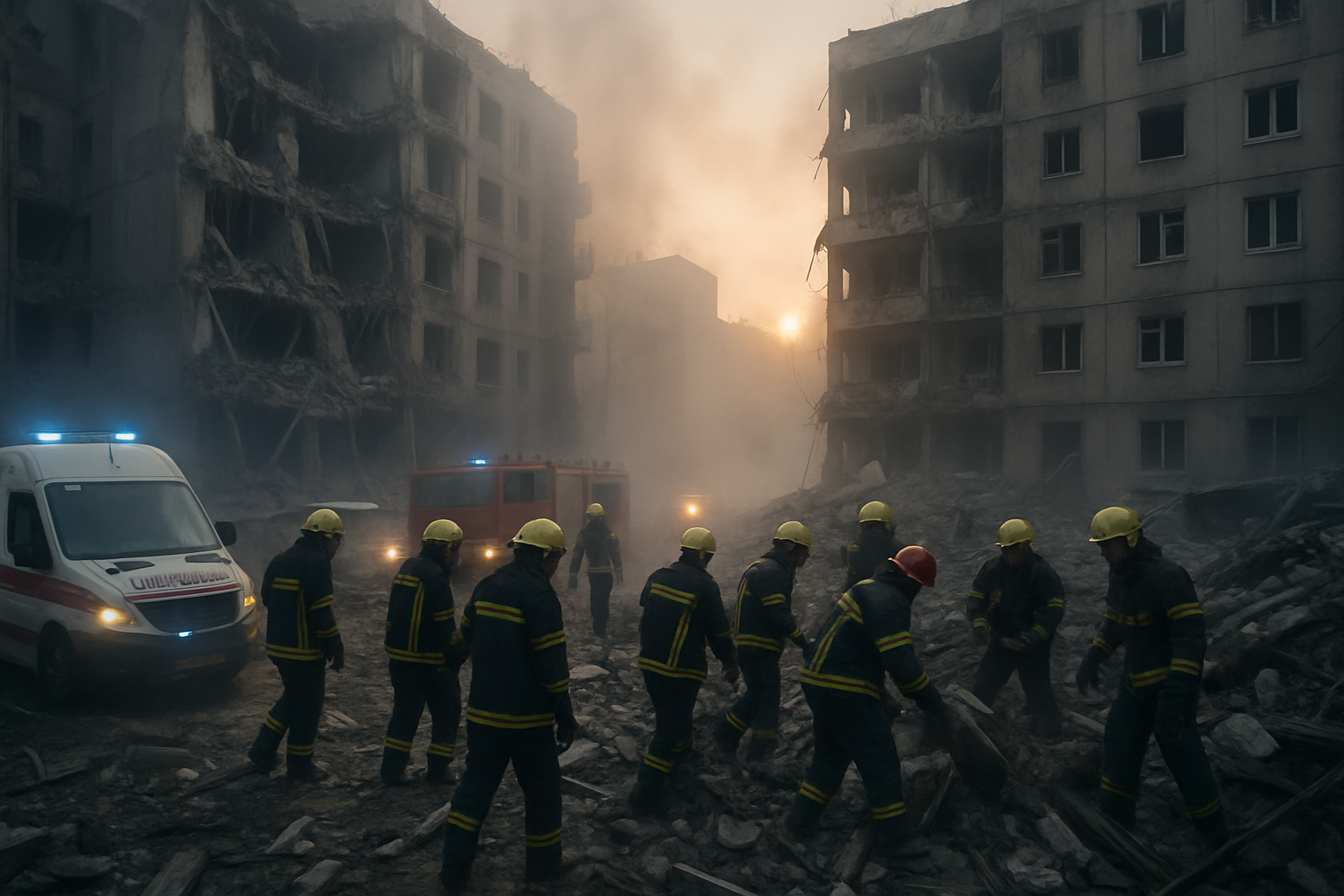
The eastern city of Dnipro bore the brunt of the assault, with at least one residential apartment building suffering significant damage from direct strikes. Regional Governor Alexander Hanža confirmed the casualties, stating that emergency rescue operations were ongoing with people potentially trapped under debris.
Ukrainian President Volodymyr Zelensky reported that rescue workers were still searching through the rubble of the damaged buildings, highlighting the scale of destruction in the densely populated urban area. The attack appeared to deliberately target civilian infrastructure during overnight hours when residents would be sleeping, maximizing potential casualties.
"Four people were killed and 27 wounded in a single strike on an apartment block in Dnipro. Another strike nearly killed a local official."
— Moscow Times Report
Unprecedented Scale of Attack
According to multiple sources, Russia deployed approximately 660 aerial targets in the coordinated assault, making it one of the largest single-day attacks since the conflict began. Ukrainian air defense forces demonstrated remarkable effectiveness, intercepting 80% of missiles and 94% of drones according to military officials, but the sheer volume of projectiles overwhelmed defensive capabilities in some areas.
The attack represents a significant escalation in Russia's aerial campaign against Ukrainian civilian targets, with French sources reporting that Ukrainian air defenses successfully neutralized 580 drones and 30 missiles out of the total barrage. This level of coordination and scale indicates extensive planning and resource allocation by Russian military forces.
Regional Spillover and International Concerns
The attack had international implications, with Romanian authorities confirming that drone fragments fell in Galati County, damaging an electricity pole and household annex. This marked the first property damage in a NATO country from Russian debris, highlighting the expanding geographic impact of the conflict and raising concerns about potential Article 5 implications.
Romanian officials evacuated the affected area citing explosive charge concerns, while emphasizing that the incident appeared to result from navigation errors during Russian operations rather than deliberate targeting of NATO territory. The spillover demonstrates the increasingly complex regional security dynamics as the conflict approaches its fourth anniversary.
Diplomatic Context and Suspended Peace Efforts
The massive attack occurred against the backdrop of indefinitely suspended trilateral peace negotiations between Ukraine, Russia, and the United States. The diplomatic process, which had achieved significant breakthroughs in February 2026 including a 314-prisoner exchange and restoration of US-Russia military communications, has been derailed by the Iran crisis consuming American foreign policy attention.
The framework for peace talks remains intact, with diplomatic mechanisms preserved for potential reactivation when the Iran crisis permits. However, fundamental territorial disputes remain unresolved, with Russia demanding recognition of occupied eastern Ukrainian territories while Ukraine maintains its territorial integrity position.
Pattern of Systematic Civilian Targeting
Saturday's attack continues a documented pattern of systematic targeting of civilian infrastructure that international observers have characterized as "energy terrorism." Over 1,170 Kyiv buildings still lack adequate heating from previous attacks, while Ukrainian nuclear plants have been forced to halt electricity production for the first time since the conflict began.
The strategy appears designed to pressure Ukrainian civilians during harsh winter conditions, creating humanitarian crises that violate Geneva Convention protections for civilian populations. International legal experts have documented these attacks as war crimes under international humanitarian law.
Ukraine's Strategic Transformation
Despite facing continued bombardment, Ukraine has evolved from an aid recipient to a security provider, deploying over 200 military specialists to UAE, Qatar, Jordan, Bahrain, and Kuwait to share expertise in combating Iranian Shahed drones—the same weapons being used against Ukrainian cities.
This strategic transformation demonstrates Ukraine's adaptation to prolonged conflict while building international partnerships that could provide future diplomatic leverage. The UK has also revealed the existence of four operational maintenance and repair facilities within Ukraine servicing Western-supplied equipment, representing unprecedented military cooperation.
Nuclear Crisis Backdrop
The attack occurs within the context of an unprecedented nuclear governance crisis, with the New START treaty having expired on February 5, 2026—the first time in over 50 years without US-Russia nuclear constraints. Both nations control 80% of global nuclear weapons, with UN Secretary-General António Guterres warning of a "grave turning point" with nuclear risks at their highest in decades.
The restored military communications between Pentagon and Russian General Staff remain the only formal diplomatic channel between the nuclear superpowers, adding extraordinary urgency to finding peaceful solutions to the conflict.
International Support and Divisions
The EU has approved a historic €90 billion loan package for Ukraine—the largest single-nation assistance in history—though Slovakia, Czech Republic, and Hungary have refused participation, exposing divisions within the European Union. Additional support includes Sweden-Denmark providing €246 million in air defense systems and Germany delivering 35 Patriot missiles.
Over 17.8 million Ukrainians are currently accessing winter support programs, highlighting the massive humanitarian toll of the systematic infrastructure targeting. The international community faces the challenge of maintaining support while managing multiple global crises simultaneously.
Implications for Future Diplomatic Efforts
The scale and timing of Saturday's attack raise questions about Russia's genuine commitment to peaceful resolution, particularly given the pattern of major escalations occurring during or immediately before diplomatic initiatives. The suspension of peace talks due to the Iran crisis has created a diplomatic vacuum that allows military escalation to continue without immediate diplomatic consequences.
The success or failure of eventual resumed negotiations will carry global implications for 21st-century territorial dispute resolution, European security architecture redefinition, and international law enforcement credibility. The stakes extend far beyond Ukraine, affecting conflict prevention mechanisms and diplomatic innovation versus military approaches to territorial sovereignty enforcement.
Coming Phase Uncertain
The timeline for resumed peace negotiations remains dependent on resolution of the Iran situation and broader Middle East stability. Military escalation continues with systematic civilian targeting while Ukraine maintains operational capabilities and expands international partnerships.
As Europe faces its deadliest conflict since World War II, the international community confronts the challenge of preserving diplomatic frameworks while managing competing global crises. The outcome will determine whether innovative diplomatic solutions can overcome military escalation or if continued violence will reshape European security for decades to come.