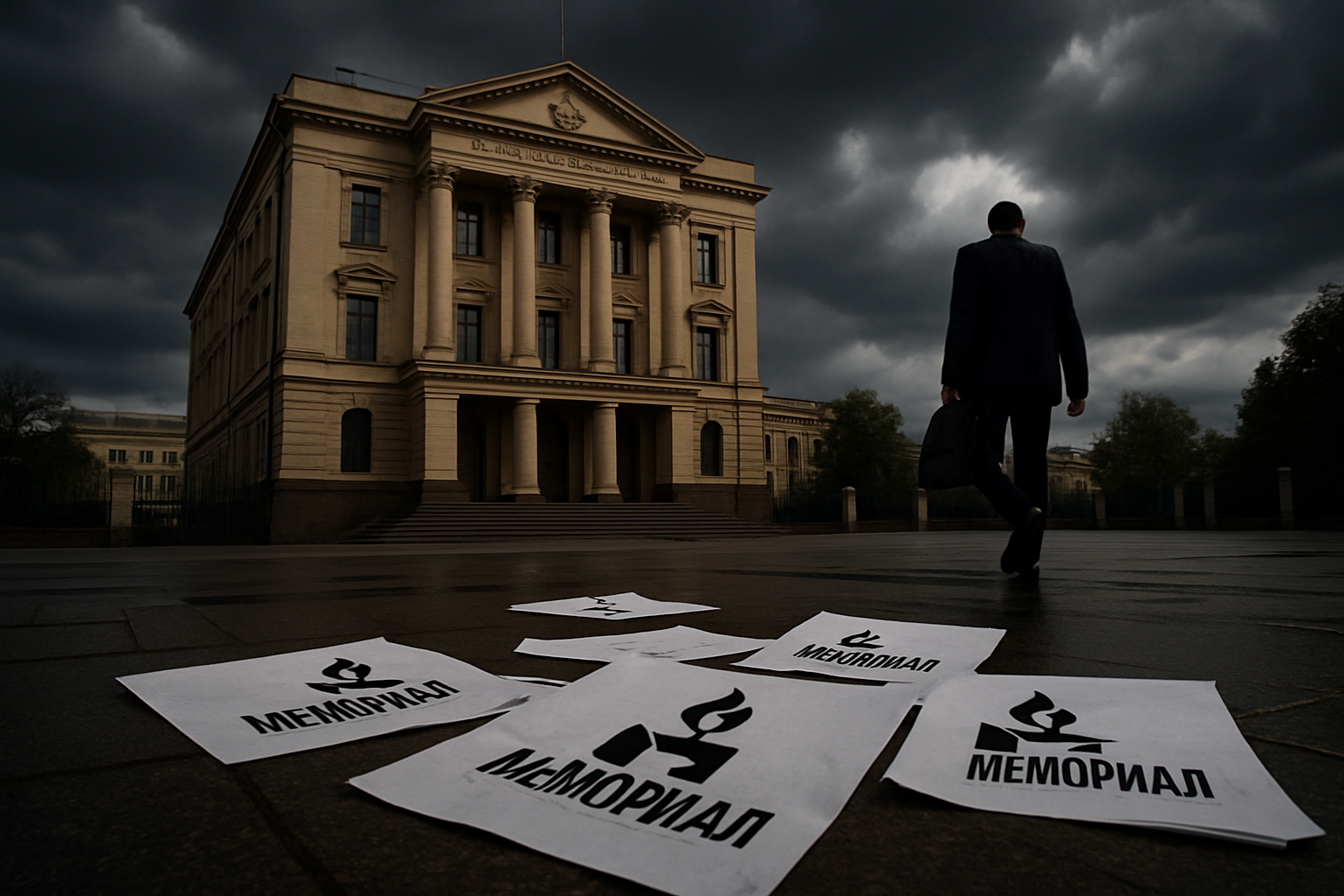
Russia's Supreme Court delivered a devastating blow to civil society on April 9, 2026, officially designating Memorial—the Nobel Peace Prize-winning human rights organization—as an "extremist organization" and banning all its activities within the Russian Federation. The closed-door court session followed a Justice Ministry lawsuit and effectively criminalizes any association with the prominent group that has spent decades documenting historical repressions and defending political prisoners.
The ruling represents the culmination of a systematic legal harassment campaign that began with Memorial's "foreign agent" labeling and escalates Russia's unprecedented assault on independent civil society organizations. Memorial, which shared the 2022 Nobel Peace Prize with Ukrainian Center for Civil Liberties and Belarusian activist Ales Bialiatski, becomes the most internationally recognized human rights organization to face such extreme legal persecution in post-Soviet Russia.
Memorial's Historic Legacy Under Attack
Founded in the late 1980s during the Soviet Union's final years, Memorial emerged as a beacon for historical truth and human rights accountability. The organization dedicated itself to documenting Stalin-era repressions, maintaining extensive archives of political prisoners, and providing crucial legal assistance to contemporary political detainees.
Over three decades, Memorial compiled comprehensive databases of persecution victims, operated museums dedicated to Stalin's victims, and preserved historical records that authorities increasingly sought to minimize. The organization's archives, research programs, and educational initiatives provided essential counternarratives to official historical interpretations that have increasingly portrayed the Soviet era in positive terms.
"Memorial's work directly challenged the government's Stalin legacy rehabilitation efforts and attempts to promote a sanitized version of Soviet history"
— Human Rights Expert, documenting the organization's impact
International Recognition Meets Domestic Persecution
The Nobel Committee's decision to award Memorial the Peace Prize alongside Ukrainian and Belarusian human rights defenders recognized their "outstanding effort to document war crimes, human rights abuses and abuse of power." The Committee specifically praised Memorial's work in establishing a "culture of accountability" in post-Soviet Russia.
According to Russian Justice Ministry officials, at least 196 individuals actively participate in Memorial's activities, with many receiving financing from foreign organizations. The ministry characterized the organization's work as having a "markedly anti-Russian character, aimed at destruction" of Russian society—claims that international human rights observers have strongly disputed.
German Memorial Branch Vows Expansion
In direct response to the Russian court's decision, the German human rights organization "Future Memorial" (Zukunft Memorial) announced it would significantly expand its operations beyond Germany's borders. Irina Shcherbakova, head of Zukunft Memorial, declared the organization would "purposefully activate our work outside Germany—in Europe and at the international level."
Shcherbakova emphasized that in the face of Russia's criminalization of memory work, such activities "must all the more remain visible and effective" internationally. The German branch's commitment to expansion demonstrates the international community's determination to preserve Memorial's legacy despite the Russian government's erasure attempts.
Broader Civil Society Crackdown Context
Memorial's designation as extremist represents the latest escalation in Russia's broader campaign to dismantle independent civil society organizations. This systematic assault has targeted human rights groups, independent media outlets, and opposition movements through increasingly severe legal restrictions, criminal prosecutions, and forced closures.
The case fits a documented pattern of Russian authorities targeting historians and researchers investigating uncomfortable truths about the Soviet past. The European Court of Human Rights previously condemned Russia for similar persecution of historians, including the prolonged detention of Gulag specialist Yuri Dmitriev, though Russia systematically ignores international oversight.
Many researchers have been forced into exile or ceased their work due to fears of prosecution, as the government seeks to control both contemporary political discourse and historical memory. The targeting of Memorial represents a significant escalation in this campaign, as authorities move to control not just present-day dissent but the preservation of historical truth itself.
International Response and Limited Enforcement
International human rights organizations have condemned Memorial's extremist designation as part of Russia's unprecedented suppression of civil society. However, enforcement mechanisms remain severely limited, as Russia has systematically rejected international human rights oversight and withdrawn from various international legal frameworks.
The European Court of Human Rights and other international bodies can provide moral authority and documentation of systematic violations for potential future accountability, but their immediate practical impact remains constrained by Russia's refusal to comply with international legal obligations.
Assault on Democratic Values and Historical Memory
Memorial's extremist designation represents more than an attack on a single organization—it constitutes an assault on academic freedom and historical memory that are essential to democratic society. The criminalization of Memorial's core activities threatens the foundational principles of accountability and historical honesty that underpin democratic governance.
The ruling sets a dangerous template for authoritarian governments worldwide seeking to control historical narratives and suppress documentation of state crimes. By criminalizing the preservation of historical memory, Russian authorities are attempting to reshape not just contemporary political discourse but society's understanding of its own past.
"This represents an assault on academic freedom and historical memory essential to democracy, setting a template for authoritarian governments worldwide seeking control over historical narratives"
— International Democracy Expert
Global Implications for Human Rights Work
The Memorial case highlights the urgent need for international protection mechanisms for historians, researchers, and human rights defenders operating in increasingly authoritarian contexts. As governments worldwide adopt more sophisticated methods of civil society suppression, the international community faces growing challenges in supporting vital human rights work.
Memorial's forced closure in Russia while its international branches pledge to expand operations illustrates both the limitations of domestic repression and the potential for transnational human rights networks to adapt and survive. The organization's legacy will likely continue through its archives preserved abroad and the work of affiliated organizations in democratic countries.
The Stakes for Democratic Accountability
The criminalization of Memorial represents a test case for whether authoritarian governments can successfully erase inconvenient historical truths and eliminate institutions dedicated to accountability. The international community's response—both governmental and civil society—will help determine whether such extreme measures succeed in suppressing historical memory or galvanize stronger international support for human rights work.
As Russia continues to reject international human rights oversight, the preservation of Memorial's work and legacy becomes increasingly dependent on international institutions, partner organizations, and democratic governments committed to supporting historical truth and human rights accountability.
The case serves as a stark reminder that the institutions and freedoms that sustain democratic society require constant vigilance and international solidarity to survive in an era of increasing authoritarianism. Memorial's struggle represents not just a Russian tragedy, but a global test of commitment to the principles of human dignity, historical truth, and democratic accountability.