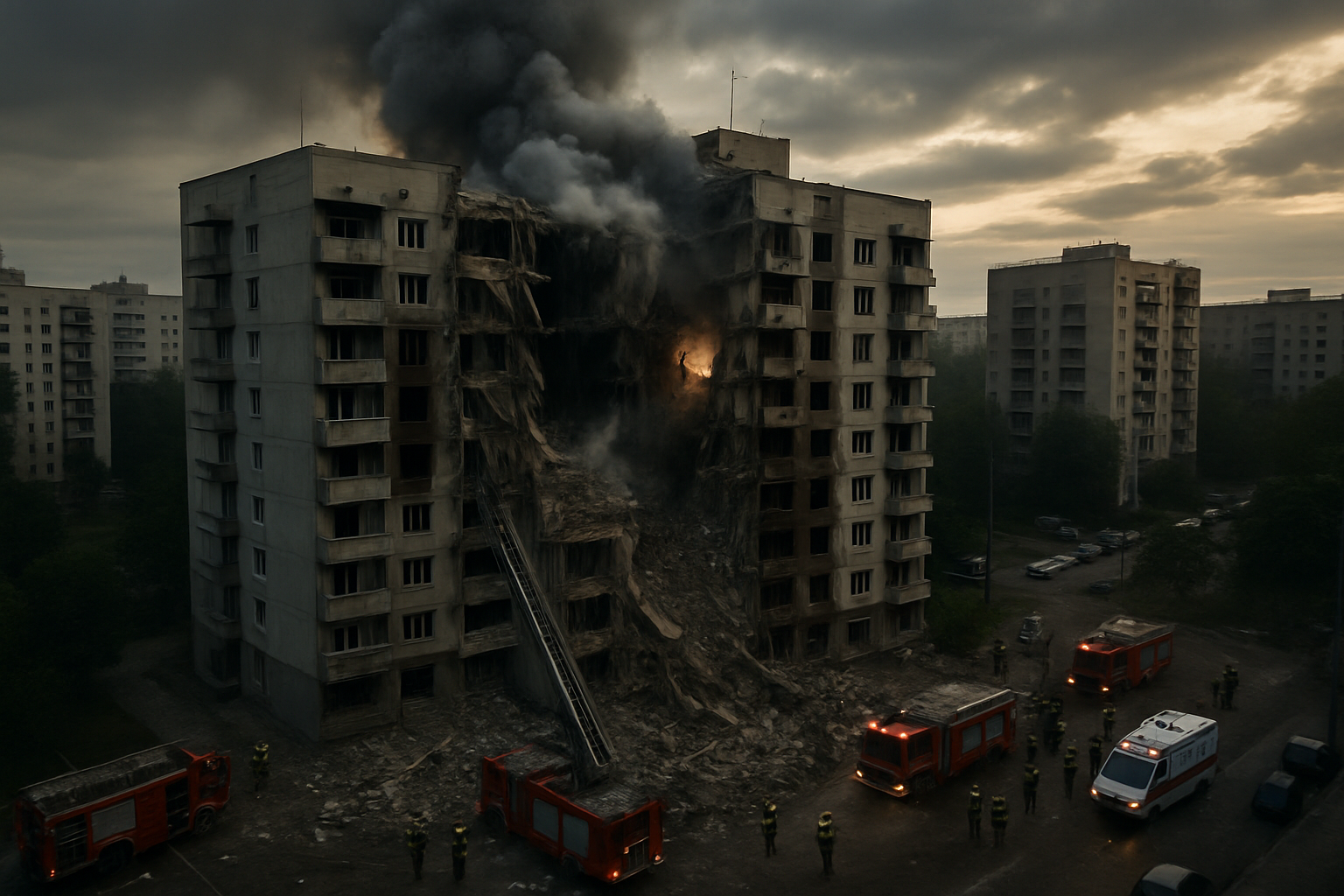
Russian forces launched a devastating assault on civilian infrastructure in Dnipro, striking a high-rise apartment building and injuring seven people, including two young girls, while Ukraine's Security Service opened investigations into the alleged execution of 306 Ukrainian prisoners of war by Russian military forces.
The attacks on April 23, 2026, represent the latest escalation in a systematic campaign targeting civilian populations that has defined Russia's approach to the conflict. According to Italian news agency ANSA and Norwegian outlet VG, the strike on Dnipropetrovsk region left multiple casualties, with particular concern for the injured children who were rushed to medical facilities.
Systematic Targeting of Civilian Infrastructure
The Dnipro assault follows a well-documented pattern of Russian forces deliberately targeting civilian buildings, residential complexes, and essential infrastructure. The high-rise apartment building strike occurred during daytime hours when residents would typically be present, raising serious questions about the deliberate nature of civilian targeting.
Intelligence reports indicate this attack is part of Russia's broader "energy terrorism" strategy that has left over 1,170 buildings in Kyiv without adequate heating and forced Ukrainian nuclear plants to halt electricity production for the first time since the conflict began. The systematic nature of these attacks represents clear violations of the Geneva Conventions' protections for civilian populations.
"The methods of execution documented by Ukraine's Security Service include the most brutal approaches, such as decapitation, mass executions, and dismemberment."
— Ukrainian Security Service Investigation Report
War Crimes Investigation: Mass Execution of POWs
In a parallel development that has shocked international observers, Ukraine's Security Service announced investigations into the alleged execution of 306 Ukrainian prisoners of war by Russian military forces. According to Portuguese news outlet RTP, the investigation reveals evidence of systematic and brutal killings that would constitute grave violations of international humanitarian law.
The investigation documents what Ukrainian authorities describe as "the most brutal methods of execution, including decapitation, mass executions, and dismemberment." These allegations, if verified, would represent some of the most serious war crimes charges since the conflict began in February 2022.
International legal experts note that the deliberate execution of prisoners of war constitutes a grave breach of the Geneva Conventions and would warrant prosecution under international criminal law. The systematic nature of the alleged killings suggests coordinated policy rather than isolated incidents.
Diplomatic Context and Suspended Peace Efforts
These attacks and alleged war crimes occur against the backdrop of indefinitely suspended trilateral peace negotiations between Ukraine, Russia, and the United States. The talks, which achieved historic breakthroughs in February 2026 including a 314-prisoner exchange and restoration of US-Russia military communications after a four-year suspension, have been derailed by the Iran crisis consuming American diplomatic attention.
European leaders have expressed concern that the suspension of diplomatic efforts has emboldened Russian forces to escalate attacks on civilian targets. The February 2026 negotiations represented the most significant diplomatic opportunity since the invasion began, with "significant progress" achieved on ceasefire monitoring mechanisms.
The framework established through those talks, including prisoner exchange mechanisms and Pentagon-Moscow deconfliction protocols, remains technically intact but inactive due to competing Middle East priorities. This suspension has left Ukraine without the diplomatic leverage that had previously helped reduce civilian casualties.
International Response and Legal Implications
The European Union, which has provided a historic €90 billion loan package to Ukraine (the largest single-nation assistance ever), condemned the attacks on Dnipro and called for immediate accountability measures. However, internal divisions remain, with Slovakia, Czech Republic, and Hungary refusing to participate in the financing package.
Legal experts emphasize that both the civilian targeting and alleged prisoner executions constitute serious violations of international humanitarian law. The systematic nature of attacks on residential buildings, combined with evidence of mass prisoner executions, could form the basis for comprehensive war crimes prosecutions.
The documentation of these incidents becomes crucial for future accountability mechanisms. Ukraine has been systematically collecting evidence of war crimes, with over 55,000 Ukrainian soldiers officially acknowledged as killed and estimates suggesting actual casualties may be 2-3 times higher.
Nuclear Governance Crisis
The escalation occurs within the context of an unprecedented nuclear governance crisis. The New START treaty between the United States and Russia expired on February 5, 2026, marking the first time in over 50 years without bilateral nuclear constraints between the superpowers who control 80% of global nuclear weapons.
UN Secretary-General António Guterres has described this as a "grave turning point" with nuclear risks at their "highest in decades." The military communications restoration achieved in February represents the only remaining formal superpower diplomatic channel, making its suspension particularly concerning.
Strategic Implications
The continuation of civilian attacks while peace talks remain suspended raises fundamental questions about Russia's commitment to diplomatic resolution. Military experts note that Russian territorial gains accelerated to 481 square kilometers in January 2026 versus 260 square kilometers in December 2025, representing an 85% increase in the fastest expansion rate recorded.
Ukraine has responded by transforming from aid recipient to global security provider, deploying over 200 military specialists to Middle Eastern nations including the UAE, Qatar, Jordan, Bahrain, and Kuwait to share expertise in countering Iranian Shahed drones—the same weapons being used against Ukrainian civilians.
This strategic evolution has created new partnerships that may provide Ukraine with additional leverage once diplomatic efforts resume. The UK has revealed four operational maintenance, repair, and overhaul (MRO) facilities operating in Ukraine to service Western equipment, representing unprecedented military cooperation.
Humanitarian Crisis Deepens
The attacks on Dnipro contribute to a mounting humanitarian crisis affecting over 17.8 million Ukrainians accessing winter support programs. The systematic targeting of energy infrastructure during extreme weather conditions represents what experts term "winter warfare" designed to break civilian morale.
International humanitarian organizations have documented the targeting of repair personnel, with 15 DTEK energy workers killed while attempting to restore power infrastructure. This pattern of targeting those working to repair civilian services represents additional violations of international humanitarian law.
The broader implications extend beyond immediate casualties to long-term reconstruction needs. The World Bank estimates reconstruction costs at $588 billion over a decade, representing one of the largest post-conflict rebuilding challenges since World War II.
Path Forward
The resumption of meaningful diplomatic engagement depends largely on resolution of the Iran crisis that has consumed American foreign policy attention. The framework established through the February negotiations remains available for reactivation, but fundamental territorial disputes remain unresolved.
Russia continues to demand recognition of occupied eastern Ukrainian territories and insists that any Putin-Zelensky talks occur in Moscow, while Ukraine maintains its territorial integrity position and categorically rejects territorial concessions.
The stakes of eventual resumed negotiations extend far beyond Ukraine-Russia relations. Success could end Europe's deadliest war since World War II and provide a 21st-century template for territorial dispute resolution. Failure risks continued escalation with global implications for international law enforcement and territorial sovereignty principles.
As documented attacks on civilians continue and evidence of systematic prisoner executions emerges, the international community faces mounting pressure to develop accountability mechanisms that can operate even during suspended diplomatic processes. The test of diplomatic innovation versus military escalation will ultimately determine not only the outcome in Ukraine but the broader trajectory of European security architecture for decades to come.