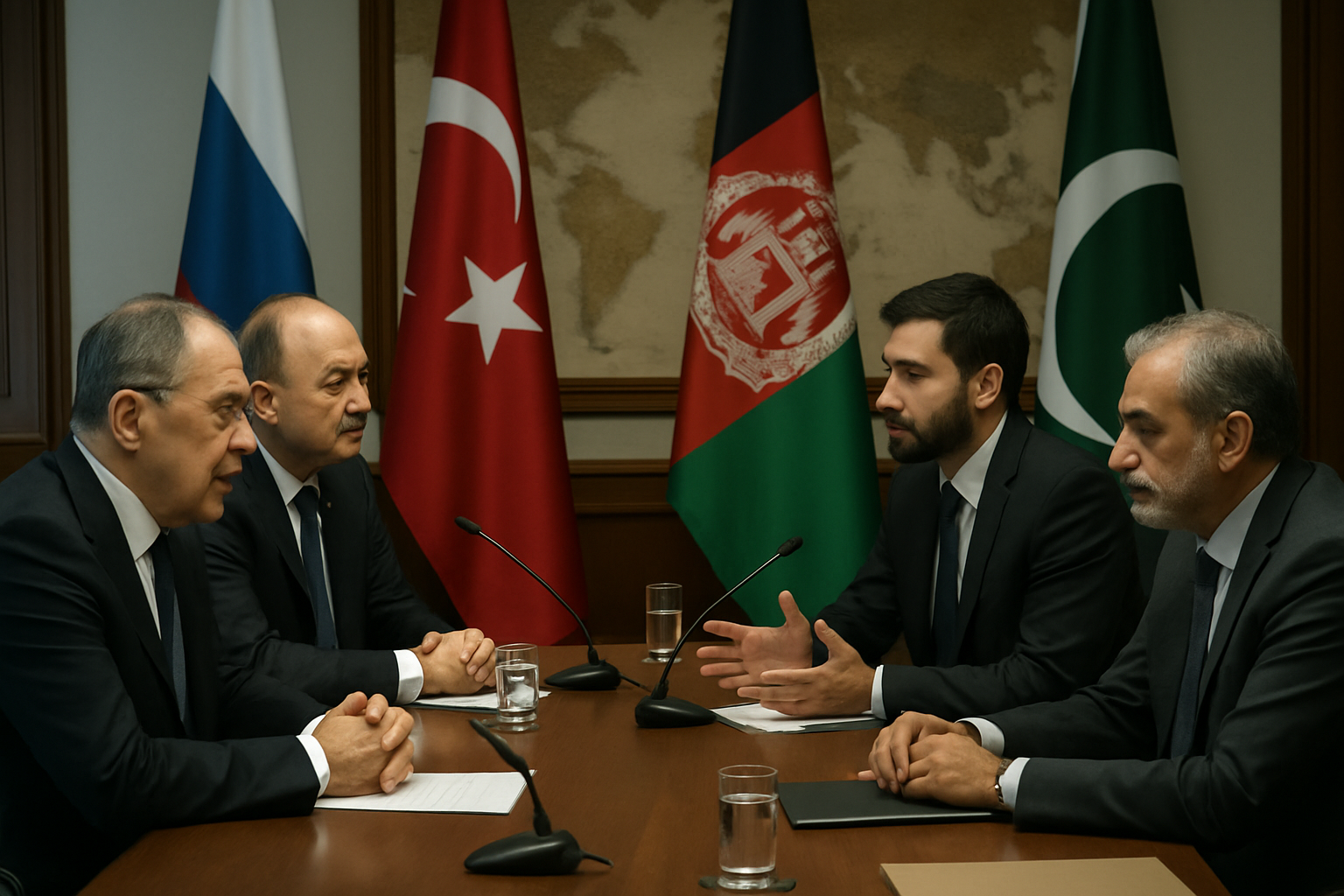
Russia and Turkey have stepped forward to offer mediation services as the Afghanistan-Pakistan border crisis escalates into what Pakistan's Defense Minister has declared "open war" – the most serious military confrontation between the neighboring nations since the Taliban's return to power in August 2021.
The diplomatic intervention comes as fresh tensions erupted over territorial violations and security concerns, with both regional powers expressing grave concern about the deteriorating situation along the disputed 2,640-kilometer Durand Line border.
Russian Mediation Offer
Zamir Kabulov, Russia's special envoy for Afghanistan, described the recent clashes as "concerning" during a meeting with Afghanistan's Ambassador to Moscow, Gul Hasan Hasan. According to a statement issued by the Afghan Embassy, Kabulov stressed that disputes should be resolved through dialogue and diplomacy.
"Russia is prepared to act as a mediator if needed to help resolve tensions between the two countries."
— Zamir Kabulov, Russia's Special Envoy for Afghanistan
The Russian envoy was briefed on what Afghan officials describe as Pakistan's violations of Afghan territory and the Islamic Emirate's official position on the matter. The meeting also covered bilateral relations between Afghanistan and Russia and ways to further develop cooperation.
Turkey's Diplomatic Initiative
Turkish President Recep Tayyip Erdogan has also entered the diplomatic fray, offering Turkey's support for restoration of peaceful dialogue between Pakistan and Afghanistan. In a phone call with Pakistani Prime Minister Shehbaz Sharif, Erdogan condemned recent terrorist attacks in Pakistan while emphasizing the need for diplomatic channels.
Turkey's presidency announced that Erdogan stressed the importance of returning to diplomatic solutions in addressing the Middle East crisis and expressed readiness to support efforts to restore a ceasefire between the two nations.
Chinese Diplomatic Engagement
Afghanistan's Foreign Minister Amir Khan Muttaqi also met with Chinese Ambassador Zhao Xing in Kabul to address recent regional security developments, including what Afghan officials described as violations of Afghan sovereignty by Pakistan. The meeting underscored China's growing interest in regional stability given its significant investments in both countries.
Muttaqi reiterated the Islamic Emirate's foreign policy approach as balanced and focused on economic engagement, emphasizing that Afghanistan seeks constructive relations with all countries based on mutual respect, non-interference, and good neighborly ties.
Escalating Military Crisis
The mediation offers come against the backdrop of what Pakistani Defense Minister Khawaja Asif has formally declared as "open war" against Afghanistan's Taliban government. The crisis began with the February 16 Bajaur attack that killed 11 Pakistani soldiers, attributed to the banned Tehreek-i-Taliban Pakistan (TTP).
Pakistan responded with airstrikes on February 22 targeting seven terrorist camps in Afghanistan's Nangarhar and Paktika provinces, claiming to have killed over 80 militants but also causing civilian casualties including eight schoolchildren. The Taliban subsequently threatened a "measured and appropriate response," describing sovereignty protection as "religious obligations and national duties."
Civilian Impact and Humanitarian Crisis
The escalating conflict has taken a severe toll on civilian populations and bilateral relations. Trade between the two countries has collapsed by 59%, with Pakistan's exports to Afghanistan dropping from $550 million to $228 million over seven months, affecting border communities dependent on cross-border commerce.
The crisis compounds Afghanistan's humanitarian emergency, where 88% of female-headed households are unable to meet minimum living requirements according to UN data. Traditional trade routes through Chaman-Spin Boldak and Torkham have faced repeated closures.
International Law Concerns
The confrontation raises serious questions about international humanitarian law, particularly given reports of civilian casualties from strikes on residential areas and educational institutions. The UN Assistance Mission in Afghanistan (UNAMA) has called for all parties to protect civilians and uphold international law principles of distinction, proportionality, and precaution.
Durand Line Disputes
At the heart of the conflict lies the disputed Durand Line, the 2,640-kilometer colonial-era border established in 1893 that has never been recognized by Afghan governments. The Taliban continues its predecessors' position of non-recognition, viewing the boundary as an artificial division of Pashtun tribal territories.
Pakistan maintains that militant groups, particularly the TTP, operate "with impunity from Afghan soil" despite Taliban assurances about preventing the use of Afghan territory for attacks against neighboring countries.
Previous Mediation Attempts
The current crisis persists despite earlier confidence-building measures, including a Saudi-mediated prisoner exchange in February 2026 that secured the release of three Pakistani soldiers from Taliban custody. However, these diplomatic gestures proved insufficient to address underlying security challenges.
Pakistan acknowledges that its traditional influence in Afghanistan has diminished compared to wealthier regional powers including Turkey, the UAE, Qatar, Saudi Arabia, and China, forcing greater reliance on military solutions.
Regional Security Architecture
The Afghanistan-Pakistan border crisis represents a critical test of the post-2021 South Asian security architecture. The confrontation demonstrates the complex challenge of addressing cross-border terrorism while respecting territorial sovereignty principles.
Chinese warnings at the UN about the presence of ISIS-K, al-Qaeda, and ETIM in Afghanistan contradict Taliban claims of having defeated terrorism, adding another layer of complexity to the regional security environment.
Stakes for International Diplomacy
The success or failure of Russian and Turkish mediation efforts will have implications extending far beyond the bilateral Pakistan-Afghanistan relationship. The crisis serves as a template for 21st-century challenges where territorial sovereignty intersects with transnational terrorism management.
The confrontation tests whether innovative diplomatic frameworks can balance legitimate security concerns with respect for territorial integrity and civilian protection, potentially influencing how similar conflicts are addressed globally.
Path Forward
The coming days will be crucial in determining whether sustained diplomatic engagement can overcome military escalation. The international community faces pressure to develop effective conflict prevention mechanisms before the crisis evolves into a broader regional confrontation.
As both nations grapple with internal challenges – Pakistan's economic pressures and domestic security concerns, Afghanistan's humanitarian crisis and governance limitations – the success of mediation efforts will depend on addressing underlying security challenges rather than merely managing immediate tensions.
The crisis underscores the urgent need for comprehensive approaches to regional security that can effectively address cross-border terrorism while maintaining the principles of territorial sovereignty and civilian protection that underpin international law.