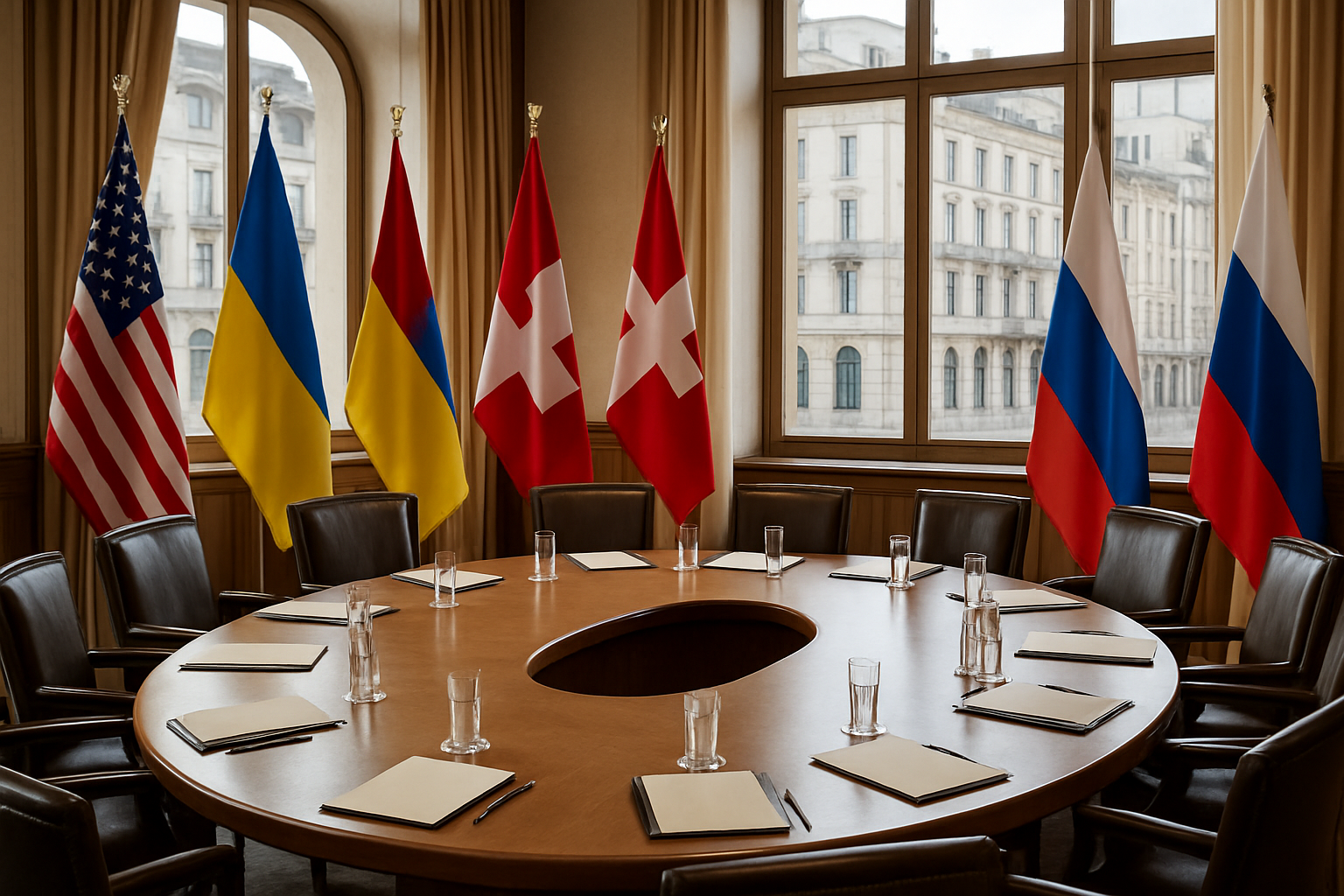
Historic peace negotiations between Russia and Ukraine have commenced in Geneva, Switzerland, with the United States serving as a crucial mediator, marking the most significant diplomatic effort to end nearly four years of devastating conflict in Eastern Europe.
The trilateral talks, scheduled for February 17-18, 2026, bring together Ukrainian Defense Minister Rustem Umerov, Russian delegation head Vladimir Medinsky, and US Special Envoy Steve Witkoff in Switzerland's neutral diplomatic capital. This represents a strategic evolution from the successful Abu Dhabi framework to European neutral territory, signaling growing international commitment to peace.
Building on Diplomatic Breakthrough
The Geneva talks build on unprecedented momentum from the Abu Dhabi negotiations in early February 2026, which achieved historic results including a 314-prisoner exchange—the first in five months—and the restoration of US-Russia military communications after a four-year suspension. Ukrainian Defense Minister Umerov described the previous talks as "substantial and productive," establishing a foundation for more complex territorial and political discussions.
The Pentagon confirmed that restored military communications include deconfliction protocols covering global operations in Syria, the Arctic, and Africa, representing the most significant US-Russia military agreement since the conflict began. These confidence-building measures demonstrate that sustained diplomatic engagement can produce concrete humanitarian results even amid ongoing military operations.
Escalating Military Context
The peace talks proceed against a backdrop of dramatic military escalation throughout early 2026. Russian forces captured 481 square kilometers in January alone, compared to 260 square kilometers in December 2025, marking a significant acceleration in territorial gains. Over 10,000 Russian drones and bombs were launched in January 2026, representing the most intense bombardment campaign of the year.
Particularly concerning has been Russia's systematic targeting of civilian infrastructure during extreme winter conditions. Energy attacks in early February left over 1,170 buildings in Kyiv without heating during temperatures reaching minus-30°C, breaking an informal Trump-Putin energy truce and prompting international condemnation.
"These attacks represent energy terrorism, using winter as a weapon against civilians during diplomatic engagement."
— NATO Secretary-General Mark Rutte
Nuclear Crisis Backdrop
The Geneva talks occur amid an unprecedented nuclear governance crisis. The New START treaty between the United States and Russia expired on February 5, 2026, marking the first time in over 50 years without nuclear arms control constraints between the superpowers. UN Secretary-General António Guterres called this a "grave turning point," warning that nuclear weapon use risks are "higher than at any time in decades."
With both nations controlling over 80% of the world's nuclear weapons—Russia with approximately 4,380 warheads and the US with 3,708—the absence of bilateral constraints creates dangerous uncertainty. The restored military communications represent the only remaining major diplomatic channel between the nuclear superpowers, adding critical importance to the Geneva framework.
Unprecedented International Support
Ukraine continues to receive historic levels of international support despite the ongoing conflict. The European Union approved a €90 billion loan package—the largest ever provided to a single nation—though Slovakia, Czech Republic, and Hungary refused participation, showing continued divisions within the bloc.
Additional support includes Sweden and Denmark's €246 million air defense package featuring advanced Tridon Mk2 systems, Germany's provision of 35 Patriot missiles, and World Bank allocation of $40 million for energy restoration. Over 17.8 million Ukrainians are currently accessing winter support programs as the international community responds to the humanitarian crisis.
Human Cost Revealed
President Volodymyr Zelensky disclosed in February that exactly 55,000 Ukrainian soldiers have been officially confirmed killed since Russia's February 2022 invasion, representing the first official casualty count in nearly a year. The figure represents only confirmed battlefield deaths, with a "large number" still classified as missing in action. International research estimates suggest actual military deaths could be 2-3 times higher when including missing personnel and undocumented casualties.
Civilian casualties continue mounting through systematic targeting. A recent drone strike in Bohodukhiv killed four civilians, including three young children—two one-year-old boys and one two-year-old girl—along with their 34-year-old father. This marked the second deadly attack on the same town within three days, demonstrating a pattern of systematic family targeting that violates international humanitarian law.
Territorial Disputes Remain Central
Despite humanitarian breakthroughs, the fundamental sticking point remains unchanged: the fate of eastern Ukrainian territories under Russian control. Russia demands territorial recognition and insists that any Putin-Zelensky talks must occur in Moscow. Ukraine maintains its territorial integrity position while seeking long-term security guarantees from Western partners.
The accelerating Russian gains in January 2026 potentially strengthen Moscow's bargaining position, while Ukraine's historic international support maintains its leverage for comprehensive security arrangements. This territorial challenge represents the core innovation required for any lasting peace agreement.
June Deadline and Washington Evolution
The Trump administration has established a June 2026 deadline for a comprehensive peace agreement, with talks potentially evolving to a Washington venue that could involve presidential-level engagement. This timeline creates unprecedented pressure for innovative territorial dispute resolution, representing a diplomatic test with global implications.
The evolution from Abu Dhabi to Geneva to potentially Washington suggests deliberate diplomatic escalation, with each venue offering unique advantages: UAE's proven neutral hosting methodology, Switzerland's institutional mediation traditions, and America's executive authority for implementation guarantees.
European Security Architecture at Stake
The Geneva talks carry implications far beyond Ukraine and Russia, potentially redefining European security architecture for decades. Success could provide a template for 21st-century conflict resolution, combining military pressure, diplomatic engagement, and international law enforcement. Failure might intensify military operations globally while undermining confidence in diplomatic solutions for territorial disputes.
European divisions persist, with Germany opposing direct Putin talks due to "maximalist demands" while France and Italy support broader engagement. These differences reflect broader questions about how democratic societies should engage with authoritarian powers during active conflicts.
Innovation Required
The Geneva framework faces the challenge of bridging positions that have remained fundamentally far apart despite humanitarian breakthroughs. Traditional territorial dispute resolution mechanisms appear insufficient for the complexity of the Russia-Ukraine conflict, requiring unprecedented diplomatic innovation.
The success of the prisoner exchange and military communications restoration demonstrates that structured engagement can produce concrete results. However, translating this momentum to territorial compromise solutions represents the ultimate test of whether sustained diplomacy can resolve Europe's deadliest conflict since World War II.
Global Implications
The stakes extend well beyond Europe, affecting global conflict prevention mechanisms, international law enforcement credibility, and territorial sovereignty principles for 21st-century power competition. The international community is watching closely for diplomatic innovation versus traditional limitations in resolving complex territorial disputes.
Success could establish new precedents for international mediation, nuclear crisis management, and democratic resilience under extreme pressure. The framework's methodology—combining humanitarian confidence-building measures with systematic political negotiations—could influence conflict resolution approaches worldwide.
As the talks commence in Geneva's historic diplomatic setting, negotiators face the monumental task of finding innovative solutions to challenges that have defied resolution for nearly four years. The coming days will determine whether this diplomatic opportunity can translate breakthrough momentum into lasting peace for Europe and beyond.