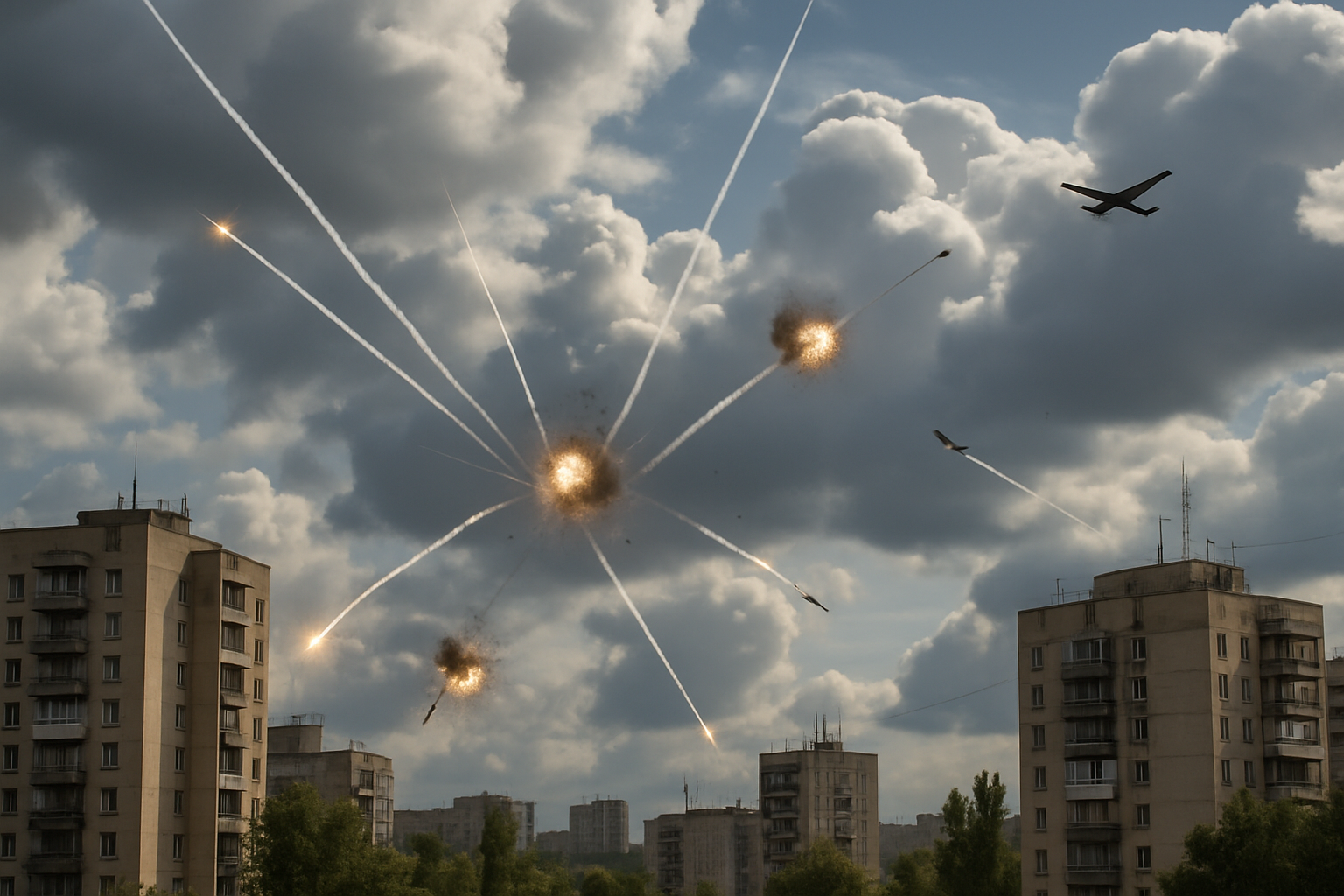
Russia has launched one of its most devastating aerial assaults since the war began, deploying approximately 500 drones and missiles in a single day against Ukrainian cities and critical infrastructure across multiple regions.
Ukrainian forces intercepted the majority of the aerial weapons, but the sheer scale of the Friday, April 3rd offensive represents a significant escalation in Russia's campaign of systematic terror against civilian targets. The attack killed at least one person in the Kyiv region and wounded several others, while causing widespread damage to residential areas and essential infrastructure.
Massive Scale of the Assault
According to Ukrainian Defense Forces, the coordinated attack involved nearly 500 unmanned aerial vehicles and missiles launched across multiple Ukrainian regions. Ukrainian Foreign Minister Andrii Sybiha condemned the assault, stating that "Russian terrorists are striking in broad daylight to maximize civilian casualties."
The offensive targeted the capital region around Kyiv, with local military officials confirming "extensive attacks on the region surrounding Ukraine's capital." French media reports described the assault as involving "près de 500 drones russes lancés en plein jour" (nearly 500 Russian drones launched in broad daylight), while German sources confirmed that Ukrainian air defenses worked for "mehrere Stunden" (several hours) to repel the attacks.
In Kherson, a Russian drone struck a bus carrying passengers, wounding five people according to regional administration reports. The systematic targeting of civilian transportation demonstrates the calculated nature of Russia's terror campaign.
Diplomatic Context and Suspended Peace Efforts
The massive assault comes as diplomatic efforts remain stalled due to the ongoing Iran crisis in the Middle East. Peace talks between Ukraine, Russia, and the United States - which achieved significant progress in February 2026 including a historic 314-prisoner exchange and restoration of US-Russia military communications after a four-year suspension - have been indefinitely suspended.
President Zelensky had previously indicated that negotiations could only proceed "when the security situation allows," with the Iran crisis preventing the high-level trilateral engagement necessary for territorial dispute resolution. The framework for renewed talks remains intact, with mechanisms able to be reactivated when geopolitical conditions permit.
"Due to the situation around Iran, there are still no necessary signals for trilateral meeting until the security situation allows."
— Volodymyr Zelensky, President of Ukraine
Strategic Implications and Military Developments
The latest offensive demonstrates Russia's continued capability to launch large-scale coordinated attacks despite nearly three years of conflict. Military analysts note that Russian forces have accelerated territorial gains in recent months, capturing 481 square kilometers in January 2026 compared to 260 square kilometers in December 2025 - an 85% increase.
Ukraine has simultaneously evolved from aid recipient to security provider, deploying military experts to Middle Eastern countries including the UAE, Qatar, Jordan, Bahrain, and Kuwait to combat Iranian Shahed drones - the same weapons being used against Ukrainian infrastructure.
The United Kingdom has revealed the existence of four operational maintenance, repair, and overhaul (MRO) facilities in Ukraine servicing Western-supplied equipment, with a fifth facility planned. This represents the first public acknowledgment of extensive military infrastructure supporting Ukraine's defense capabilities.
Humanitarian Crisis and Civilian Targeting
The systematic targeting of civilian infrastructure continues to violate Geneva Conventions, with over 1,170 Kyiv buildings still lacking adequate heating from previous attacks. Ukrainian nuclear plants have been forced to halt electricity production for the first time in the conflict due to grid attacks.
President Zelensky has disclosed that 55,000 Ukrainian soldiers have been officially killed, with a "large number" missing. International estimates suggest actual casualties may be 2-3 times higher than official figures. Over 17.8 million Ukrainians are currently accessing winter support programs due to systematic infrastructure destruction.
Nuclear Governance Crisis
The escalation occurs against the backdrop of an unprecedented nuclear governance crisis. The New START treaty between the United States and Russia expired on February 5, 2026, marking the first time in over 50 years without nuclear constraints between the superpowers. Both nations control approximately 80% of global nuclear weapons, with UN Secretary-General António Guterres warning of a "grave turning point" with nuclear risks at their "highest in decades."
International Support and Response
Despite the escalating attacks, international support for Ukraine remains robust. The European Union has approved a historic €90 billion loan package - the largest single-nation assistance package in EU history - though Slovakia, Czech Republic, and Hungary have refused participation, exposing divisions within the bloc.
Germany has delivered 35 Patriot missiles as part of commitments made at the Ramstein Group meetings, while Sweden and Denmark have provided €246 million in air defense systems. These weapons prove crucial as Ukraine faces an estimated expansion of Russian unmanned forces to 101,000 troops by April 2026 - representing the largest dedicated drone force in modern warfare.
Regional and Global Implications
The conflict's implications extend far beyond Ukraine's borders. NATO allies are establishing forward support infrastructure in conflict zones, while energy security concerns affect European markets and regional stability. The suspension of peace talks due to the Iran crisis demonstrates how interconnected regional conflicts challenge international community efforts to manage multiple simultaneous crises.
European leaders at the Munich Security Conference declared that the "post-war order no longer exists," with discussions underway about European strategic autonomy including France's first nuclear deterrent expansion beyond national scope since the Cold War.
Looking Forward
As Ukraine enters its fifth year of conflict, the stakes continue to escalate. The success or failure of eventual resumed peace talks carries global implications for territorial sovereignty principles, international law enforcement, and 21st-century conflict resolution mechanisms. The current framework preserves the possibility of reactivation when geopolitical conditions improve, but fundamental territorial disputes remain unchanged.
Russia demands recognition of occupied eastern territories and Moscow venue for any Putin-Zelensky talks, while Ukraine maintains its territorial integrity position. The timeline for renewed negotiations depends on resolution of the Iran situation, as military escalation continues with systematic civilian targeting while Ukraine maintains operational capabilities and expands international partnerships.
This latest massive assault underscores the urgent need for diplomatic innovation versus continued military escalation in determining European security redefinition for decades to come. The template established by this conflict will significantly influence global conflict prevention mechanisms and territorial sovereignty enforcement in the 21st century.