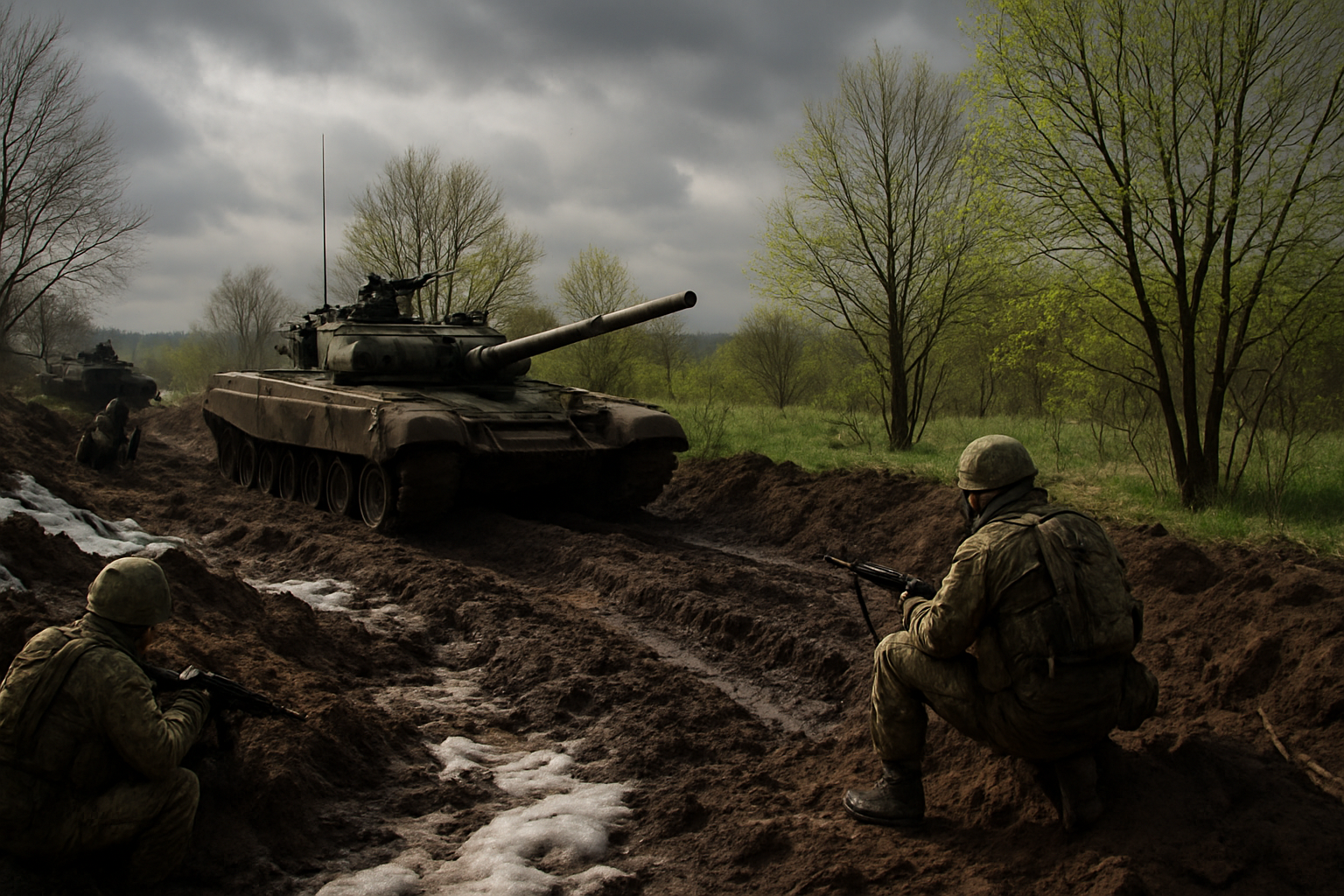
Russian forces are intensifying preparations for a potential spring offensive in Ukraine, according to multiple intelligence assessments, as the most promising diplomatic initiatives since the war began remain indefinitely suspended due to the Middle East crisis.
Estonian Defense Intelligence Colonel Ants Kiviselg confirmed a sharp rise in combat intensity, with Russian forces demonstrating clear signs of spring offensive preparations through increased airstrikes, territorial gains acceleration, and systematic expansion of unmanned capabilities. The intelligence indicates Russian troop levels are projected to reach 101,000 by April 2026.
This military escalation comes as historic diplomatic breakthroughs achieved in February 2026 hang in the balance. The trilateral Ukraine-Russia-US peace negotiations, which produced the first prisoner exchange in five months and restored military communications between Washington and Moscow after a four-year suspension, remain stalled as American foreign policy attention shifts to Iran.
Accelerating Military Dynamics
The military situation on the ground reflects the urgency behind potential Russian spring operations. Russian territorial gains have accelerated dramatically—481 square kilometers captured in January 2026 compared to 260 square kilometers in December 2025, representing an 85% increase and the fastest territorial acquisition in months.
German military analysis suggests Russian forces are employing a dual-track strategy: maintaining pressure through systematic attacks while preparing for larger-scale operations when weather conditions improve. The past week alone saw 1,750 strike drones, 1,530 guided aerial bombs, and 39 missiles launched against Ukrainian positions.
Swedish intelligence reports indicate the conflict has evolved into what experts describe as "a static war of attrition," with trench warfare conditions resembling World War I battlefields. However, the integration of modern technology—particularly drones and artificial intelligence—is creating unprecedented tactical dynamics that may reshape spring operations.
French diplomatic sources reveal that Russian Foreign Minister Sergey Lavrov has maintained that "Vladimir Putin is always ready for dialogue," yet the timing of military preparations suggests Moscow may be positioning for negotiations from a position of enhanced strength.
Diplomatic Momentum Derailed
The suspension of peace talks represents a critical setback for what many considered the most significant diplomatic opportunity since the conflict began in February 2022. The February 2026 Abu Dhabi breakthrough achieved unprecedented results: a 314-prisoner exchange, the restoration of US-Russia military communications, and the establishment of Pentagon deconfliction protocols covering global operations from Syria to the Arctic.
Geneva talks in February, which included European "Big 5" observers (Germany, France, Italy, UK, Poland) for the first time, showed "significant progress" on ceasefire monitoring mechanisms according to US Special Envoy Steve Witkoff. The evolution from Abu Dhabi to Geneva to the planned Washington venue suggested a deliberate diplomatic escalation toward potential presidential-level engagement.
"There are no necessary signals for a trilateral meeting until the security situation allows."
— President Volodymyr Zelensky
However, the Iran crisis has effectively derailed this momentum. Reports suggest complex interconnections between regional conflicts, with Austrian sources revealing Putin allegedly offered the United States a deal to withhold Russian targeting data from Iran in exchange for reduced American intelligence support to Ukraine.
Technology Warfare Evolution
The anticipated spring offensive will likely showcase the conflict's transformation into a technology-dominated battlefield. Swedish classified reports, now partially public, detail how drones and AI systems have fundamentally altered combat dynamics, with autonomous robots expected to play increasingly independent roles.
Ukrainian forces have demonstrated remarkable technological adaptation, conducting what military experts describe as historic operations. A recent 283-drone offensive against Russian territory represented one of the largest such attacks since the conflict began, with debris hitting facilities near oil refineries in Ufa, Bashkortostan.
The technological dimension extends beyond battlefield applications. Ukraine's strategic pivot toward becoming a security provider—deploying military experts to five Middle Eastern countries to combat Iranian Shahed drones—demonstrates how battlefield experience is being leveraged into broader international partnerships.
Humanitarian and Nuclear Concerns
The military preparations occur against a backdrop of unprecedented humanitarian and nuclear governance crises. Ukrainian officials have disclosed 55,000 soldiers officially killed, with international estimates suggesting actual casualties may be 2-3 times higher. Over 17.8 million Ukrainians currently access winter support programs.
The systematic targeting of civilian infrastructure continues, with more than 1,170 Kyiv buildings lacking adequate heating following what energy officials describe as "terrorism" attacks. Ukrainian nuclear plants were forced to halt electricity production for the first time in the conflict, raising concerns about European nuclear security.
The nuclear governance crisis has reached unprecedented levels following the February 5, 2026 expiration of the New START Treaty—the first time in over 50 years without US-Russia nuclear constraints. Both nations control 80% of global nuclear weapons, prompting UN Secretary-General António Guterres to warn of a "grave turning point" with nuclear risks at their "highest in decades."
International Support Under Strain
European unity faces severe testing as the conflict approaches its fifth year. Hungary's threats to veto the historic €90 billion EU aid package—the largest single-nation assistance ever—over the Druzhba pipeline dispute expose the deepest divisions within the European Union since the war began.
Despite these challenges, international support remains substantial. Sweden and Denmark have committed €246 million for air defense systems, Germany has delivered 35 Patriot missiles, and the UK has revealed four operational maintenance facilities in Ukraine servicing Western equipment, with a fifth planned.
The persistence of such support reflects broader strategic calculations about European security architecture. As German Chancellor Olaf Merz noted at the Munich Security Conference, "the post-war order no longer exists," suggesting fundamental recalibrations of international relations.
Territorial Sticking Points
The core challenge that suspended diplomatic progress remains unchanged: the status of eastern Ukrainian territories under Russian control. Moscow demands territorial recognition and insists that any Putin-Zelensky talks must occur in Moscow, while Ukraine maintains its territorial integrity position and seeks long-term security guarantees.
President Zelensky has categorically rejected territorial concessions, stating Ukrainian people would reject "handing over territories" in any referendum as a "failure story." This position has been complicated by recent US proposals that would condition security guarantees on Ukrainian withdrawal from unoccupied Donbas territories—a demand Zelensky described as "compromising Ukraine and Europe's security."
The territorial dispute represents more than bilateral disagreement; it carries implications for 21st-century international law enforcement and territorial sovereignty principles that will shape global power competition for decades.
Strategic Implications
The suspended peace process and preparations for spring operations occur at a critical juncture for European security architecture. The success or failure of eventual resumed negotiations carries global implications for conflict resolution templates and territorial sovereignty enforcement mechanisms.
Military experts suggest the coming phase will be decisive. Ukraine's evolution from aid recipient to security provider, demonstrated through Middle East partnerships and technological innovation, provides new leverage. However, Russia's territorial gains acceleration and offensive preparations may strengthen Moscow's bargaining position.
The framework achievements from February 2026—prisoner exchange mechanisms, military communications restoration, and structured negotiation formats—remain intact and can be reactivated when favorable conditions return. The United Arab Emirates methodology of working groups by topic and joint position synchronization has proven effective for producing concrete humanitarian results.
Looking Ahead
The timeline for renewed high-level diplomacy depends largely on resolution of the Iran crisis and broader Middle East stability. The interconnected nature of regional conflicts in the current multipolar security environment demonstrates how competing priorities can derail even the most promising peace initiatives.
Should spring military operations proceed as intelligence suggests, they will test both Ukrainian defensive capabilities developed over four years of conflict and Russian offensive potential amid resource constraints. The outcome could significantly influence the eventual resumption of diplomatic engagement and the terms under which parties might return to negotiations.
For the international community, the current phase represents a critical test of diplomatic innovation versus military escalation in resolving complex territorial disputes. The stakes extend far beyond Ukraine, encompassing questions of international law credibility, European integration trajectory, and conflict prevention mechanisms that will define security architecture for the 21st century.
As President Zelensky warned in his fourth anniversary interview, the implications may already extend beyond regional conflict to global security challenges, stating that Putin "has already started" World War III. Whether diplomatic breakthrough or military escalation ultimately defines the war's trajectory may determine not just Ukraine's future, but the fundamental principles governing international relations in the decades ahead.