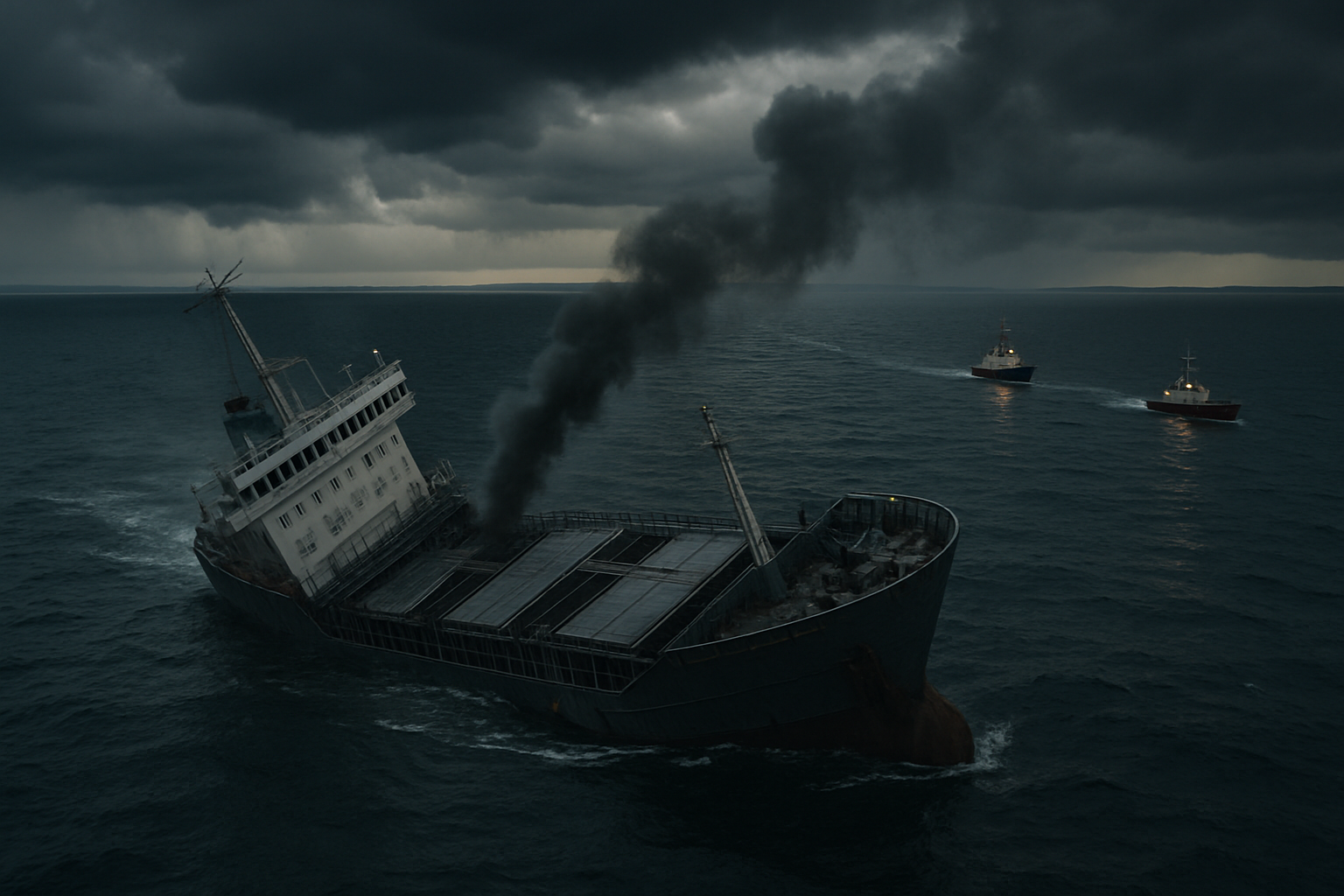
A Russian cargo ship carrying wheat sank in the Sea of Azov after coming under attack from Ukrainian drones, leaving one person dead and two missing, according to Vladimir Saldo, the Moscow-installed leader of Russian-controlled parts of Ukraine's Kherson region.
The attack on the vessel Volgo-Balt occurred on Friday but crew members were unable to make contact until Sunday due to communication difficulties, Saldo reported via social media. According to Russian news agency TASS, the ship was struck by a drone, marking another escalation in Ukraine's maritime warfare campaign against Russian vessels and infrastructure.
The incident represents a significant development in the ongoing naval conflict between Ukraine and Russia, as Ukrainian forces have increasingly targeted Russian cargo ships, particularly those carrying grain and oil products. The vessel was reportedly transporting wheat when it came under attack in the strategically important Azov Sea.
Historical Context: Pattern of Ukrainian Maritime Operations
This attack follows a series of Ukrainian drone strikes on Russian maritime assets throughout 2026. The sinking of Volgo-Balt comes amid an intensifying campaign by Ukrainian forces targeting Russian energy infrastructure and shipping, which has disrupted significant portions of Moscow's war economy.
In March 2026, Ukrainian forces successfully targeted the Russian-flagged LNG tanker Arctic Metagaz in the Mediterranean, marking the first successful attack on a Russian LNG carrier. That incident resulted in the complete sinking of the vessel carrying 61,000 tons of LNG, though all crew members were rescued.
Ukrainian operations have also targeted Russian port facilities, including multiple strikes on the strategic Ust-Luga oil export terminal in the Leningrad region, which handles approximately 700,000 barrels per day. These attacks have reportedly disrupted 40% of Russian oil export capacity, forcing dozens of shadow fleet tankers to remain stranded in the Gulf of Finland.
Strategic Significance of the Azov Sea
The Azov Sea holds particular strategic importance as it provides access to Russian-controlled territories and serves as a crucial shipping route for agricultural exports from occupied Ukrainian regions. The attack on Volgo-Balt demonstrates Ukraine's expanding operational capabilities to target Russian assets in waters that Moscow has largely considered secure.
"The reason for the sinking of the Volgo-Balt in the Sea of Azov was a drone strike, which resulted in the death of one crew member and two others going missing."
— Vladimir Saldo, Russian-installed Kherson leader
Intelligence sources suggest that Ukrainian drone technology has evolved significantly, enabling strikes at considerable distances from Ukrainian-controlled territory. The ability to successfully target vessels in the Azov Sea represents an extension of Ukraine's deep-strike capabilities, which have previously reached targets over 1,000 kilometers from the Ukrainian border.
Impact on Russian Grain Exports
The targeting of a wheat-carrying cargo ship raises questions about the security of Russian grain shipments, many of which originate from occupied Ukrainian territories. International maritime law experts have previously noted concerns about vessels carrying what they term "stolen Ukrainian grain" under false documentation as part of Russia's shadow fleet operations.
The incident occurs amid broader international efforts to counter Russia's shadow fleet, which consists of over 600 vessels using false documentation and concealed ownership to circumvent sanctions. Swedish authorities have recently seized multiple Russian vessels, including the tankers Caffa and Sea Owl One, both operating under false flags.
Escalating Energy and Economic Warfare
The sinking of Volgo-Balt represents part of a broader pattern of energy and economic warfare that has intensified throughout 2026. Ukrainian strikes on Russian infrastructure have demonstrated sophisticated coordination and intelligence gathering, successfully penetrating Russian air defenses to strike critical facilities.
These operations have coincided with a global energy crisis triggered by conflicts in multiple theaters, including the Iran-Israel confrontation that has disrupted Middle Eastern oil supplies and driven prices above $100 per barrel for the first time since 2022.
The International Energy Agency has deployed the largest strategic petroleum reserve release in its 50-year history, totaling 400 million barrels from 32 countries, in response to supply disruptions affecting global energy markets.
Diplomatic Context and Peace Process
The maritime attack occurred while trilateral peace negotiations between Ukraine, Russia, and the United States remain indefinitely suspended due to the Iran crisis consuming American foreign policy attention. The suspension has derailed momentum from February 2026 breakthroughs that included a historic 314-prisoner exchange and the restoration of US-Russia military communications after a four-year suspension.
Ukrainian President Volodymyr Zelensky has indicated that peace talks could resume once international security conditions allow, but fundamental territorial disputes over eastern Ukrainian territories remain unresolved. The Trump administration had established a June 2026 deadline for comprehensive peace negotiations, potentially at the presidential level in Washington.
International Maritime Security Implications
The attack on Volgo-Balt highlights the vulnerability of commercial shipping in contested maritime domains. Maritime security analysts have noted that modern drone technology has created new vulnerabilities for vessels operating in international waters, leading to surging insurance premiums and costly alternative routing.
The incident adds to growing concerns about the militarization of commercial maritime traffic, as civilian vessels increasingly become targets in modern conflicts. International maritime organizations have called for enhanced cooperation to protect commercial shipping while maintaining the distinction between military and civilian assets.
Regional Security Implications
The successful targeting of a Russian cargo ship in the Azov Sea demonstrates Ukraine's expanding operational reach and technological capabilities. The attack pattern suggests sophisticated intelligence coordination and advanced unmanned systems deployment, capabilities that Ukrainian forces have leveraged in their evolution from aid recipients to security providers.
Ukrainian military experts are now deployed across five Middle Eastern countries, sharing expertise in combating Iranian Shahed drones—the same weapons systems that Russia has used extensively in attacks on Ukrainian civilian infrastructure. This strategic transformation represents Ukraine's growing role in global security partnerships.
Looking Ahead: Implications for Ongoing Conflict
The sinking of Volgo-Balt occurs as both sides continue military escalation despite diplomatic efforts. Russian forces have accelerated territorial gains, capturing 481 square kilometers in January 2026 compared to 260 square kilometers in December 2025. Meanwhile, Ukraine has maintained its capacity for long-range strikes while expanding international partnerships.
The incident underscores the maritime dimension of the conflict, which has evolved beyond traditional land-based operations to include sophisticated naval warfare targeting economic and logistical assets. As the conflict approaches its fourth anniversary in February 2026, the sinking represents another example of how modern warfare has blurred traditional boundaries between military and civilian targets.
The attack on Volgo-Balt serves as a reminder of the ongoing humanitarian and economic costs of the conflict, while highlighting the technological evolution that continues to shape modern warfare dynamics in the 21st century.