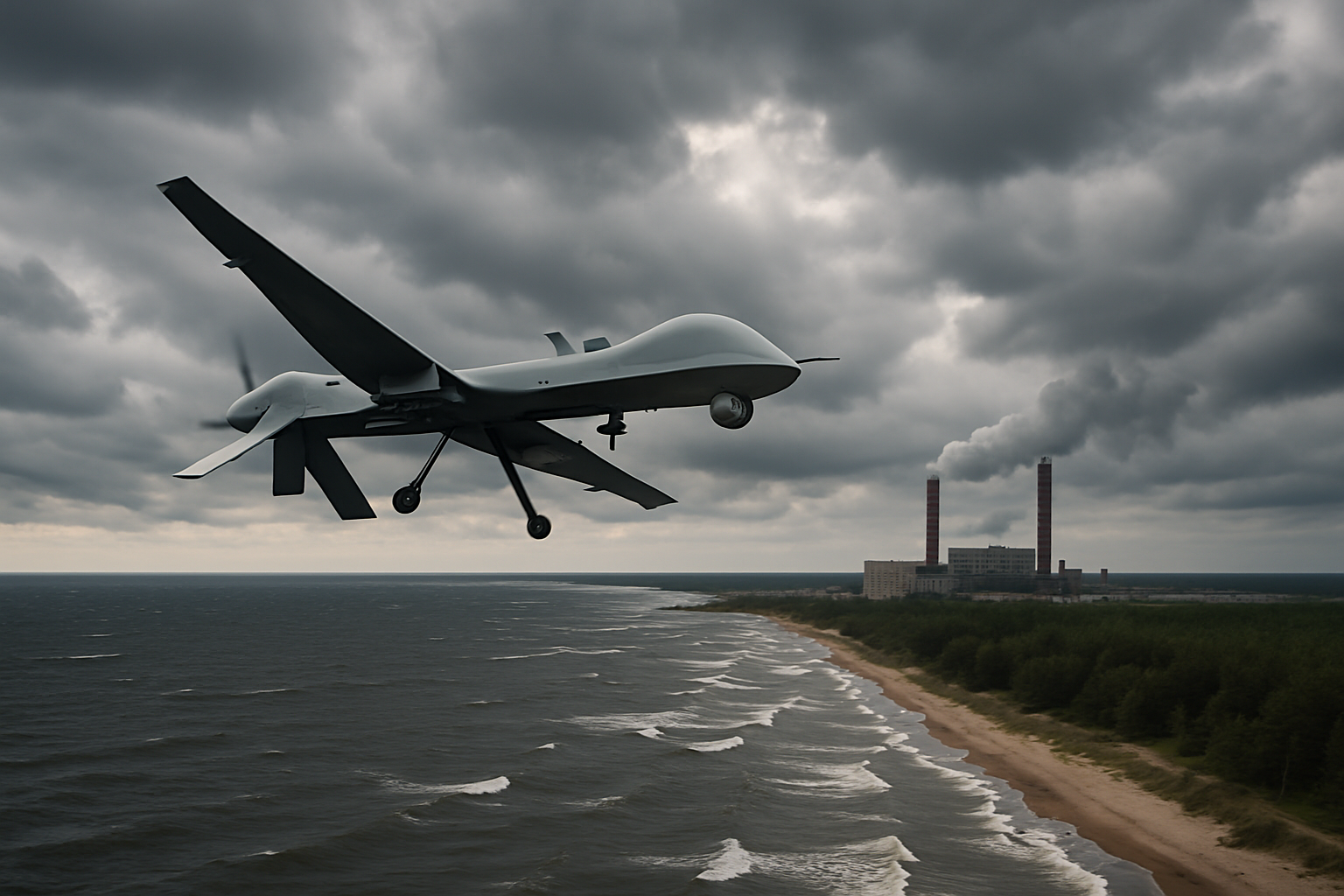
Russian drones penetrated the airspace of Estonia and Latvia early Wednesday morning, with one striking the chimney of Estonia's Auvere power station in a stark demonstration of how regional conflicts are spreading dangerous fallout to NATO's frontiers.
The incidents, which occurred within hours of each other, represent the most serious breach of Baltic security since the region joined NATO, raising urgent questions about airspace defense and regional stability as tensions continue to escalate across Eastern Europe.
Estonian Power Plant Strike
At 3:43 AM on March 25, a drone that entered Estonian territory from Russian airspace struck the chimney of the Auvere power station in Ida-Viru County, according to Estonian Internal Security Service officials. The facility, operated by Enefit Power, serves as a critical component of the country's energy infrastructure.
"A drone arriving from Russian airspace struck the chimney of the Auvere power plant in north-eastern Estonia in the early hours of Wednesday, in a stark sign of how the war in Ukraine is sending dangerous fallout towards NATO's frontier," confirmed officials from the Estonian Internal Security Service.
Remarkably, no injuries were reported and Estonia's electricity system remained undamaged despite the direct impact on the industrial facility. Estonian Rescue Board explosive ordnance disposal teams were immediately deployed to assess the situation and secure the area.
Latvian Drone Incident
Simultaneously, Latvian Air Force identified a foreign unmanned aerial vehicle entering Latvian airspace from Russia, according to the National Armed Forces. The drone crashed and exploded approximately one kilometer from the center of Svariņu parish in Krāslava county.
Aivars Belkovskis, the municipal civil defense organizer for Krāslava county, confirmed that the drone exploded in the Krāslavas region without causing civilian casualties or damage to civilian infrastructure. Latvia's Defense Ministry scheduled a press conference to brief the public on the incident, though initial reports indicated no immediate information about the drone's origin or purpose.
Regional Security Implications
The drone incidents come amid escalating tensions following recent Russian military activities in the Baltic region. Nordic security officials have documented a dramatic 23% increase in Russian reconnaissance operations since Sweden and Finland joined NATO, fundamentally altering the strategic balance in the region.
Lithuanian intelligence agencies have warned that Moscow could be ready for "limited military conflict" within 3-5 years if a Ukraine ceasefire is achieved, providing Russia time to rebuild military stockpiles and develop new tactical approaches specifically designed for Baltic terrain and NATO defenses.
"This incident demonstrates the spillover effects of ongoing conflicts and the need for enhanced regional coordination,"
— Estonian security officials
The timing of these incidents is particularly concerning as they occur during a period of unprecedented regional cooperation initiatives. Baltic states have recently enhanced intelligence sharing, satellite surveillance, and maritime patrols through NATO's Arctic Sentry mission, representing the alliance's most comprehensive Arctic security response since the Cold War.
Historical Context and Pattern
These drone incidents fit within a broader pattern of Russian provocations documented across the Baltic Sea region. Previous incidents have included submarine incursions, GPS jamming, underwater cable sabotage, and systematic reconnaissance operations targeting NATO assets.
Most notably, Swedish Armed Forces recently confirmed that a Russian drone intercepted near the French aircraft carrier Charles de Gaulle originated from the Russian reconnaissance vessel Zhigulevsk, demonstrating Moscow's willingness to conduct intelligence operations targeting NATO exercises in Baltic waters.
The Baltic states have been developing comprehensive security frameworks to address these challenges. Estonia maintains European leadership in renewable energy with 88% renewable electricity and continental Europe's largest battery storage facility, while simultaneously investing in advanced surveillance and defensive technologies.
NATO and International Response
The incidents highlight the strategic importance of the Baltic region as a potential flashpoint in great power competition. The UK has doubled its troop presence in Norway from 1,000 to 2,000 over three years, while Finland is contributing operational planning to enhanced regional security cooperation.
Recent policy shifts have been dramatic across the Nordic region. Finland's Defense Minister Antti Häkkänen announced plans to lift the country's comprehensive nuclear weapons ban "as soon as possible," stating current legislation is inadequate for NATO membership needs. Similarly, Sweden's Defense Minister Pål Jonson announced the country's willingness to host nuclear weapons during wartime, breaking an 80-year Nordic nuclear taboo.
These developments occur against the backdrop of the New START treaty's expiration on February 5, 2026 - the first time in over 50 years without US-Russia nuclear constraints. UN Secretary-General António Guterres has warned this represents a "grave turning point" with nuclear risks at their "highest in decades."
Energy Security Vulnerabilities
The strike on Estonia's Auvere power station, while causing no operational damage, underscores critical infrastructure vulnerabilities that have become increasingly apparent across Europe. The facility represents part of Estonia's sophisticated energy grid, which has become a model for renewable energy integration and battery storage technology.
Energy infrastructure has become a particular target of hybrid warfare tactics, with systematic attacks on civilian power systems documented as violations of international humanitarian law. The targeting of the Auvere facility, even if the damage was minimal, sends a clear message about the vulnerability of critical infrastructure to asymmetric threats.
Technological Warfare Evolution
The sophistication of these drone operations reflects the evolution of unmanned warfare capabilities. Intelligence sources suggest these incidents may represent testing of NATO's detection and response systems rather than attempts to cause significant damage.
The drones' ability to penetrate Baltic airspace undetected until impact raises questions about current defensive capabilities and the need for enhanced surveillance systems. Estonia has been at the forefront of technological innovation in security, hosting the Tallinn Cyber Diplomacy Winter School with participants from 33 countries and developing advanced AI-powered monitoring systems.
Broader Strategic Context
These incidents occur amid a complex regional security environment shaped by multiple concurrent crises. The Baltic states are navigating severe energy market volatility, with fuel prices rising across all three capitals as global oil breaches $100 per barrel due to Middle Eastern instability affecting the Strait of Hormuz.
Despite economic pressures, all three Baltic nations maintain firm anti-Russian sanctions positions, contrasting with some European neighbors who have implemented immediate price controls or sought sanctions relief. This principled stance reflects their unique geopolitical position and historical experience with Russian influence.
Democratic Resilience Framework
The response to these incidents demonstrates an innovative approach to regional cooperation that extends beyond traditional military measures. Baltic national libraries have agreed to unprecedented cooperation in addressing geopolitical challenges and protecting cultural heritage - the first time cultural institutions have played such a direct role in democratic resilience efforts.
This comprehensive approach integrates cultural institutions with traditional security measures, providing a template for small nation coordination in a volatile international environment. The model emphasizes technology enhancement rather than replacement, authentic international collaboration that respects local identity, and sustained political commitment beyond electoral cycles.
Looking Forward
The drone incidents represent a watershed moment for Baltic security, demonstrating that regional conflicts can no longer be contained within traditional geographic boundaries. The successful response coordination between Estonian and Latvian authorities, combined with broader NATO support, provides a framework for addressing future incidents.
However, the incidents also highlight the need for continued vigilance and enhanced defensive capabilities. The 3-5 year timeline warned by Lithuanian intelligence for potential Russian military action underscores the urgency of strengthening regional defenses while maintaining diplomatic channels.
As the Baltic states continue to serve as NATO's eastern frontier, these incidents serve as a stark reminder that the security challenges of the 21st century require both technological innovation and unprecedented international cooperation to protect democratic values against authoritarian pressure.
The international community's response to these provocations will likely influence Russian calculations about the costs and benefits of continued escalatory actions in the region, making the coming months critical for determining the trajectory of Baltic security and broader European stability.