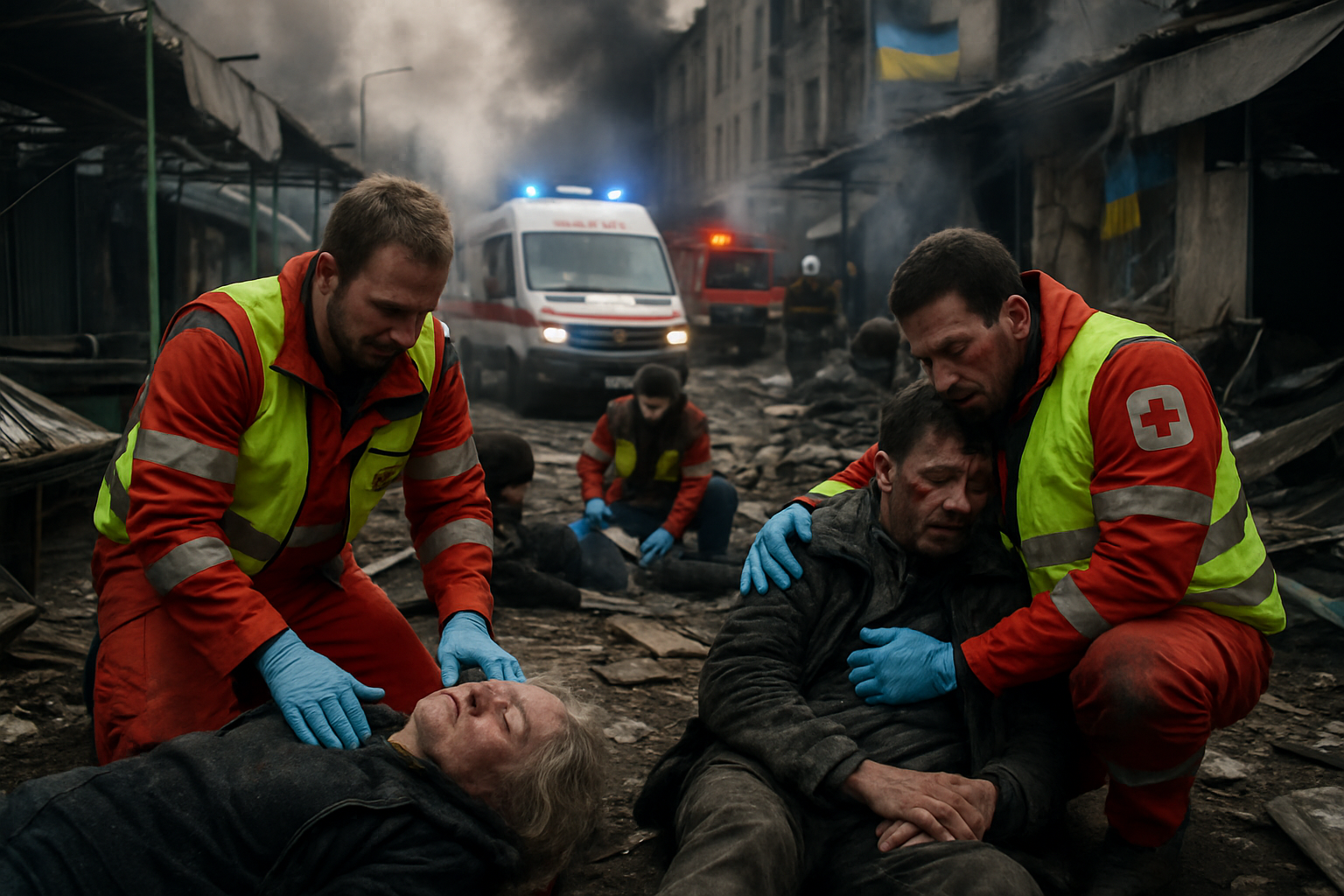
A Russian FPV drone strike on a market in Nikopol, in Ukraine's Dnipropetrovsk region, killed at least five civilians and wounded 19 others on Saturday morning, regional authorities confirmed, as the deadly conflict continues amid suspended peace negotiations.
The attack occurred at approximately 9:50 AM local time (7:50 AM GMT), according to the regional prosecutor's office. Among the wounded was a 14-year-old girl who remains in critical condition, highlighting the attack's devastating impact on Ukraine's civilian population.
Regional military administration head Oleksandr Hanža confirmed the death toll, stating that the victims included three women and two men. The FPV (First Person View) drones, increasingly used by Russian forces for precision targeting, struck the market area during morning hours when civilian activity typically peaks.
Pattern of Systematic Civilian Targeting
The Nikopol attack is part of a documented pattern of systematic targeting of civilian infrastructure and populated areas by Russian forces. Ukraine's Prosecutor General's Office condemned the strike as "another war crime committed by the Russian Federation," underscoring the deliberate nature of attacks on non-military targets.
This latest assault follows extensive Russian drone and missile campaigns targeting Ukrainian cities throughout 2026. According to historical data from previous attacks, Russia has launched over 700 drones in 24-hour periods, demonstrating an unprecedented escalation in drone warfare tactics.
The choice to target a market—a clearly civilian facility—continues a pattern that has included attacks on schools, hospitals, residential buildings, and energy infrastructure throughout the nearly four-year conflict.
Broader Military Context
The Nikopol attack occurred amid ongoing military operations across multiple Ukrainian regions. In the Sumy region, another Russian drone assault left 13 people wounded, including one child, according to separate reports from Ukrainian authorities.
These attacks represent part of Russia's expanded drone warfare capabilities. Ukrainian intelligence reports indicate Russia has expanded its unmanned forces to 101,000 troops by April 2026, creating the largest dedicated drone force in modern warfare history.
Ukrainian forces have maintained defensive capabilities while conducting their own long-range strikes against Russian military targets, including recent successful operations against oil facilities and weapons manufacturing plants deep inside Russian territory.
Diplomatic Efforts Stalled
The deadly strikes come as diplomatic efforts to resolve the conflict remain indefinitely suspended due to the Iran crisis that has consumed American foreign policy attention since early March 2026.
The suspension has derailed significant diplomatic momentum achieved in February 2026, including:
- A historic 314-prisoner exchange between Ukraine and Russia—the first in five months
- Restoration of US-Russia military communications after a four-year suspension
- Geneva talks that achieved "significant progress" on ceasefire monitoring mechanisms
- Participation of European "Big 5" observers (Germany, France, Italy, UK, Poland) for the first time
The Trump administration had established a June 2026 deadline for comprehensive peace talks in Washington, potentially involving presidential-level engagement. However, this timeline has become uncertain due to competing Middle East priorities.
"Due to the situation around Iran, there are still no necessary signals for trilateral meeting until the security situation allows."
— President Volodymyr Zelensky
Humanitarian Crisis Deepens
The systematic targeting of civilian areas has created a profound humanitarian crisis across Ukraine. More than 17.8 million Ukrainians are currently accessing winter support programs, according to government data.
President Zelensky has disclosed that 55,000 Ukrainian soldiers have been officially killed since the conflict began, with a "large number" still missing. International estimates suggest actual casualties could be 2-3 times higher when including missing personnel and undocumented deaths.
Russian attacks on energy infrastructure have left over 1,170 buildings in Kyiv without adequate heating, while nuclear power plants were forced to halt electricity production for the first time in the conflict due to grid attacks.
International Response and Support
Despite the stalled peace talks, international support for Ukraine continues. The European Union approved a historic €90 billion loan package for Ukraine—the largest single-nation assistance package in EU history—though Slovakia, Czech Republic, and Hungary have refused participation, highlighting divisions within the bloc.
Military support continues with deliveries including:
- 35 Patriot missiles from Germany
- €246 million air defense package from Sweden and Denmark
- Continued NATO coordination through established frameworks
The United Kingdom has revealed the existence of four operational maintenance, repair, and overhaul (MRO) facilities in Ukraine servicing Western-supplied equipment, with a fifth facility planned, marking the first public acknowledgment of such extensive military infrastructure support.
Nuclear Governance Crisis
The conflict continues against the backdrop of an unprecedented nuclear governance crisis. The New START treaty between the United States and Russia expired on February 5, 2026—the first time in over 50 years that the two nuclear superpowers lack bilateral nuclear constraints.
Both nations control approximately 80% of global nuclear weapons, with Russia possessing 4,380 warheads and the US maintaining 3,708. UN Secretary-General António Guterres has warned of a "grave turning point" with nuclear risks at their "highest level in decades."
Ukraine's Strategic Evolution
Amid the ongoing conflict, Ukraine has evolved from an aid recipient to a security provider, deploying military experts to Middle Eastern countries including the UAE, Qatar, Jordan, Bahrain, and Kuwait to help combat Iranian Shahed drones—the same weapons being used to attack Ukrainian infrastructure.
This strategic pivot demonstrates Ukraine's growing regional security partnerships and battlefield expertise, potentially creating new diplomatic leverage when peace negotiations resume.
Territorial Disputes Persist
The fundamental sticking point in any future negotiations remains unchanged: the eastern Ukrainian territories currently under Russian control. Russia demands recognition of these occupied territories and insists that any Putin-Zelensky talks occur only in Moscow. Ukraine maintains its position on territorial integrity and seeks long-term security guarantees.
President Zelensky has categorically rejected territorial concessions, stating that the Ukrainian people would reject "handing over territories" as a "failure story."
Russian territorial gains have accelerated, with forces capturing 481 square kilometers in January 2026 compared to 260 square kilometers in December 2025—an 85% increase representing the fastest monthly territorial expansion in recent periods.
Looking Ahead
The timeline for resumed peace negotiations depends entirely on the resolution of the Iran crisis and broader Middle East stability. While the diplomatic framework remains intact—with prisoner exchange mechanisms and Pentagon-Moscow deconfliction protocols available for reactivation—the window for the significant diplomatic opportunity appears to be closing.
Military escalation continues with systematic civilian targeting while Ukraine expands its international partnerships and maintains operational capabilities. The success or failure of eventual resumed talks carries global implications for territorial dispute resolution, European security architecture, and international law enforcement in the 21st century.
As the conflict approaches its fourth anniversary in February 2026, the deadly attack on Nikopol's market serves as a stark reminder of the human cost of this war—Europe's deadliest conflict since World War II—and the urgent need for diplomatic solutions to end the bloodshed.