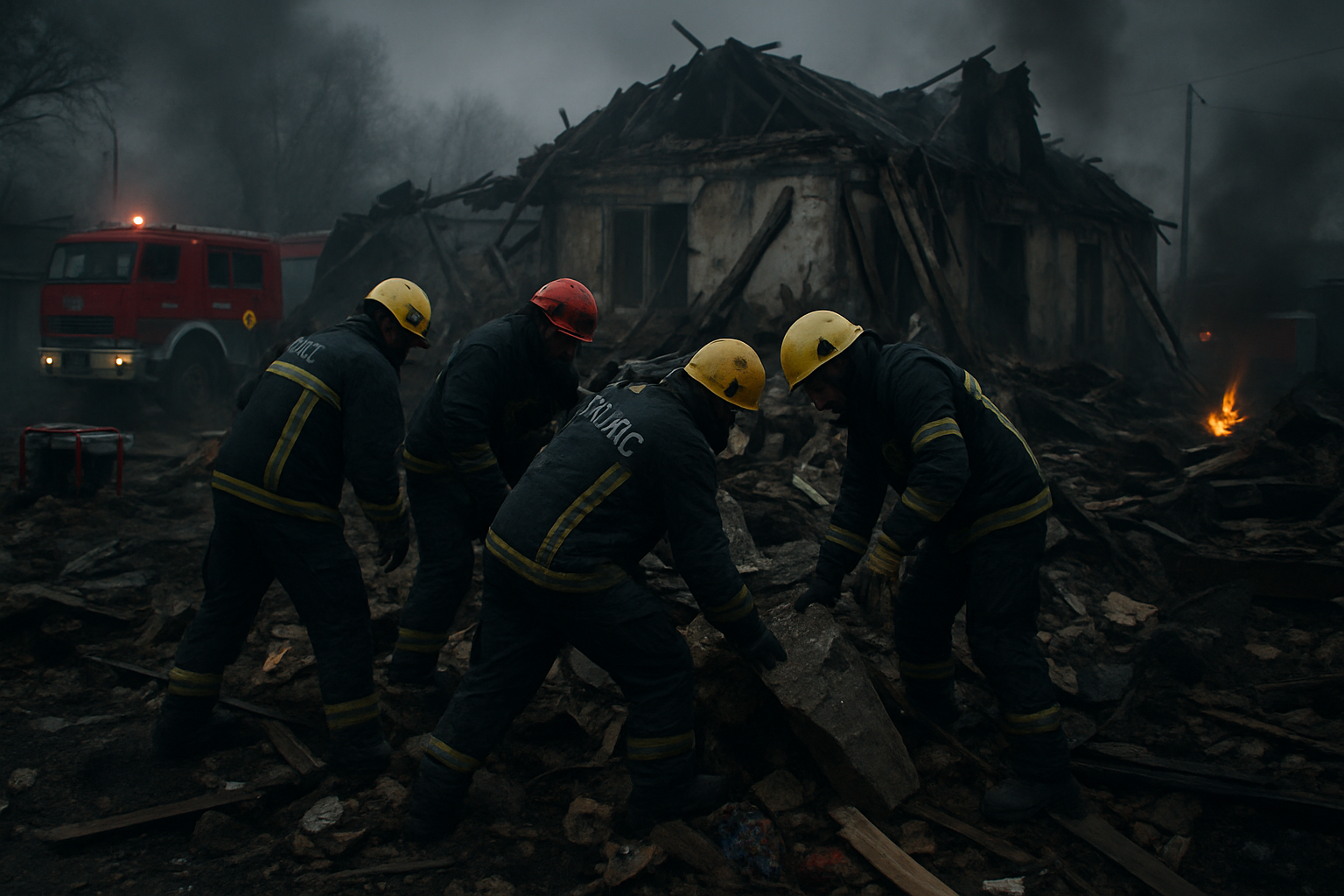
A Russian drone strike killed a father and three young children in the eastern Ukrainian town of Bohodukhiv on Tuesday night, while severely injuring their pregnant mother in what officials described as another devastating attack on civilian targets.
The victims included a 34-year-old man and three children—two one-year-old boys and a two-year-old girl—according to Ukraine's State Emergency Service. The attack completely destroyed the family's house and set it ablaze, trapping the victims under the rubble before emergency crews could reach them.
The pregnant mother, aged 74, was pulled from the debris with serious injuries and is receiving medical treatment at a local hospital. Rescue workers recovered the bodies of the father and children from the collapsed structure in what the Kharkiv regional prosecutor's office confirmed was a direct hit from a Russian drone.
Second Attack Within Days
This tragic incident represents the second deadly Russian strike on Bohodukhiv within just three days. On Monday, another attack on the same town killed a woman and a 10-year-old child, demonstrating a systematic pattern of civilian targeting in the border region.
Local authorities in Bohodukhiv, situated approximately 60 kilometers from the Russian border, have declared three days of mourning for the victims. The town has become emblematic of the human cost of Russia's continued attacks on residential areas housing families with children.
"The strike completely destroyed the house and set it on fire, with the family trapped under the rubble."
— Kharkiv Regional Prosecutor's Office
Broader Context of Civilian Targeting
The attack occurred during a night when Russian forces launched a coordinated assault involving 129 drones across multiple Ukrainian regions, according to official statements. The strikes targeted not only Bohodukhiv but also the regions of Zaporizhzhia and Sumy, indicating a widespread campaign against civilian infrastructure and residential areas.
This pattern of attacks comes despite ongoing diplomatic efforts, including recent trilateral peace talks in Abu Dhabi between Ukraine, Russia, and the United States that achieved a historic prisoner exchange of 314 individuals—the first such swap in five months. The continued targeting of civilians during diplomatic engagement highlights the complexity of achieving lasting peace.
International Condemnation
The international community has consistently condemned Russia's systematic targeting of civilian areas. NATO Secretary-General Mark Rutte recently described such attacks as sending a "bad signal" during diplomatic negotiations, emphasizing how military escalation undermines peace efforts.
Multiple international sources, from Bulgaria to New Zealand, have reported on the casualties, demonstrating the global attention focused on these violations of international humanitarian law. The targeting of residential buildings housing families with young children represents a clear breach of the Geneva Conventions' protections for civilians during armed conflict.
Escalating Humanitarian Crisis
The Bohodukhiv attack adds to an extensive toll of civilian casualties in what has become Europe's deadliest conflict since World War II. Recent Ukrainian government disclosures indicate that 55,000 Ukrainian soldiers have been officially confirmed killed, with a "large number" still missing in action.
The winter months have seen intensified attacks on civilian infrastructure, with over 10,000 Russian drones and bombs launched in January 2026 alone. Energy infrastructure has become a particular target, leaving more than 1,170 buildings in Kyiv without heating during temperatures as low as minus-30°C, demonstrating what officials describe as a "winter weapon" strategy.
Regional Vulnerability
Bohodukhiv's proximity to the Russian border makes it particularly vulnerable to drone and missile attacks. The Kharkiv region, where the town is located, has experienced some of the heaviest bombardment throughout the conflict, with residential areas, schools, and hospitals frequently targeted.
The systematic nature of these attacks—two deadly strikes on the same small town within three days—suggests a deliberate strategy of terrorizing civilian populations rather than achieving military objectives. International humanitarian organizations have documented this pattern across eastern Ukrainian territories.
Ongoing Diplomatic Efforts
Despite the continued violence, diplomatic initiatives continue. The recent Abu Dhabi talks not only achieved the prisoner exchange but also restored US-Russia military communications after a four-year suspension, representing the most significant breakthrough since the conflict began.
However, fundamental disagreements remain, particularly regarding eastern Ukrainian territories currently under Russian control. Ukraine maintains its position on territorial integrity, while Russia demands recognition of its territorial gains—a core obstacle to any comprehensive peace agreement.
International Support Response
The European Union has responded to the escalating humanitarian crisis with historic support measures, including a €90 billion loan package for Ukrainian defense and reconstruction. Sweden and Denmark have announced a €246 million air defense package featuring advanced Tridon Mk2 systems designed to protect civilians from exactly these types of drone attacks.
Over 17.8 million Ukrainians are currently accessing winter support programs, highlighting the massive humanitarian scope of the crisis. Emergency warming centers have been activated across multiple regions as attacks on energy infrastructure continue during life-threatening winter conditions.
Looking Forward
As the conflict approaches its fourth year, the targeting of families like the one killed in Bohodukhiv underscores the urgent need for effective civilian protection measures. The international community faces the challenge of providing both immediate humanitarian assistance and long-term security guarantees for Ukrainian civilians.
The tragedy in Bohodukhiv—three young children and their father killed in their own home—serves as a stark reminder of the human cost of this conflict and the imperative for sustained international efforts to end the violence that continues to claim innocent lives across Ukraine.