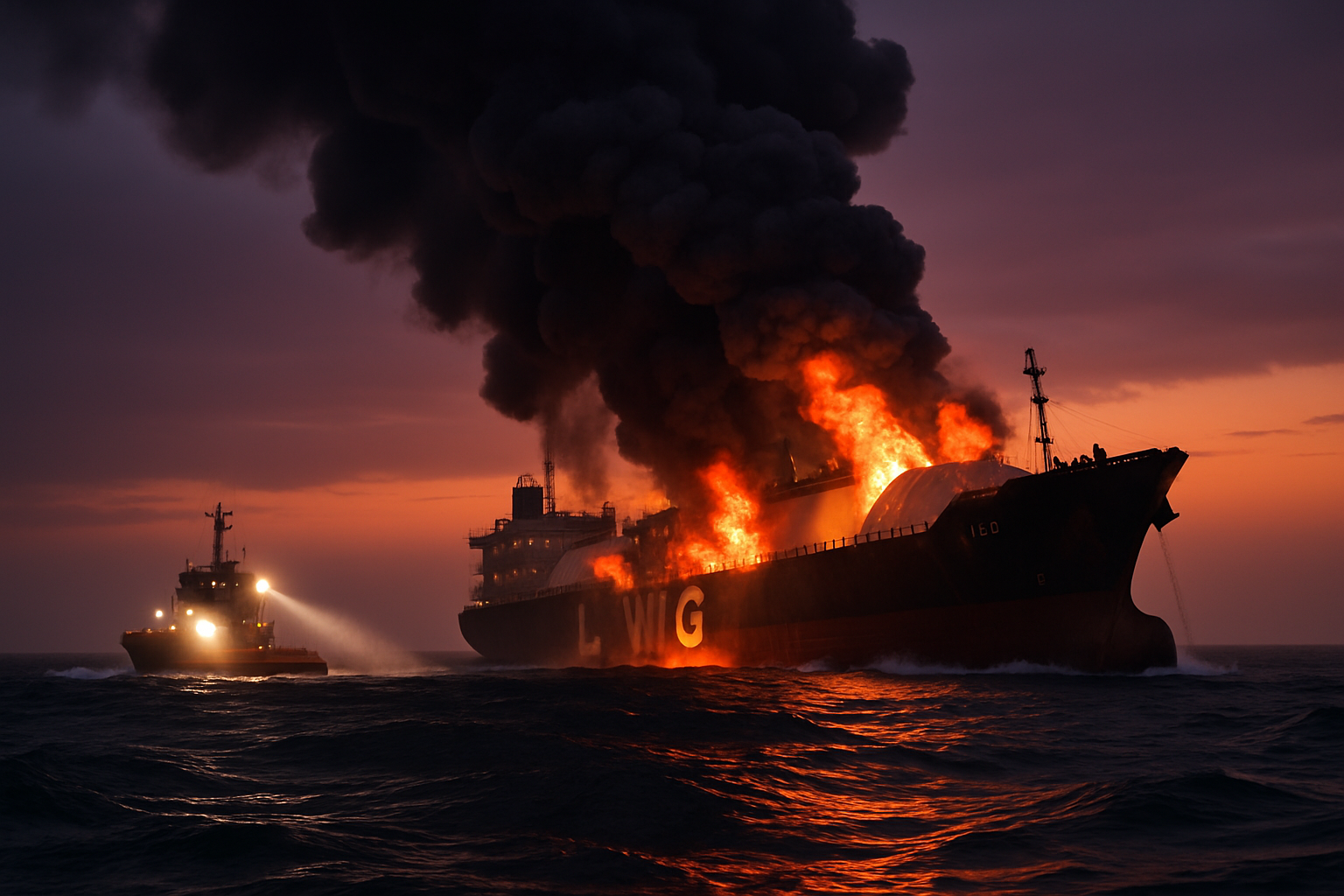
A Russian liquefied natural gas tanker exploded and sank completely in the Mediterranean Sea on Wednesday after what Moscow described as a targeted Ukrainian drone attack, marking a dramatic escalation in the maritime dimensions of the ongoing conflict.
The Arctic Metagaz, carrying approximately 61,000 tons of LNG from the Arctic port of Murmansk, succumbed to massive fires and explosions in waters between Libya and Malta. All 30 crew members were successfully rescued, according to multiple sources, but the incident represents what could be Ukraine's first successful attack on a Russian LNG tanker since the conflict began.
Timeline of the Incident
Libya's maritime rescue agency reported that the vessel "experienced sudden explosions followed by a massive fire, which ultimately led to its complete sinking." The tanker had caught fire a day earlier, with the situation rapidly deteriorating despite initial rescue efforts.
Russian President Vladimir Putin swiftly characterized the incident as a "terrorist attack," telling Russian state television that "this isn't the first time we've seen this kind of thing." Putin's accusation places the Arctic Metagaz incident within a broader pattern of Ukrainian operations targeting Russian energy infrastructure.
The Russian transport ministry confirmed that Ukrainian naval drones, allegedly launched from Libya, were responsible for the attack. However, Ukraine's Security Service did not respond to requests for comment, maintaining the operational secrecy that has characterized many of Kyiv's long-range operations.
Strategic Significance and Shadow Fleet Operations
The Arctic Metagaz was reportedly part of Russia's extensive "shadow fleet" – a sophisticated network of over 600 vessels worldwide that use false documentation and concealed ownership to circumvent international sanctions. Both the United States and European Union had sanctioned the vessel specifically for its role in helping Moscow evade restrictions on its energy exports.
This shadow fleet has become central to Russia's strategy for maintaining energy revenues despite mounting international sanctions. The EU's recent 20th sanctions package added 43 additional vessels to the blacklist and introduced a comprehensive ban on maritime services for Russian crude oil exports, including insurance, maintenance, port access, and technical support.
Intelligence assessments indicate that approximately one-third of these shadow fleet vessels operate without correct flag state authorization, creating enforcement opportunities for international authorities. The loss of the Arctic Metagaz represents a significant blow to this clandestine network.
Ukrainian Strategic Evolution
If confirmed, the attack would mark a significant evolution in Ukraine's operational capabilities and targeting strategy. Throughout the conflict, Ukrainian forces have frequently targeted Russian oil refineries and other energy infrastructure in an attempt to deprive Russia's war machine of funding, but this would represent the first successful attack on an LNG tanker at sea.
The incident occurs within the context of broader Ukrainian long-range operations that have reached deep into Russian territory and occupied areas. Recent operations have included successful strikes on ammunition depots, energy facilities, and military installations hundreds of kilometers from Ukrainian-controlled territory.
The alleged launch of drones from Libya, if accurate, would also demonstrate remarkable operational reach and coordination capabilities, suggesting sophisticated logistical networks extending far beyond Ukraine's immediate borders.
International Maritime Security Implications
The sinking occurs against the backdrop of unprecedented maritime security challenges worldwide. The Mediterranean incident coincides with the ongoing Strait of Hormuz crisis, where Iran has declared the strategic waterway "unsafe," affecting 40% of global seaborne oil transit and forcing major shipping companies like Maersk and MSC to suspend operations.
Over 150 oil and LNG tankers remain stranded in the Persian Gulf, representing billions in cargo value, while aviation networks have been paralyzed with over 18,000 flights cancelled as eight Middle Eastern countries maintain closed airspace. This broader maritime security crisis has exposed critical vulnerabilities in global energy supply chains and shipping networks.
The Arctic Metagaz incident adds another dimension to these challenges, demonstrating how maritime energy transportation has become increasingly militarized. The targeting of LNG carriers represents a particularly concerning escalation given the specialized nature of these vessels and their critical role in global energy security.
Environmental and Economic Impact
The complete sinking of a vessel carrying 61,000 tons of LNG raises significant environmental concerns for the Mediterranean ecosystem. While LNG is generally considered cleaner than crude oil in terms of marine pollution, the sudden release of such quantities could have lasting ecological impacts on marine life and coastal environments.
Economically, the incident is likely to further strain global energy markets already under pressure from multiple regional conflicts. Energy prices have surged dramatically in recent weeks, with oil reaching $80 per barrel and European natural gas prices increasing by 50% to €47.32 per megawatt-hour, the highest levels since February 2025.
The loss of the Arctic Metagaz will likely force Russia into even more expensive and inefficient shipping arrangements, potentially involving state-controlled infrastructure development to maintain its energy export capabilities.
Diplomatic and Military Context
The incident unfolds amid complex diplomatic efforts to resolve the broader Ukraine-Russia conflict. Recent talks in Geneva achieved what officials described as "significant progress" on ceasefire monitoring mechanisms, building on earlier breakthroughs in Abu Dhabi that restored U.S.-Russia military communications after a four-year suspension.
However, fundamental territorial disputes remain unresolved, with Russian forces having accelerated territorial gains in recent months while continuing systematic attacks on Ukrainian civilian infrastructure. The Trump administration has established a June 2026 deadline for comprehensive peace negotiations in Washington, potentially at the presidential level.
The maritime attack demonstrates how military operations continue to expand in scope and geography even as diplomatic channels remain active. Ukraine's apparent willingness to target Russian energy assets at sea represents a significant escalation that could complicate ongoing peace efforts.
Regional Security Architecture
The Mediterranean incident reflects broader changes in regional security dynamics that extend far beyond the immediate Ukraine-Russia conflict. European naval missions have been reinforced in response to growing maritime security threats, while countries across the region are reassessing their port security and critical infrastructure protection measures.
The alleged involvement of Libyan territory in launching the drone attack, if confirmed, could have significant implications for North African stability and international maritime law enforcement. Libya's ongoing political fragmentation and limited central government control have made it a potential staging ground for various military operations.
Intelligence agencies across Europe and the Mediterranean are likely to intensify maritime surveillance capabilities in response to this incident, potentially leading to enhanced cooperation frameworks for monitoring and interdicting hostile maritime activities.
Looking Forward
The sinking of the Arctic Metagaz represents a watershed moment in the maritime dimensions of modern conflict, demonstrating how energy infrastructure and shipping networks have become primary targets in contemporary warfare. The incident will likely accelerate international efforts to protect critical maritime assets while potentially inspiring similar operations by other actors.
For Russia, the loss highlights the vulnerabilities inherent in its shadow fleet strategy and may force costly adaptations to its energy export networks. For Ukraine, the successful attack – if confirmed – demonstrates evolving operational capabilities that extend the conflict's reach far beyond traditional battlefields.
The international community faces urgent questions about maritime security frameworks, enforcement mechanisms for sanctions violations, and the protection of critical energy infrastructure in an increasingly multipolar and conflict-prone world. The Arctic Metagaz incident may well be remembered as the moment when energy wars definitively moved from land to sea.